

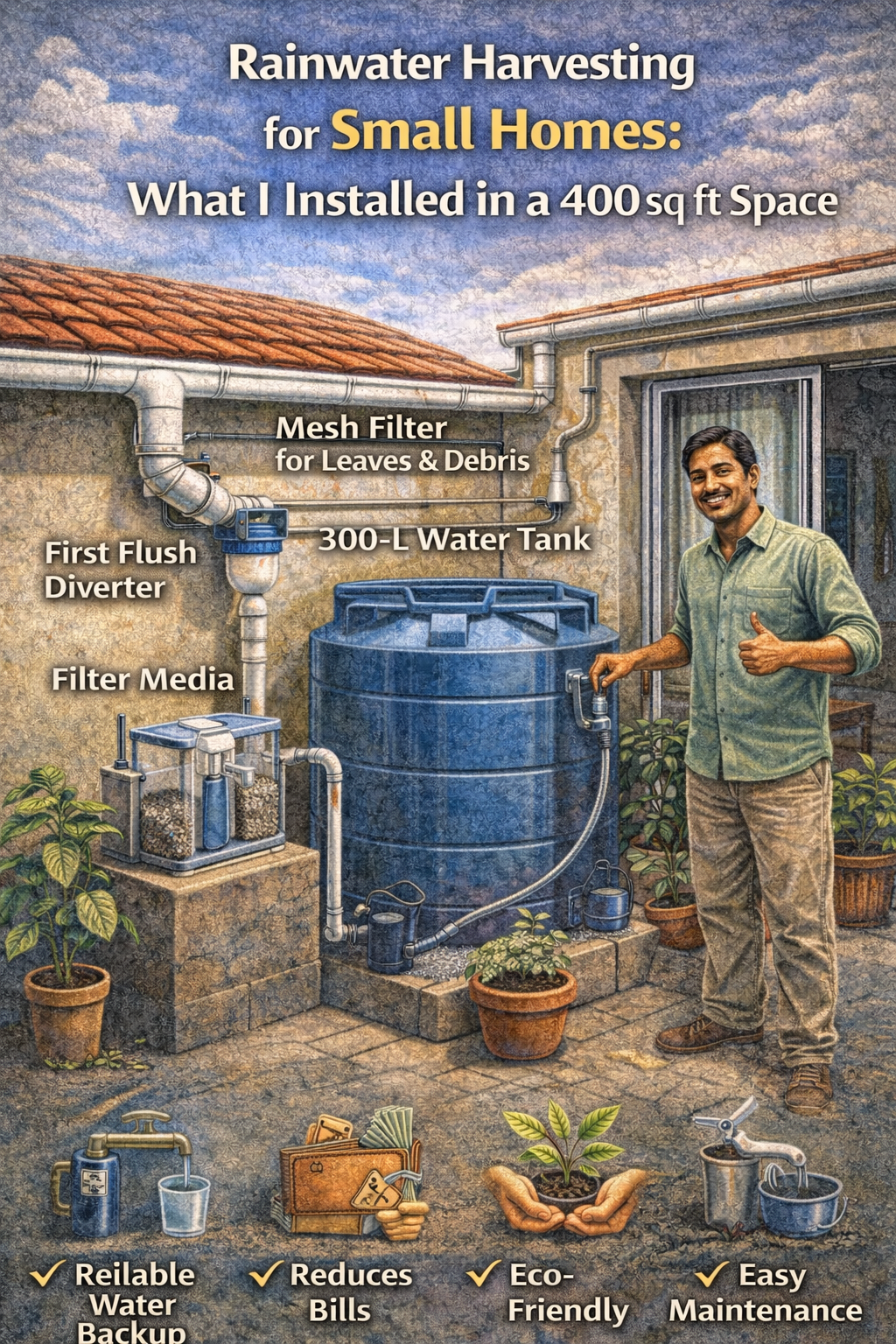

Rainwater Harvesting for Small Homes: What I Installed in a 400 sq ft Space
🏠Rainwater Harvesting for Small Homes: What I Installed in a 400 sq ft Space
Most people believe rainwater harvesting needs big bungalows, large rooftops, or open plots.
But here’s the truth:
👉 Even a 400 sq ft home can collect thousands of litres of clean rainwater every monsoon.
I live in a compact 400 sq ft home — and with help from Jalsanchay, I installed a smart, space-efficient rainwater harvesting (RWH) system that fits perfectly in small Indian houses.
This blog explains:
- Exactly what I installed
- Where I placed each component
- How much it costs
- How much water I now save
- And how you can do the same even with limited space
Let’s make every small home water-independent.
🧩 Step 1: Measuring My Roof Area (400 sq ft Built-Up Space)
My home has:
- Roof area: ~400 sq ft
- Rainfall (Delhi/NCR average): 750 mm annually
Formula Used:
Rainwater (litres) = Roof area (sq ft) × 0.623 × Rainfall (mm)
Calculation:
400 × 0.623 × 750 ≈ 187,000 litres/year
⚡ Yes — my tiny roof can harvest up to 1.8 lakh litres annually.
Small homes have BIG potential when calculations are done right.
🪣 Step 2: Choosing the Right Storage (Because of Space Constraints)
My challenge → No space for a huge tank.
Solution by Jalsanchay:
👉 A 1,000-litre modular tank placed in the unused corner near the back wall.
Why modular tanks?
- Compact
- Stackable
- Easy to hide
- Great for small homes & rooftops
Result:
Fits in < 2 sq ft of ground area.
🌀 Step 3: Installing a First Rain Separator (Must for All Homes)
A first rain separator helps remove the dirty first 1–2 mm of rainfall.
My Setup:
A small PVC-based first flush chamber that:
- Separates dirty first rain
- Prevents dust/bird droppings from entering tank
- Requires almost zero maintenance
Size: 5-litre chamber
Cost: Very low (₹300–₹600 depending on fittings)
🪨 Step 4: The Filter That Made the Biggest Difference
Space being small, I wanted something vertical.
Jalsanchay suggested a “Compact 3-Layer RWH Filter” with:
- Pebble layer
- Sand layer
- Charcoal layer
Why it worked perfectly:
- Takes only 1 sq ft area
- Easy to open and clean
- Efficient enough for rooftop water
- Best for small Indian homes
Output water became clear within the first 5 minutes of rain.
🌍 Step 5: Creating a Groundwater Recharge Point
Since I didn’t have a big yard, we built a mini recharge shaft beside the house.
Size:
- Diameter: 1 ft
- Depth: 4–5 ft
- Filled with stones + sand filter
- PVC pipe connected from rooftop
This ensures:
✔ Zero water wastage
✔ All overflow water directly recharges groundwater
✔ No flooding even during heavy rainfall
💧 Final Layout of My 400 sq ft RWH System (Simple Breakdown)
| Component | Size | Space Used | Purpose |
|---|---|---|---|
| Catchment (Rooftop) | 400 sq ft | — | Collects rainwater |
| Modular storage tank | 1,000 litres | <2 sq ft | Temporary storage |
| First rain separator | 5 litres | Wall-mounted | Removes dirty first rain |
| 3-layer compact filter | 1 sq ft | Beside tank | Purifies water |
| Recharge shaft | 1×5 ft | Corner | Recharges surplus water |
Everything fits inside less than 5 sq ft of total ground space.
Perfect for:
- Small homes
- Basti areas
- Village homes
- Slum redevelopment areas
- Tiny independent houses
- 1-room/1-BHK homes
- Rooftop flats
📉 Investment vs Savings
💰 Total Installation Cost:
₹8,000–₹15,000 (varies by city & fittings)
💧 Water Saved Annually:
Up to 1.8 lakh litres
⏳ ROI:
Recover cost within 1 monsoon season through reduced tanker dependency.
🌦️ How Much Rainwater I Actually Collected This Year
Monsoon data for Delhi/NCR this year (approx):
Total rainfall: 700 mm
My actual water collected (via tank + recharge):
≈ 1,50,000 litres
This covered:
- Gardening
- Toilet flushing
- Washing floors
- Drinking (after purification)
- Washing vehicles
And tanker use reduced from 6 tankers/month → 1 tanker/month.
Massive savings.
🎯 Why Small Homes Benefit the Most From Rainwater Harvesting
- Lower water storage needs
- Faster ROI
- Simple system
- Low maintenance
- High efficiency
- Smaller rooftops = cleaner catchment
Small homes often become self-sufficient faster than big homes.
✨ Key Takeaways (Snippet-Friendly)
Here’s what I installed in my 400 sq ft home:
- 1,000-litre modular storage tank
- Compact 3-layer RWH filter
- First rain separator
- Mini recharge shaft
- PVC pipeline network
Space used: Less than 5 sq ft
Water saved: 1.5–1.8 lakh litres annually
📞 Want a Space-Saving RWH System for Your Home?
Contact Jalsanchay.
📞 Call / WhatsApp Jalsanchay: 9016465919
📧 Email: ask@jalsanchay.com
🌐 Website: jalsanchay.com
Whether your house is 200 sq ft, 400 sq ft, or 2,000 sq ft, Jalsanchay designs:
- Low-cost rainwater harvesting
- Compact systems for small homes
- Groundwater recharge pits
- Filtration units
- Complete installation & support
👉 Call Jalsanchay: The Experts in Space-Efficient Rainwater Harvesting
We help you save every drop — even in the smallest home.
❓ FAQs About RWH for Small Homes
1. Can rainwater harvesting work in a 400 sq ft home?
Yes — you can collect over 1 lakh litres annually.
2. Do I need a big tank?
No. Modular tanks or even 500-litre tanks work well.
3. What if I have no space on the ground?
Tanks can be placed on rooftops or corners.
4. Is filtration necessary?
Yes — even small homes need a basic filtration unit.
5. Can Jalsanchay install this for me?
Absolutely. We specialize in small-space RWH systems.