
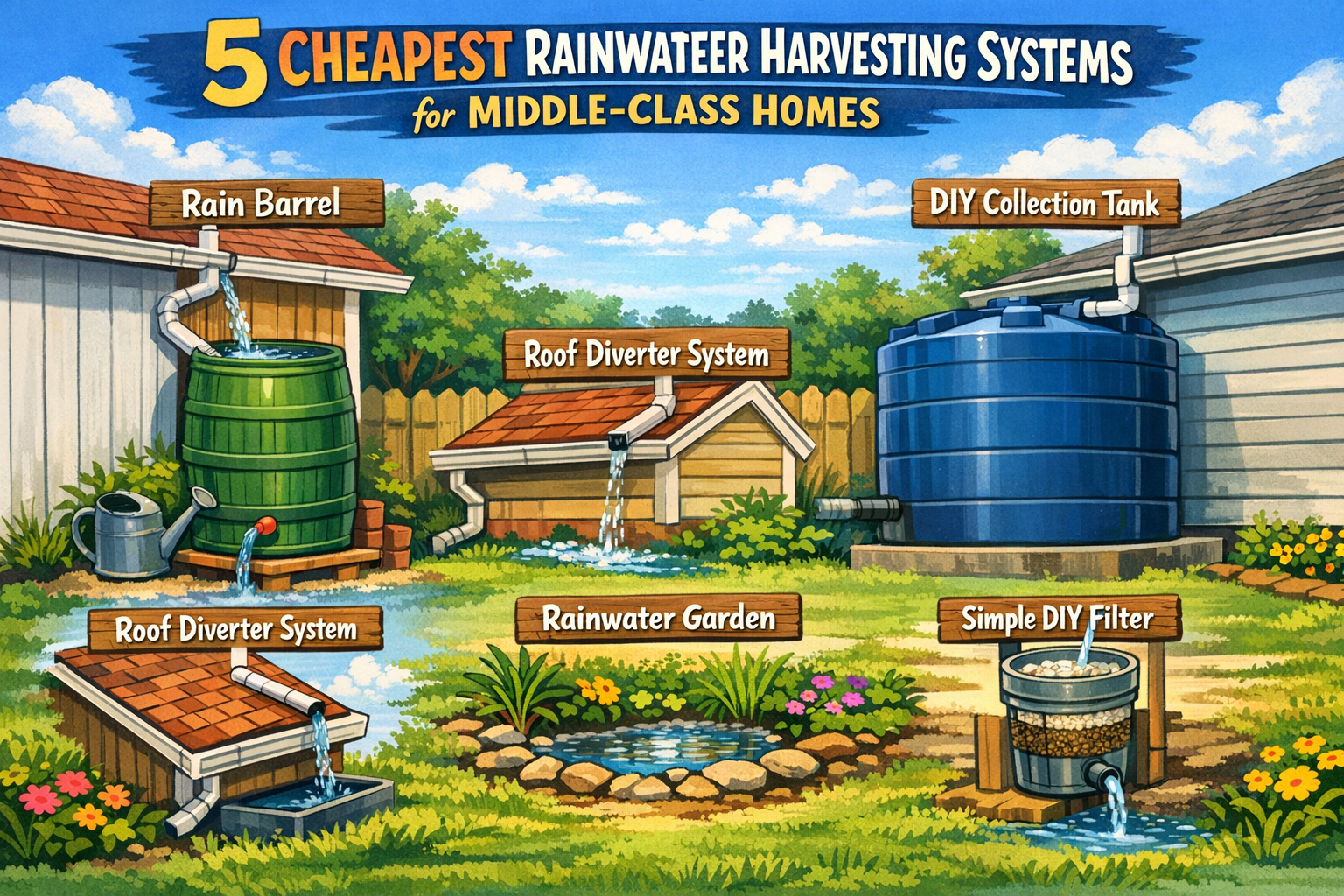
5 Cheapest Rainwater Harvesting Systems for Middle-Class Homes (Budget-Friendly Guide 2025)

For many middle-class Indian households, rising water bills and increasing water shortages make rainwater harvesting a smart, budget-friendly solution. But the biggest question is:
“Which rainwater harvesting system is the cheapest and most effective for my home?”

At Jalsanchay, a trusted rainwater harvesting consultant and service provider, we help families install cost-effective, efficient, and easy-to-maintain harvesting systems tailored for homes, apartments, and small residential plots.

This guide covers the 5 cheapest rainwater harvesting systems you can install without compromising on performance.


1. Rooftop Direct Storage System (Cheapest & Easiest)

Best for: Small homes with limited roof area
Approx. Budget: ₹5,000 – ₹15,000

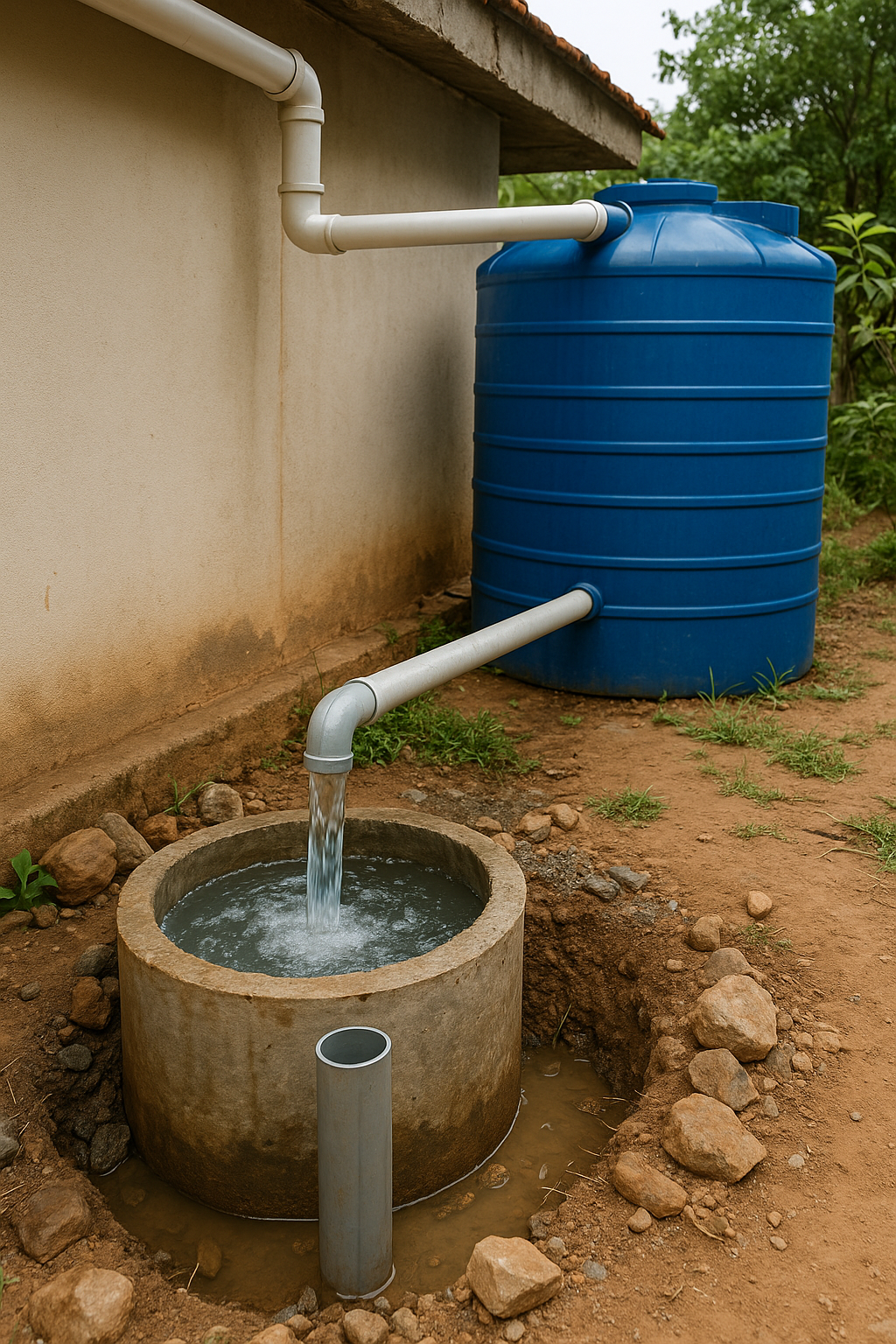
This is the most basic and economical method where rainwater from your rooftop is filtered and stored directly in an existing or new water tank.

How it Works

  • Rainwater flows through a downpipe
  • Passes through a simple mesh filter or first flush
  • Gets stored in a plastic/HDPE tank

Benefits

  • Cheapest setup cost
  • Easy to install & maintain
  • Ideal for middle-class households

Why It’s Good for SEO Snippet:

This system has simple steps that Google/AI search prefers for direct answers.


2. Recharge Pit System (Low Cost, High Efficiency)

Best for: Houses suffering from low borewell yield
Approx. Budget: ₹12,000 – ₹25,000

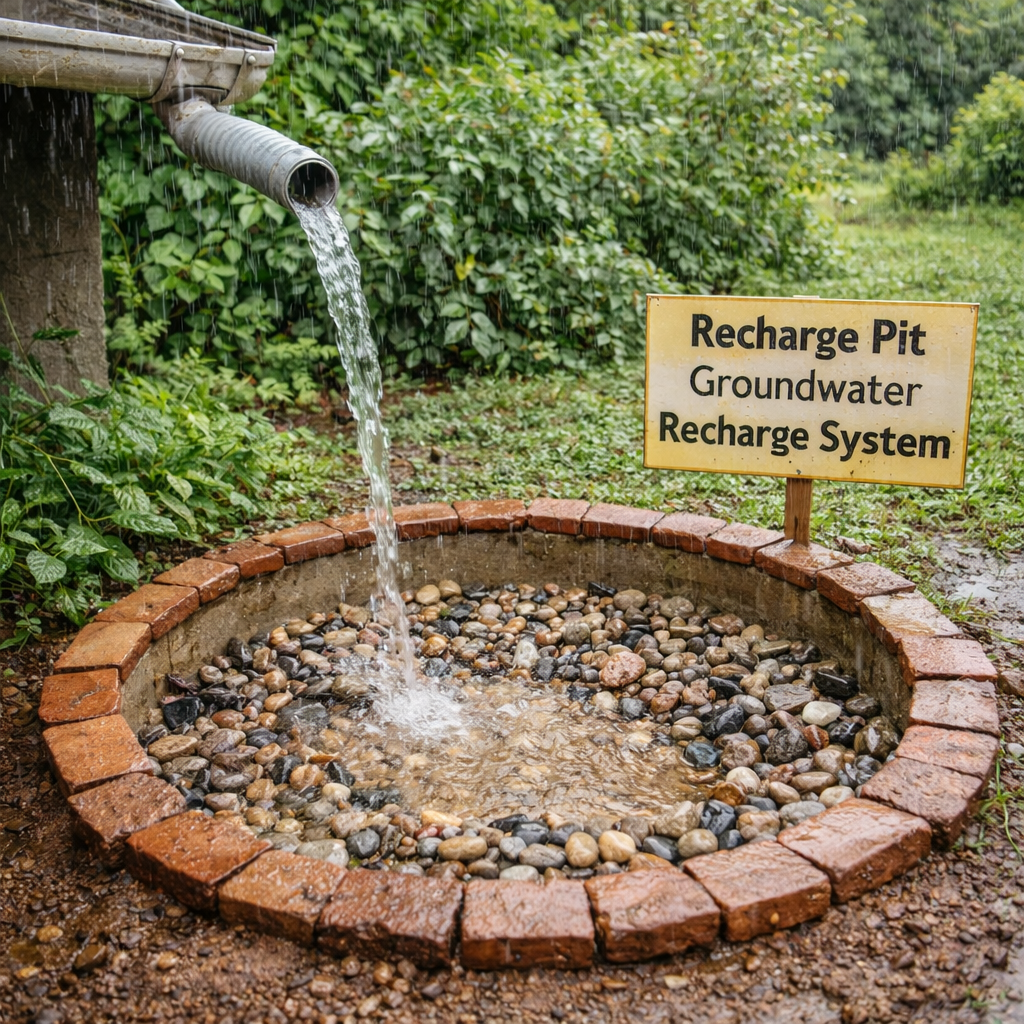
A recharge pit allows rainwater to percolate into the ground, increasing groundwater levels.

Components

  • 3–5 ft pit
  • Brick jelly
  • Pebbles & charcoal layers
  • PVC piping

Benefits

  • Improves borewell output
  • Very low maintenance
  • Long-term solution for water scarcity

Why Jalsanchay Recommends It

We specialize in designing pits based on soil, plot size, and water table depth ensuring maximum recharge.


3. Modular Rainwater Filters (Instant & Affordable)

Best for: Homes needing clean, usable non-potable water
Approx. Budget: ₹6,000 – ₹20,000

Modular filters are compact devices fitted to your downpipe to remove dust, leaves, and debris.

Benefits

  • No civil work required
  • Quick installation
  • Suitable for washing, gardening, floor cleaning

SEO Tip:

“Modular rainwater filter price” is a high-volume keyword you can rank easily.


4. Recharge Borewell System (Highly Impactful, Moderate Cost)

Best for: Homes with existing borewells
Approx. Budget: ₹15,000 – ₹35,000

This system channels roof water directly into a borewell through filtration chambers.

Benefits

  • Restores groundwater
  • Helps maintain borewell water levels
  • Works even in urban compact plots

AEO-Friendly Summary

A recharge borewell system routes clean roof water into the borewell to restore groundwater levels at a low cost.


5. Rain Barrel / Drum Storage System (Super Low Budget)

Best for: Families wanting ultra-cheap solutions
Approx. Budget: ₹2,500 – ₹10,000

Plastic barrels or drums can be connected to the roof drainage to collect water.

Benefits

  • Most affordable option
  • Zero structural changes
  • Portable and easy

Best Use Cases

  • Garden watering
  • Cleaning purposes
  • Emergency water storage

Comparison Table (Best for Google Snippets)

System TypeBest ForCost RangeMaintenanceLifespan
Rooftop Direct StorageSmall homes₹5k–15kVery Low10+ years
Recharge PitBorewell recharge₹12k–25kLow20+ years
Modular FilterClean non-potable water₹6k–20kVery Low8–10 years
Recharge BorewellGroundwater boost₹15k–35kLow15–20 years
Rain BarrelsUltra budget use₹2.5k–10kVery Low5–8 years

How to Choose the Right Low-Cost System?

Choosing depends on:

  • Roof area
  • Water demand
  • Soil type
  • Existing borewell
  • Budget

At Jalsanchay, we inspect your home and recommend the perfect system at minimum cost.


Benefits of Low-Cost Rainwater Harvesting for Middle-Class Families

  • Reduces water bills
  • Improves borewell output
  • Prevents waterlogging
  • Eco-friendly & sustainable
  • Requires minimal maintenance
  • 100% return on investment within 1–2 seasons

Rainwater Harvesting FAQs (AEO & Featured Snippet Optimized)

1. Which is the cheapest rainwater harvesting system for homes?

The rain barrel/drum system is the cheapest, starting at just ₹2,500–₹10,000.

2. How much does a basic rainwater harvesting setup cost in India?

A simple rooftop system costs between ₹5,000 and ₹20,000, depending on filter type and tank capacity.

3. Can middle-class homes afford rainwater harvesting?

Yes, most homes install budget systems under ₹10,000–25,000, making it very affordable.

4. Which system increases borewell water levels?

A recharge pit or recharge borewell system is best for improving groundwater.

5. How long does installation take?

Most systems are installed by Jalsanchay in 4–8 hours depending on complexity.


Final Thoughts

Rainwater harvesting doesn’t have to be expensive. With these five cheapest systems, every middle-class home can save water, reduce bills, and become self-reliant.

If you’re planning to install a budget-friendly rainwater harvesting system, Jalsanchay can help with:

✅ Site assessment
✅ System design
✅ Low-cost installation
✅ Maintenance & support


Contact Jalsanchay

📞 Call/WhatsApp: 9016465919
🌐 Website: jalsanchay.com
📧 Email: ask@jalsanchay.com

👉 For any help in selecting or installing a low-cost rainwater harvesting system, contact Jalsanchay today.



How Rainwater Harvesting Helps in Reducing Global Warming

Rainwater Harvesting Helps in Reducing Global Warming by lowering energy-intensive water pumping, cutting carbon emissions, improving soil moisture, supporting groundwater recharge, increasing green cover, and reducing urban flooding and heat. By capturing rain where it falls, RWH minimizes dependence on fossil-fuel-powered water supply systems and creates cooler, greener environments.


Water Crisis and Climate Crisis Are Connected

When people talk about global warming, they rarely think about water.
But in reality, water and climate change are deeply linked.

  • More heat → more evaporation
  • More evaporation → less groundwater
  • Less groundwater → more pumping
  • More pumping → more electricity
  • More electricity → more carbon emissions

This vicious cycle speeds up global warming.

Rainwater Harvesting (RWH) is one of the simplest and most powerful tools to break this cycle — and surprisingly, very few people know how big its impact really is.

At Jalsanchay, we explain to homeowners, societies, corporates, and farmers that RWH is not just a water-saving solution…
👉 It is a climate solution.

Let’s understand how.


1️⃣ RWH Reduces Electricity Use — and Thus Carbon Emissions

Did you know?
Pumping groundwater is one of the biggest sources of energy consumption in India.

Farm pumps
Society borewells
Industrial pumps
Municipality pumping stations

All run on electricity or diesel.

When we harvest rainwater:

  • Groundwater dependence reduces
  • Pumping hours drop
  • Electricity consumption decreases
  • CO₂ emissions come down

✔ Example Calculation

Pumping 10,000 litres of groundwater uses approx 3–4 units of electricity.

If a society harvests 10 lakh litres annually, they reduce up to:
👉 3,000–4,000 electricity units
👉 Equivalent to planting 150–200 trees

Rainwater = less pumping = less carbon = less global warming.


2️⃣ RWH Reduces Urban Heat by Recharging Soil Moisture

Dry land heats up faster.
Moist soil stays cooler.

RWH systems:

  • Recharge groundwater
  • Maintain soil moisture
  • Reduce heat absorption
  • Lower surrounding temperature by 1–3°C
  • Prevent heat islands in cities

Cities like Delhi, Mumbai, Bengaluru and Pune experience extreme heat partly because:
✔ Groundwater is depleted
✔ Soil is dry
✔ Concrete retains heat

Rainwater harvesting reverses this effect naturally.


3️⃣ RWH Increases Greenery — Which Absorbs CO₂

Plants grow better with rainwater because it is:

  • Soft
  • Low in minerals
  • Free from chlorine

When homes, farms, and societies store rainwater:

  • Plantation projects increase
  • Green belts revive
  • Trees grow stronger
  • Air quality improves
  • CO₂ absorption rises

Small Rainwater Harvesting → Big Environmental Benefits

1 roof = thousands of litres = greener surroundings.


4️⃣ RWH Reduces Flooding and Soil Erosion (Both Linked to Climate Change)

Extreme rainfall events are rising due to global warming.
But uncontrolled runoff causes:

  • Flooding
  • Soil erosion
  • Topsoil loss
  • Sedimentation in rivers
  • Destruction of crops

Farm ponds, recharge pits, contour trenches, and rooftop systems created by Jalsanchay control runoff and store it safely.

This reduces pressure on natural systems and stabilizes local climate conditions.


5️⃣ RWH Reduces Dependence on Tankers — A Big CO₂ Source

Water tankers burn massive amounts of diesel.

One tanker trip = 3–6 kg of CO₂ released into the air.

If a society or industry installs RWH:
👉 Tanker trips reduce
👉 Diesel consumption drops
👉 Air pollution decreases
👉 Carbon emissions fall

This has a direct impact on global warming.


6️⃣ RWH Helps Recharge Groundwater — Nature’s Own Climate Buffer

Groundwater behaves like a natural climate defense system.
When aquifers are full:

  • Wells stay stable
  • Soil retains moisture
  • Streams flow longer
  • Plants survive heat waves
  • Local climate becomes cooler

Rainwater harvesting strengthens this natural protection.


7️⃣ RWH Converts Rooftops and Open Land Into Climate Protectors

Every rooftop in India is a missed climate opportunity.

A 1,000 sq ft roof can capture 25,000–60,000 litres of water annually.

If 1 crore Indian homes harvest rainwater:
💧 25,000 crore litres saved
💨 Millions of units of electricity saved
🌱 Huge reduction in CO₂ emissions
🔥 Lower urban heat

This is why global climate experts call RWH:
“The simplest climate action that anyone can start today.”


Why Jalsanchay’s RWH Solutions Make Climate Impact Stronger

At Jalsanchay, we design RWH systems for:
✔ Homes
✔ Apartments
✔ Schools
✔ Industries
✔ Farmlands
✔ Commercial buildings
✔ Village communities

Our systems maximize:

  • Ground recharge
  • Water storage
  • Energy savings
  • Soil cooling
  • Greenery growth

Because better design = better climate benefits.


Conclusion: Rainwater Harvesting Is a Climate Action You Can Start Today

You don’t need massive investments…
You don’t need expensive technology…

You just need to store the rain that already falls on your roof or land.

Rainwater harvesting:
🌍 Reduces carbon
🌿 Increases greenery
💧 Saves water
🔥 Lowers heat
⚡ Cuts electricity
🏙 Improves city climate

Few actions offer this many environmental benefits at such a low cost.


**📞 Want to Make Your Home or Building Climate-Friendly?

Contact Jalsanchay Today**

Jalsanchay provides:
✔ Complete RWH consultation
✔ Custom system design
✔ Farm, home & society RWH solutions
✔ Groundwater recharge structures
✔ Maintenance & audits
✔ Budget-friendly, high-impact systems

Whether you want to lower your water bills or reduce your carbon footprint —
Jalsanchay is your trusted rainwater partner.


How Cities Like Bengaluru and Chennai Are Combating Urban Water Crisis with Rainwater Harvesting (RWH)

Urban water crisis has hit Bengaluru and Chennai — two of India’s fastest-growing cities — causing them to face one of the worst shortages in recent decades. Rapid urbanization, shrinking lakes, erratic monsoons, and over-extraction of groundwater have pushed both cities to the edge.

But both cities are also proving that rainwater harvesting (RWH) is not just an eco-friendly idea — it is a survival strategy.

This blog explains how Bengaluru and Chennai are fighting the water crisis through large-scale RWH adoption, government policies, community movements, and successful city-wide models that other Indian cities can copy.


🌆 Why We Are Facing Urban Water Crisis

1. Overdependence on external water sources

  • Bengaluru: 60% water comes from the Cauvery River
  • Chennai: Highly dependent on distant reservoirs & tankers

2. Vanishing lakes

  • Bengaluru once had 262 lakes; less than 80 remain functional
  • Chennai lost over 50% of its natural water bodies in 30 years

3. Groundwater depletion

Both cities have areas where groundwater levels dropped to 1,000+ feet.

4. Unpredictable rainfall patterns

Heavy rainfall but short duration → poor natural recharge.


🌧️🌆 How Bengaluru Is Combating the Water Crisis with Rainwater Harvesting

1. Mandatory RWH Laws

Bengaluru’s RWH mandate (BBMP & BWSSB) requires:

  • Every building above 60×40 ft plot must install RWH.
  • New constructions must include rooftop + recharge pits.

This law pushed over 2.5 lakh households to adopt rainwater harvesting.

2. Apartment-Level RWH Revolution

Large apartment complexes now install:

  • Rooftop RWH tanks
  • Recharge wells
  • Stormwater diversion systems

Many apartments report:
➡ Reduction of tanker use by 50–70%
➡ Reduction in maintenance costs
➡ Year-round water availability

3. Revival of Bengaluru Lakes Through RWH

Citizen groups like Jal Mitra, Namma Lake, and Paani Panchayat work with BBMP to:

  • Desilt lakes
  • Create recharge wells
  • Install percolation trenches
  • Reconnect natural stormwater channels

Examples:

  • Kaikondrahalli Lake
  • Puttenahalli Lake
  • Jakkur Lake
    These lakes now recharge millions of liters into groundwater every monsoon.

4. The “Recharge Wells” Bengaluru Model

Bengaluru is the only Indian city with a community-driven “Million Wells Campaign”, reviving the ancient tradition of Mannuvaddars (well diggers).

Over 30,000 recharge wells were dug, significantly improving groundwater levels in areas like:

  • Koramangala
  • Whitefield
  • Indiranagar
  • Malleshwaram

🌧️🌇 How Chennai Is Combating the Water Crisis with Rainwater Harvesting

1. The Most Successful RWH Law in India (Tamil Nadu 2003 Act)

Tamil Nadu was the first state in India to make RWH compulsory for all buildings.
Result?
Chennai’s groundwater levels rose by 50% in just six years.

This is considered India’s most successful water management story.

2. Chennai’s Rooftop RWH Model

Buildings are required to:

  • Channel rooftop water into underground tanks
  • Install percolation pits & recharge wells

Many homes store 20,000–50,000 liters per monsoon.

3. Restoration of Temple Tanks & Lakes

Chennai revived dozens of ancient water bodies like:

  • Mylapore Tank
  • Madhavaram Lake
  • Villivakkam Lake

These act as massive natural recharge structures.

4. Community-Led RWH Projects

Residents Welfare Associations across:

  • Anna Nagar
  • Velachery
  • Tambaram
  • Porur

…have built shared community RWH systems that provide free water for:

  • Gardening
  • Cleaning
  • Recharge
  • Drinking (after filtration)

⚖️ Bengaluru vs Chennai: A Quick Comparison

FeatureBengaluru ModelChennai Model
Mandate Year20092003
RWH StyleRecharge wells + RooftopRooftop + Community Tanks
Success RateHigh in apartmentsHighest in India
Key ChallengeUnplanned growthFrequent drought cycles
Unique FeatureMillion Wells CampaignRecharged ancient temple tanks

💧 How Rainwater Harvesting Helps Cities Solve Water Crises

✔ Boosts groundwater levels

✔ Reduces dependency on tankers

✔ Cuts water bills

✔ Prevents flooding (excess rain is redirected into earth)

✔ Increases water security for future generations

✔ Supports sustainable urban development


🧰 How Citizens Can Contribute (Simple Steps)

🏡 For Homeowners

  • Install a rooftop RWH system (₹8,000–₹40,000).
  • Create a 3×3 ft recharge pit.
  • Maintain filters & mesh screens.

🏢 For Apartments

  • Build a common storage tank (10,000–50,000 liters).
  • Divert terrace water into recharge wells.
  • Monitor water quality every 6 months.

🏙️ For Communities

  • Revive lakes & ponds.
  • Adopt stormwater recharge programs.
  • Support local RWH volunteers & NGOs.

🧩 FAQs

How is Bengaluru solving its water crisis?

Bengaluru solves its water crisis through mandatory RWH laws, widespread recharge wells, apartment-level systems, and large-scale lake revival projects.

How is Chennai combating water shortage?

Chennai uses the strongest RWH mandate in India, rooftop RWH systems in almost every building, revival of temple tanks, and community rainwater programs.

Which Indian city has the best rainwater harvesting model?

Chennai is widely considered the most successful city due to the 2003 mandatory RWH law and significant groundwater recovery.

Does rainwater harvesting reduce tanker dependence?

Yes. Most apartments report a 50–70% reduction in tanker usage after installing proper RWH systems.


🏁 Conclusion

Bengaluru and Chennai prove that rainwater harvesting is not optional — it is essential for urban survival in India. Their models show that with the right policies, community participation, and consistent maintenance, any city can overcome water scarcity.

Whether you are a homeowner, builder, RWA member, policymaker, or citizen —
you have the power to contribute to water security starting today.

Fun Rainwater Harvesting Projects Kids Can Do at Home

🌧️ Teach Your Kids Rainwater Harvesting the Fun Way!

Kids love hands-on activities — and rainwater harvesting (RWH) is a perfect mix of fun + science + sustainability.
With climate change, rising water bills, and depleting groundwater, teaching children water conservation early is one of the best gifts a parent can give.

This guide shares easy, safe, zero-cost projects kids can try at home using household items… and all of them help them understand how rainwater harvesting works in real life.


🧒🌱 Why Kids Should Learn About Rainwater Harvesting

Rainwater harvesting is not “just for adults or RWAs.”
Kids who experience it young:

  • Develop lifelong water-saving habits
  • Become more environmentally aware
  • Understand science concepts like filtration, storage, and evaporation
  • Feel excited about sustainability

And the best part?
These projects require no tools, no plumbing, and no expertise.


🎉 10 Fun Rainwater Harvesting Projects Kids Can Do at Home

Below are child-safe, easy-to-build, real educational RWH activities.


1️⃣ Make a Mini Rain Collector Using a Plastic Bottle

Material Required:

  • 1-litre plastic bottle
  • Marker
  • Measuring scale
  • Funnel (optional)

Steps:

  1. Cut the top of the bottle.
  2. Invert it like a funnel.
  3. Place it outside before rain.
  4. Mark water levels—20 ml, 50 ml, 100 ml.

What Kids Learn:

  • Rain intensity
  • Measuring rainfall
  • Basic harvesting concept

2️⃣ Build a Mini Sand-Charcoal Filter Model (Kid-Friendly Version)

Material Required:

  • Transparent jar
  • Clean sand
  • Pebbles
  • Cotton
  • Activated charcoal (optional)

Steps:

  1. Add cotton at the bottom.
  2. Add charcoal.
  3. Add sand.
  4. Add pebbles.
  5. Pour rainwater and watch it filter.

What Kids Learn:

  • Layers of filtration
  • How real RWH filters work

3️⃣ Create a “Rain Garden in a Bottle”

Material Required:

  • Plastic bottle
  • Soil
  • Small plant
  • Pebbles

Steps:

  1. Cut bottle in half.
  2. Fill bottom part with soil + plant.
  3. Add pebbles on top.
  4. Place outdoors to catch rain.

What Kids Learn:

  • Groundwater recharge
  • Soil absorption

4️⃣ Test How Much Water a Roof Can Collect (Paper Model Roof)

Material Required:

  • Cardboard
  • Glue
  • Mug
  • Measuring cup

Steps:

  1. Create a slanted mini-roof.
  2. Pour water to mimic rainfall.
  3. Collect and measure runoff.

What Kids Learn:

  • Roof catchment concepts
  • Runoff vs absorption

5️⃣ DIY Water Flow Channels Using LEGO

Kids LOVE this.
They can build channels that carry “rainwater” (tap water) from roof to tank.

What Kids Learn:

  • Flow direction
  • Pipe-like structures

6️⃣ Super Easy Sponge Rain Absorption Experiment

Material Required:

  • Sponges
  • Bowl
  • Water

Kids dip sponges and learn how soil absorbs rainwater.


7️⃣ Map the “Water Journey” in Your Home

Kids draw:
rain → rooftop → pipes → ground/tank.

This helps them understand real RWH systems.


8️⃣ Decorate a Mini Storage Drum (Healthy Habit Formation)

Give kids a small jar, and label it:
“Rainwater Saved Today.”

This builds habit awareness.


9️⃣ Make a Water-Saving Poster About Rainwater Harvesting

Kids create their own posters to understand:

  • Why saving water matters
  • How RWH helps India
  • Their role in change

🔟 Build a Toy-Scale Recharge Pit Model (Safe & Creative)

Using clay + stones + sand, kids can recreate a recharge pit in a bowl.

What Kids Learn:

  • How groundwater recharge works
  • How percolation happens

🎁 Bonus Activity: 7-Day Water Savings Challenge for Kids

Each day assign:

DayActivityGoal
1Collect and measure rainwaterObservation
2Build a mini filterUnderstanding purification
3Make a posterCreativity
4Identify leakage points at homeAwareness
5Water plants with collected waterHabits
6Reduce water wasteBehavior
7Teach a friendImpact

Completing all 7 days earns them a “Water Warrior Certificate.”


🌧️💡 What This Teaches Your Child Long-Term

These activities help children develop:

  • Environmental responsibility
  • Measuring, observing, and scientific thinking
  • Understanding of sustainability
  • Interest in STEM concepts
  • A sense of achievement

And more importantly…

They grow up valuing water — something India needs urgently.


📞 **Need Help Setting Up a Real Rainwater Harvesting System?

Contact Jalsanchay.**

Whether you live in an apartment, independent house, bungalow, or manage an RWA — Jalsanchay provides:

  • Rainwater harvesting consultancy
  • End-to-end installation
  • Groundwater recharge solutions
  • Maintenance & troubleshooting

👉 We help Indian homes save lakhs of litres of water every monsoon.

📲 Contact Jalsanchay today to start your RWH journey.


FAQs About Kids’ Rainwater Harvesting Projects

1. Are these projects safe for children?

Yes — all activities listed are simple, safe, and supervised.

2. Can kids actually learn real RWH concepts through these?

Absolutely. These projects simplify filtration, storage, runoff, and recharge principles.

3. Can I implement these in apartments?

Yes, all activities need minimal space.

4. Is rainwater safe for kids to touch?

Yes, but not for drinking in raw form.

5. Can these projects be done even without rain?

Yes, you can simulate rainfall using cups or mugs.


From Water Shortage to Self-Sufficiency: How Families Are Reclaiming Control of Water

Explain how Indian families overcome water shortage and achieve independence through rainwater harvesting with examples, benefits, and actionable steps.


💧From Water Shortage to Self-Sufficiency: How Families Are Reclaiming Control of Water

Across India — from Bengaluru to Delhi, Chennai to Jaipur, Pune to Hyderabad — families are facing the harshest water scarcity in decades.
Tanker rates are rising. Borewells are drying. Municipal supply is unstable.

But amidst this crisis, something inspiring is happening.

👉 Thousands of families are reclaiming control of their water by installing Rainwater Harvesting (RWH) systems — and becoming nearly self-sufficient.

This blog explains:
✔ Why families are shifting from panic to empowerment
✔ Real examples of how homes save 50,000–3,00,000 litres annually
✔ How rainwater harvesting transforms a household
✔ Steps to become water-independent
✔ How Jalsanchay helps homes achieve self-sufficiency


🥵 The Reality: Water Shortage Is No Longer a “Future Problem”

Indian families today face:

  • Tankers costing ₹1,200–₹2,000 each
  • Unpredictable municipal supply
  • Borewells falling 200–1,000 ft deep
  • Rising TDS and poor water quality
  • Summers stretching longer and harsher
  • Kids missing school because water didn’t arrive in time
  • Elderly struggling with daily chores due to scarcity

The water crisis has turned daily life into a struggle.

But the good news is…

🌧️ Rainwater Harvesting Is Making Self-Sufficiency Possible for Ordinary Families

Rain is free.
It falls on every roof.
And even the smallest house can collect thousands of litres.

A typical Indian home with a 500–1,000 sq ft roof can capture:

🌧️ 1,50,000 to 3,50,000 litres of clean water every year.

That’s enough for:

  • Drinking (after purification)
  • Washing
  • Mopping
  • Toilets
  • Gardening
  • Cooking (with filtration)

This is why families who once depended on tankers are now:

✔ Filling their own tanks
✔ Recharging their own borewells
✔ Reducing 50–90% tanker dependency
✔ Saving lakhs of rupees over time
✔ Enjoying consistent, high-quality water supply

This shift is empowering Indian households like never before.


🏠 Real Transformations: How Indian Families Are Becoming Water-Independent

1️⃣ A Bengaluru Family Went from 12 Tankers/Month → 2 Tankers/Month

After installing a rooftop harvesting + recharge system, the borewell water level rose by 25–30 ft in one monsoon.

2️⃣ A Chennai Family Stored 22,000 Litres in Just 2 Months

Using a compact tank + first rain separator setup.

3️⃣ A Delhi Home Revived a Dry Borewell

By building a 4 ft × 8 ft recharge pit connected directly to rooftop runoff.

4️⃣ A Pune Apartment Used RWH to Eliminate Tanker Dependency Entirely

Their STP + RWH combo meets almost 80% daily water demand.

Jalsanchay has seen this repeatedly across India:

💡 “Once families start harvesting rainwater, their water stress reduces dramatically.”


🚀 5 Ways Rainwater Harvesting Makes Families Self-Sufficient

1. Immediate Storage for Daily Use

Collect rainwater directly into tanks to use for:
✔ Washing clothes
✔ Utensils
✔ Gardening
✔ Bathroom usage

This instantly cuts 20–40% water bills.


2. Groundwater Recharge (Long-Term Benefit)

Recharge pits send clean rainwater deep into the soil.
This helps:

  • Borewell revival
  • Higher yield
  • Improved TDS
  • Reduced energy costs of pumps

3. Lower Dependency on Tankers

Families who once needed 10–15 tankers/month now need 2–4 tankers/month.

That’s a huge saving — financially and emotionally.


4. Better Water Quality

Rainwater is naturally soft and low-TDS, making it perfect for:

  • Washing
  • Showers
  • Plants
  • Purification for drinking

5. Freedom from Unpredictable Supply

No more waking up at 4 AM because “pani aa raha hai.”
No more fighting tanker line delays.
No more stress.

You become water wealthy.


🧠 Why Families Trust Rainwater Harvesting Now More Than Ever

Because it is:

  • Easy
  • Affordable
  • Practical
  • Government-approved
  • Low maintenance
  • Suitable for small & large homes
  • Effective in every Indian city

Even a 300 sq ft roof can harvest 40,000–60,000 litres annually.

There is no household too small.


📦 How You Can Start Your Journey from Water Shortage to Water Independence

Here’s the simplest 4-step path:

Step 1 — Measure Your Roof Area

Even a 400 sq ft roof can harvest huge volumes.

Step 2 — Install a Basic Filter + First Rain Separator

Ensures the water entering tank or recharge pit is clean.

Step 3 — Decide: Storage or Recharge?

(Or both)

Step 4 — Connect Downpipes + Create a Recharge/Storage System

Simple PVC-based systems work for most Indian homes.


📞 **Want to Become Water-Self-Sufficient?

Contact Jalsanchay Today.**

Jalsanchay helps families across India set up:

✔ Rainwater harvesting systems
✔ Groundwater recharge structures
✔ Small home RWH installations
✔ Maintenance + Troubleshooting
✔ Fully custom space-saving designs

Whether your home is 300 sq ft or 3,000 sq ft —
you CAN become water independent.

📲 Reach out to Jalsanchay and reclaim control of your water.


FAQs: Water Self-Sufficiency for Families

1. Can a small home really become water independent?

Yes — even a 300–500 sq ft roof can provide a major share of annual water needs.

2. How much water can a typical home save?

Anywhere between 50,000–3,00,000 litres per year.

3. Can rainwater be used for drinking?

Yes, after filtration and purification.

4. How expensive is installation?

Starts as low as ₹8,000–₹20,000 depending on setup.

5. Does Jalsanchay install RWH systems?

Yes — we offer full installation, consultancy, design, and support.


How Rainwater Harvesting Helps Recharge Groundwater

Why Groundwater is Drying Up Faster Than We Realize and Rainwater Harvesting Helps Recharge Groundwater?

Indian cities like Bengaluru, Delhi, Pune, and Chennai are witnessing rapidly falling groundwater levels. Borewells are drying, tanker prices are rising, and monsoon rainfall is becoming unpredictable.

But here’s the good news: the solution is beneath our feet.
And rainwater harvesting (RWH) is the quickest, simplest way to recharge groundwater naturally.

In this blog, we break down—in the simplest way—how rainwater harvesting actually helps groundwater recharge, and why every home, RWA, school, and commercial building should adopt it.


How does rainwater harvesting help recharge groundwater?


Rainwater harvesting directs clean rooftop or surface runoff into the soil through recharge pits, recharge wells, percolation trenches, and injection systems. This water slowly seeps down through soil layers and refills underground aquifers, increasing groundwater levels and boosting borewell yield.


How Rainwater Harvesting Helps Recharge Groundwater

Instead of letting rainwater escape into drains, RWH captures, filters, and channels it into the ground.
Here’s how it works step-by-step:


1. Rainwater Is Collected From Rooftops or Open Areas

Roofs, terraces, paved areas, and open grounds receive clean rainwater.
This runoff is naturally soft, low in minerals, and perfect for recharge.


2. The Water Is Filtered to Remove Dust & Debris

Basic filters such as:

  • Mesh filters
  • Sand + gravel filters
  • Charcoal filters
  • Jalsanchay’s dual-stage recharge filters

These ensure only clean water enters the ground.


3. The Water Is Directed Into Recharge Structures

Depending on the property type, the harvested rainwater flows into:

  • Recharge pits
  • Recharge wells
  • Percolation trenches
  • Injection wells (for deep aquifers)
  • Borewell recharge systems

These structures hold water long enough for the soil to absorb it.


4. Water Slowly Percolates Through the Soil

This natural filtration is powerful. As water moves downward:

  • Soil traps impurities
  • Bacteria neutralize contaminants
  • Pebbles and sand layers filter out solids

By the time the water reaches deeper layers, it becomes clean and safe.


5. Aquifers Get Refilled Naturally

This is where the magic happens.
Rainwater recharges:

  • Shallow aquifers (used by handpumps)
  • Deeper aquifers (used by borewells)
  • Fractured rock layers in hard-rock regions like Karnataka, Telangana, Maharashtra

This increases the overall groundwater table of the area.


Why Groundwater Recharge Through Rainwater Harvesting Is So Important

  • ✔ Helps revive dry borewells
  • ✔ Reduces dependency on tankers
  • ✔ Prevents flooding by absorbing excess rain
  • ✔ Improves soil health
  • ✔ Restores natural water cycles
  • ✔ Saves lakhs on water bills
  • ✔ Supports long-term water security

When done correctly, one good RWH system can recharge 1–3 lakh liters every year—sometimes even more.


Different RWH Methods to Recharge Groundwater (Explained Simply)

1. Recharge Pits

Best for homes, villas & small buildings.
They allow water to seep into shallow aquifers.


2. Recharge Wells

Deep cylindrical wells (20–40 ft) that push water deep into rock fractures.


3. Percolation Trenches

Long trenches filled with gravel—ideal for schools, parks, industries.


4. Borewell Recharge

A method Jalsanchay specializes in.
Filtered rainwater is directly sent to an old or active borewell to revive yield.


5. Injection Wells

For commercial buildings and large RWAs, especially where aquifers are deep.


How Much Water Can You Recharge?

Roof SizeRainfallRecharge Potential
1,000 sq ft600–900 mm75,000–1,00,000 liters/year
5,000 sq ft600–900 mm4–6 lakh liters/year
1 acre plot600–900 mm12–18 lakh liters/year

(These are typical figures; actual recharge varies based on soil type and geology.)


Signs That Groundwater Recharge Is Working

  1. Borewell water volume increases
  2. Water level rises in nearby wells
  3. Soil becomes moist even in dry months
  4. Reduced flooding during monsoons
  5. Tanker demand drops


FAQs

1. How much water can rainwater harvesting recharge?

From 1 lakh liters (homes) to 20 lakh+ liters (large campuses) annually.

2. Does RWH really increase borewell water?

Yes — when filtration & soil conditions are correct, borewell yield improves significantly.

3. Do all soils support groundwater recharge?

Most do, but sandy and gravelly soils recharge fastest. Hard-rock areas require recharge wells.

4. How long does recharge take to show results?

Usually within one monsoon season; deep aquifers may take longer.

5. Can recharge fail?

Yes — if filters clog, pits fill with silt, or design is incorrect. Jalsanchay provides auditing and correction.


Groundwater Recharge Is the Most Powerful Benefit of RWH

When rainwater harvesting is designed correctly, it transforms the way water behaves beneath our homes, cities, and communities. It revives borewells, strengthens aquifers, and ensures long-term water security.

Groundwater recharge through RWH is not just a sustainability practice—
it’s a survival necessity for India.


Need Expert Help? Contact Jalsanchay

Jalsanchay is a dedicated Rainwater Harvesting Consultancy & Service Provider offering:

  1. RWH design & installation
  2. Borewell recharge systems
  3. Site inspection & water audits
  4. RWH repair & optimization
  5. End-to-end recharge solutions for homes, RWAs, industries, schools & commercial buildings

📞 Call / WhatsApp Jalsanchay: 9016465919
📧 Email: ask@jalsanchay.com
🌐 Website: jalsanchay.com


Grandma’s Forgotten Water-Saving Wisdom That Still Works Today

Grandma’s forgotten water-saving wisdom—such as storing rainwater, reusing kitchen water, and letting nature guide consumption—still works today because these practices reduce daily wastage, increase household water availability, and perfectly complement modern rainwater harvesting systems. Companies like Jalsanchay help turn these traditional habits into efficient, long-term solutions for homes, societies, and businesses.


When Wisdom Was Stronger Than Wi-Fi

Before apps tracked every drop of water and before modern plumbing made water feel unlimited, our grandmothers were running homes with deep respect for every single drop.

Today, as India faces growing water scarcity, those old-school habits suddenly feel like genius innovations. And interestingly, many of those age-old practices mirror the principles of modern rainwater harvesting.

At Jalsanchay, we often say: “Technology has changed, but water hasn’t. Wisdom still matters.”

Let’s revisit some powerful traditional methods and how you can implement them today—smarter, cleaner, and more effectively.


1️⃣ “Rain Is a Blessing — Store It Before It Goes Away”

Your grandma didn’t wait for a water tanker.
She placed drums, pots, or metal containers outside whenever it rained.

This simple idea is the foundation of Rainwater Harvesting (RWH).

Why it still works:

  • Rainwater is free, pure, and soft
  • It reduces dependence on groundwater
  • Perfect for washing, gardening, mopping, and even drinking with filtration
  • Cuts water bills by 40–70%

Modern Implementation:

Today, instead of pots and buckets, Jalsanchay installs:
✔ Roofwater harvesting systems
✔ Recharge pits
✔ Modular filtration systems
✔ Storage tanks with UV/RO purification

Traditional wisdom → Modern engineering → Zero wastage.


2️⃣ “Don’t Throw Used Water — It Has Another Life”

Grandmothers reused everything:
Water from washing vegetables → Plants
Leftover pot water after boiling → Floor cleaning
Water used for rinsing rice → Hair care

Why it still works:

These practices reduce water consumption by 15–30% daily.

Modern application:

We now call it:

  • Greywater recycling
  • Water repurposing
  • Low-waste household water loops

And yes, these systems can be integrated with rainwater harvesting for even bigger impact.


3️⃣ “Grow More, Waste Less” – The Kitchen Garden Philosophy

Your grandmother’s home was always full of:
Mint
Tulsi
Lemon
Coriander

She watered them using leftover water, never from the tap.

Why it still works:

Plants improve humidity, enrich soil, and reduce heat.
Rainwater is naturally soft — plants love it.

Modern version:

  • Drip irrigation
  • Rain barrels
  • Soil moisture sensors
  • Terrace/kitchen gardens linked with rainwater tanks

4️⃣ “Use Only What You Need — Not What You Want”

Grandmothers never left taps running.
They used controlled quantities for cooking, washing, or cleaning.

Why it still works:

Mindful water usage reduces wastage by 20–25%.

Today:

  • Smart taps
  • Low-flow fixtures
  • Leak detection sensors
  • Aerators
  • Water budgeting systems

5️⃣ “The Well Is Our Wealth — Protect It”

Many households had wells that lasted decades because elders maintained them regularly.

Why it still works:

Groundwater recharge is critical today as water tables drop drastically.

Modern Jalsanchay Solution:

  • Recharge wells
  • Borewell recharge structures
  • Percolation pits
  • Stormwater diversion systems

Your grandma protected wells.
Today, we recharge them.


How Grandma’s Wisdom Inspired Modern Rainwater Harvesting

Grandma’s MethodModern Solution by Jalsanchay
Storing rainwater in utensilsRoofwater harvesting systems
Reusing waterGreywater recycling plants
Watering plants wiselyDrip irrigation + rainwater tanks
Maintaining wellsBorewell recharge systems
Using only what’s requiredSmart fixtures + usage monitoring

This powerful combination of old and new creates the perfect water-secure home.


Why Jalsanchay Is the Right Partner for Your Water-Secure Future

At Jalsanchay, we specialise in:
✔ Rainwater harvesting design and installation
✔ Recharge well creation
✔ Society-level RWH systems
✔ Commercial, industrial & residential water solutions
✔ Water audits and ground recharge improvement
✔ Annual maintenance & filtration upgrades

Our mission is simple:
Bring back the wisdom that saved India for generations — but with the power of modern engineering.


Final Thought: Wisdom Never Gets Old

The world may have changed, but the value of water hasn’t.
Grandma didn’t need a degree in sustainability; she simply cared.
Her thoughtful habits can still save thousands of litres each month — and with the right systems, millions each year.

Let’s bring that wisdom back.
With Jalsanchay, you don’t just save water —
you build a future where every drop matters.


📞 Need Help Setting Up Rainwater Harvesting or Recharge Systems?

Contact Jalsanchay today:
Expert Consultation
Site Survey
End-to-End RWH Installation
Affordable, Eco-Friendly Solutions

Bring back the wisdom. Build a water-secure future.


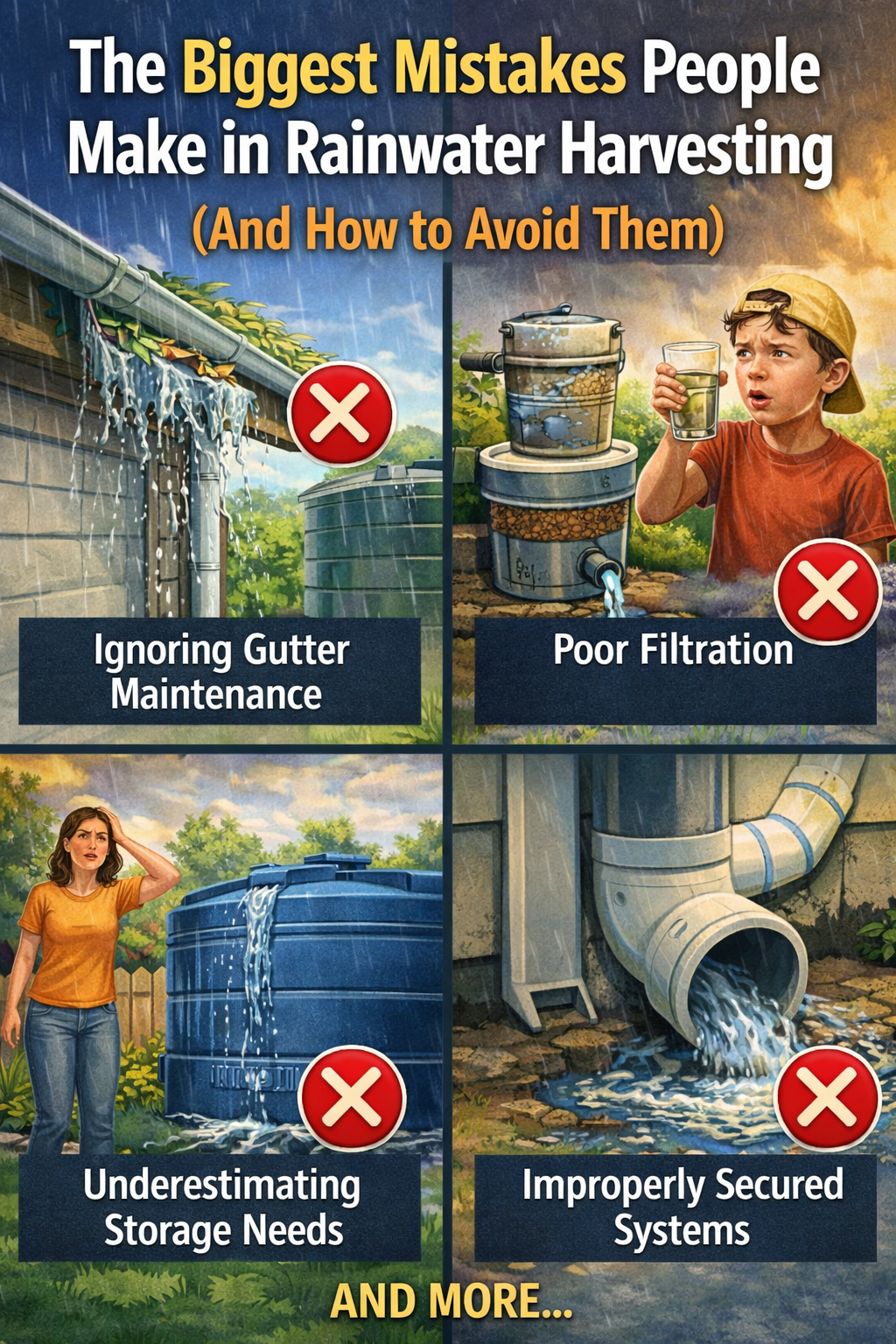
The Biggest Mistakes People Make in Rainwater Harvesting (And How to Avoid Them)

Rainwater harvesting (RWH) is one of the most effective ways to reduce water bills, recharge groundwater, and ensure water security. But many homeowners, builders, and RWAs install systems that don’t work well — or fail entirely — because of a few common mistakes.

The good news?
Most of these issues are easy to fix and even easier to avoid when you know what to look out for.

This blog explains the biggest mistakes people make in rainwater harvesting and provides simple, actionable solutions for each.


1. Using Poor or No Filters

The Mistake:

Many people let direct rooftop water flow into tanks or recharge pits without filtering debris, dust, or leaves.

Problems Caused:

  • Dirty water
  • Clogged pipes
  • Contaminated storage tanks
  • Mosquito breeding

How to Fix It

  • Install a basic mesh filter or first-flush diverter
  • Clean filters monthly
  • Use a multi-layer filter (mesh + sand + charcoal) for clean water

2. Incorrect Pipe Sizing

The Mistake:

Too-narrow pipes cannot handle heavy rainfall flow.

What Happens:

  • Overflow
  • Wastage of rainwater
  • Backflow into drains
  • Reduced recharge efficiency

How to Fix It

  • Use a minimum 63–75 mm diameter for vertical downpipes
  • Upgrade pipes if you notice overflow during rains

3. No First-Flush System

The Mistake:

Allowing the first rainfall to directly enter storage tanks.

Why It’s Bad:

The first rain washes off dust, bird droppings, and pollutants from the roof.

How to Fix It

Install a first-flush valve that automatically diverts the initial dirty water.


4. Wrong Slope or Poor Roof Design

The Mistake:

Using roofs that don’t channel water properly or have low slope.

Consequences:

  • Water stagnation
  • Poor flow
  • Wasted catchment potential

How to Fix It

  • Ensure minimum slope of 1 in 40
  • Use PVC channels or gutters to redirect water efficiently

5. Storing Rainwater in Unclean or Open Containers

The Mistake:

Using buckets, drums, or tanks that are open or dirty.

Risks:

  • Mosquito breeding
  • Algae growth
  • Bad smell
  • Unsafe water

How to Fix It

  • Always keep lids on storage tanks
  • Clean containers every 60–90 days
  • Use food-grade or UV-stabilized barrels

6. Oversized or Undersized Storage Tanks

The Mistake:

Choosing tank size without calculating daily usage or rainfall volume.

Issues:

  • Oversized tanks = unused space + extra cost
  • Small tanks = overflow + wastage

How to Fix It

Use the formula:

Roof Area (sq ft) × Rainfall (mm) × 0.8 = Harvestable Liters

A simple calculation saves money and maximizes storage.


7. Ignoring Maintenance

The Mistake:

After installation, many people forget to maintain their system.

What Goes Wrong:

  • Blocked filters
  • Sediment buildup
  • Lower efficiency
  • Poor-quality water

Maintenance Checklist:

  • Clean filters monthly
  • Wash tanks quarterly
  • Flush pipes at the start of monsoon
  • Check mesh screens regularly

8. Poor Recharge Pit Design

The Mistake:

Recharge pits that are too small, too shallow, or incorrectly placed.

Problems Caused:

  • Slow percolation
  • Overflow
  • No groundwater recharge

How to Fix It

  • Standard pit size: 3×3 ft to 6×6 ft depending on rainfall
  • Use layers: gravel + sand + charcoal
  • Keep the pit near a natural water flow path

9. Connecting Rainwater to Sewage Lines

The Mistake:

Directing rooftop water into drainage or sewage channels.

Why It’s Catastrophic:

  • Wastes clean water
  • Overloads drainage systems
  • Causes flooding
  • Zero groundwater benefit

How to Fix It

Redirect water to:

  • Recharge pits
  • Wells
  • Storage tanks
  • Garden beds

10. Not Considering Water Quality Needs

The Mistake:

Using the same RWH setup for drinking, cooking, gardening, and flushing.

Reality:

Different uses need different filtration levels.

How to Fix It

  • Use basic filters for gardening
  • Use sediment + charcoal for cleaning
  • Use UV/RO filtration for drinking (only if required)

🧩 AEO-Optimized Quick Answers (Snippet Format)

What is the biggest mistake in rainwater harvesting?

The most common mistake is not using proper filters, which leads to dirty water, clogged systems, and low efficiency.

Why do many RWH systems fail?

Poor design, wrong pipe sizes, lack of maintenance, and no first-flush systems cause most failures.

How do I fix a faulty RWH system?

Add proper filters, clean storage tanks, install first-flush mechanisms, and size your pipes and pits correctly.

Is maintenance important in rainwater harvesting?

Yes. Without regular cleaning, the system loses efficiency and water becomes unsafe.


🏁 Conclusion

Most rainwater harvesting systems fail not because of technology — but due to simple, avoidable mistakes. With the right filters, correct sizing, regular cleaning, and proper design, you can create a highly efficient system that lasts for years.

Avoid these mistakes, follow the best practices, and enjoy cleaner, safer, and more abundant rainwater every monsoon.


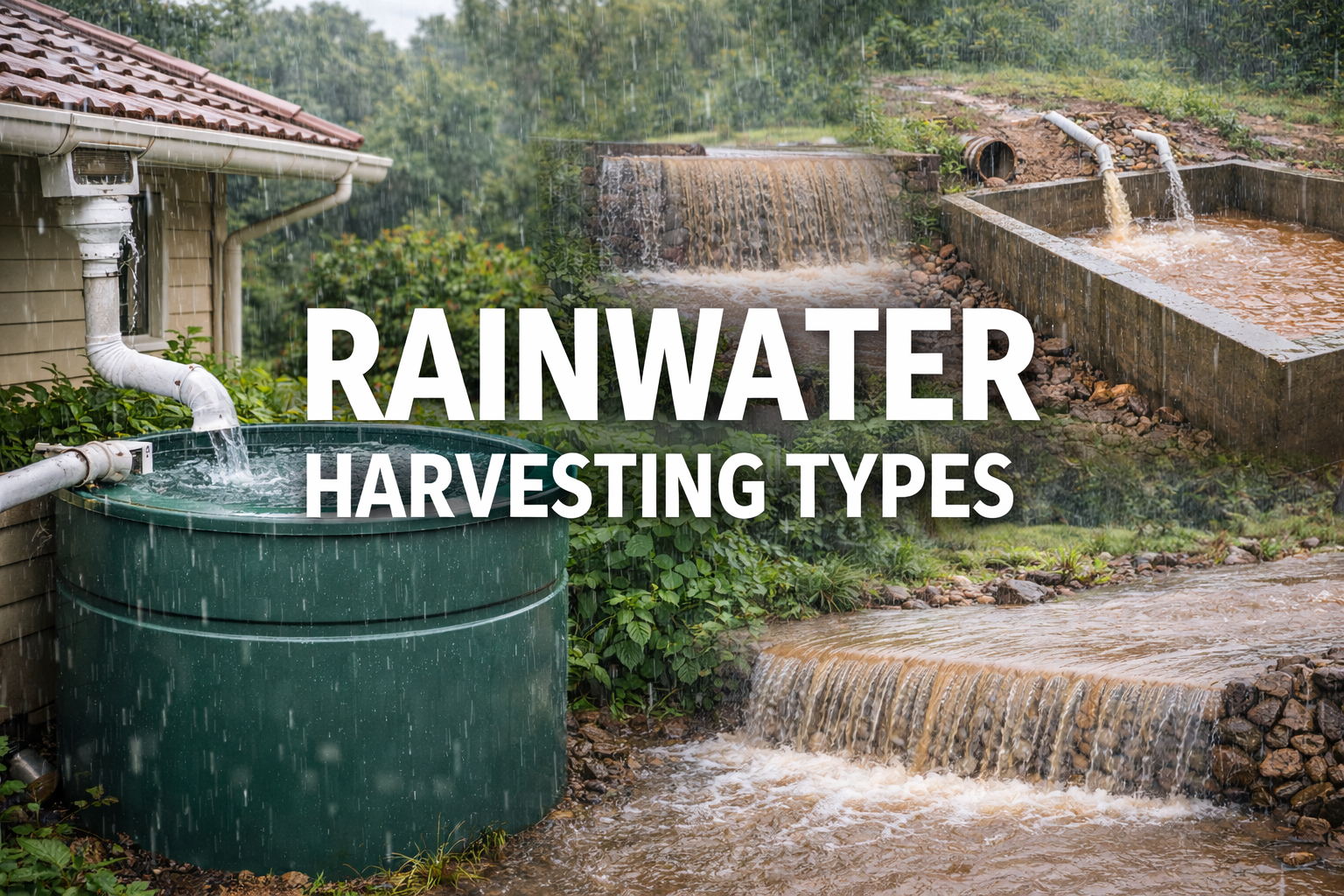
Types of Rainwater Harvesting Systems — Explained with Simple Diagrams

Most homeowners want to install a rainwater harvesting system but feel confused by the technical terms—recharge pit, percolation chamber, rooftop harvesting, first flush, etc.

So in this blog, Jalsanchay (India’s trusted rainwater harvesting consultant) explains every major type of rainwater harvesting system using simple diagrams and easy-to-understand descriptions.

This guide is structured to help you:

  • Understand the types of systems
  • Learn how each one works
  • Choose the right system for your home
  • Improve your SEO and AEO visibility with clear definitions and diagrams

1. Rooftop Rainwater Harvesting System (Most Common for Homes)

How It Works

Rainwater from the roof is collected through gutters → filtered → stored or recharged into the ground.

Best For

✔ Houses
✔ Apartments
✔ Schools
✔ Small commercial buildings

Why It Works Best
  • Easy to install
  • Very economical
  • Low maintenance
  • High water collection efficiency

2. Recharge Pit (Groundwater Recharge System)

How It Works

Rainwater is directed into a pit filled with pebbles/sand where it slowly percolates into the soil to recharge groundwater.

Best For

✔ Homes with borewells
✔ Areas with declining groundwater
✔ Places prone to water scarcity


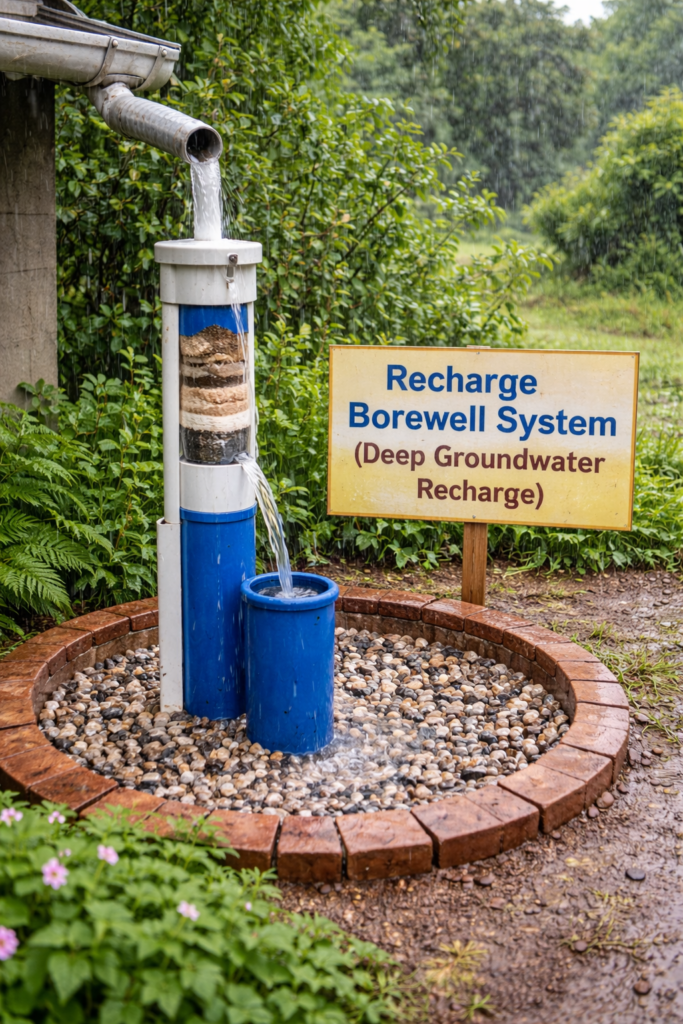
3. Recharge Borewell System (Deep Groundwater Recharge)

How It Works

Filtered rainwater is directed into an existing borewell to recharge deeper aquifers.

Best For

✔ Homes where the borewell is drying
✔ Borewells giving less water
✔ Rock-heavy soil areas

Advantages
  • Highest recharge depth
  • Can revive failing borewells
  • Supports long-term water security

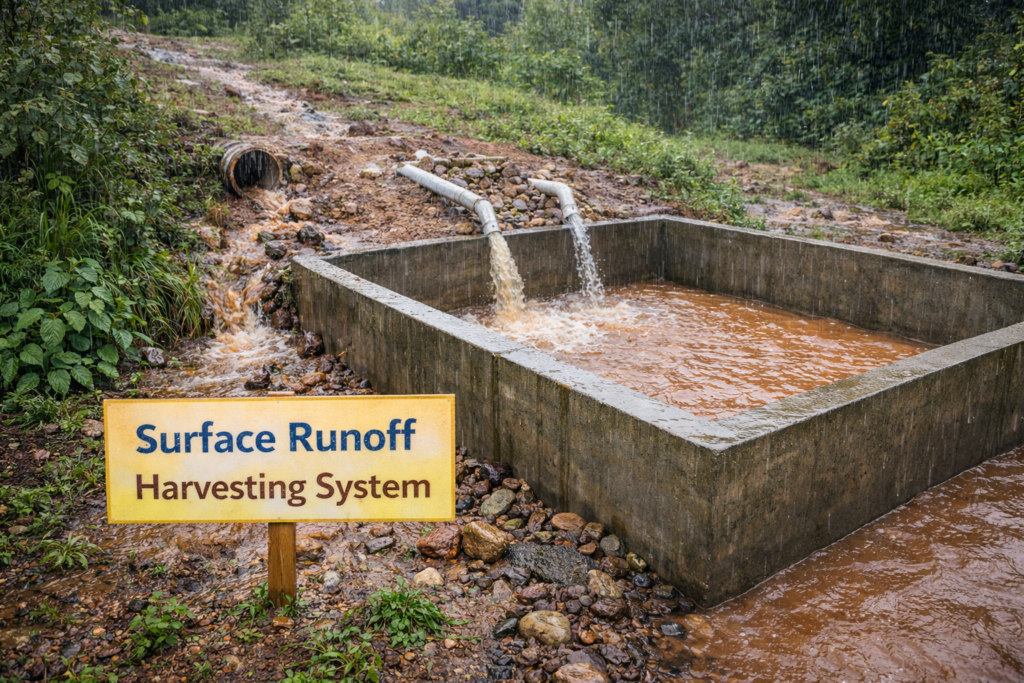
4. Surface Runoff Harvesting System

How It Works

Rainwater from open spaces (courtyards, driveways, roads) is collected through drains and sent to a recharge pit or storage tank.

Best For

✔ Large campuses
✔ Industries
✔ Houses with large open areas


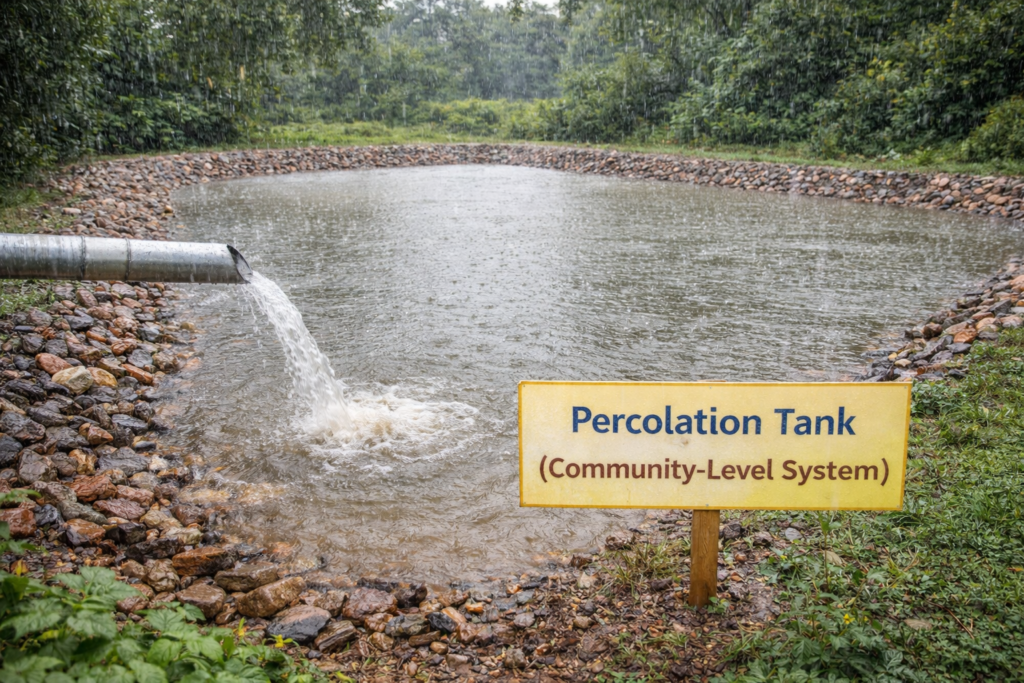
5. Percolation Tank (Community-Level System)

How It Works

A large tank is built to store rainwater temporarily, allowing it to gradually seep into the ground.

Best For

✔ Villages
✔ Farms
✔ Institutions with large land areas


6. Check Dam / Overflow Structure (Rural & Semi-Urban)

How It Works

A small dam is built across a stream to slow water flow, allowing groundwater recharge.


Which Rainwater Harvesting System Should You Choose?

For a house:

✔ Rooftop Rainwater Harvesting
✔ Recharge Pit
✔ Recharge Borewell

For apartments:

✔ Rooftop + Common Recharge Pit
✔ Surface runoff collection

For commercial buildings:

✔ Rooftop
✔ Recharge Borewell
✔ Percolation tanks for excess runoff

For farmlands / villages:

✔ Check dams
✔ Percolation tanks
✔ Contour trenches


Advantages of All These Rainwater Harvesting Systems
✔ Saves 40–50% daily water
✔ Reduces tanker dependency
✔ Improves borewell water level
✔ Cuts water bills
✔ Protects against climate uncertainty
✔ Eco-friendly and sustainable

AEO-Optimized FAQs (For Google Snippets)
1. What are the main types of rainwater harvesting systems?

The main types include rooftop harvesting, recharge pits, recharge borewells, surface runoff harvesting, percolation tanks, and check dams.

2. Which rainwater harvesting system is best for homes?

Rooftop rainwater harvesting with a recharge pit or recharge borewell is best for residential houses.

3. Can rainwater be used directly after filtration?

Yes. Basic filtration makes rainwater suitable for bathing, washing, flushing, and cleaning.

4. Do diagrams help understand rainwater harvesting?

Yes. Simple diagrams show the flow of water and make system design easier to understand for homeowners.

5. How long does installation take?

Most Jalsanchay systems take only 4–8 hours to install.


Conclusion

Rainwater harvesting is simple, powerful, and essential for every modern home.
Understanding the types of systems helps you choose the right solution and save thousands of liters of water every year.

Whether your goal is to recharge your borewell, reduce tanker bills, or ensure water security, Jalsanchay designs the perfect system for your needs.


Contact Jalsanchay for Expert Rainwater Harvesting Installation

📞 Call / WhatsApp Jalsanchay: 9016465919
📧 Email: ask@jalsanchay.com
🌐 Website: jalsanchay.com

👉 Want a customized rainwater harvesting system with professional design and installation?
Contact Jalsanchay today. We help homes save water, save money, and secure their future.

Rainwater Harvesting Basics: A Beginner’s Guide for Every Indian Household

Introduction: Why Every Indian Household Should Start Rainwater Harvesting Today

India receives abundant rainfall—yet most homes face water shortages, tanker dependency, and rapidly falling borewell levels.
Why?
Because 90% of rainwater simply flows away into drains, never reaching the ground.

Rainwater Harvesting (RWH) is the simplest, most effective solution for every Indian home—urban, rural, rented, or owned. And the best part?
Anyone can start it with basic knowledge.

This guide explains RWH in the simplest way possible so that every Indian household can begin harvesting water this monsoon.


Quick Answer (AEO Snippet Ready)

What is rainwater harvesting?
Rainwater harvesting is the process of collecting rainwater from roofs or open spaces, filtering it, and storing it in tanks or directing it into the ground to recharge groundwater. It helps reduce water bills, revive borewells, and ensure year-round water security.


Rainwater Harvesting Basics: Explained Simply

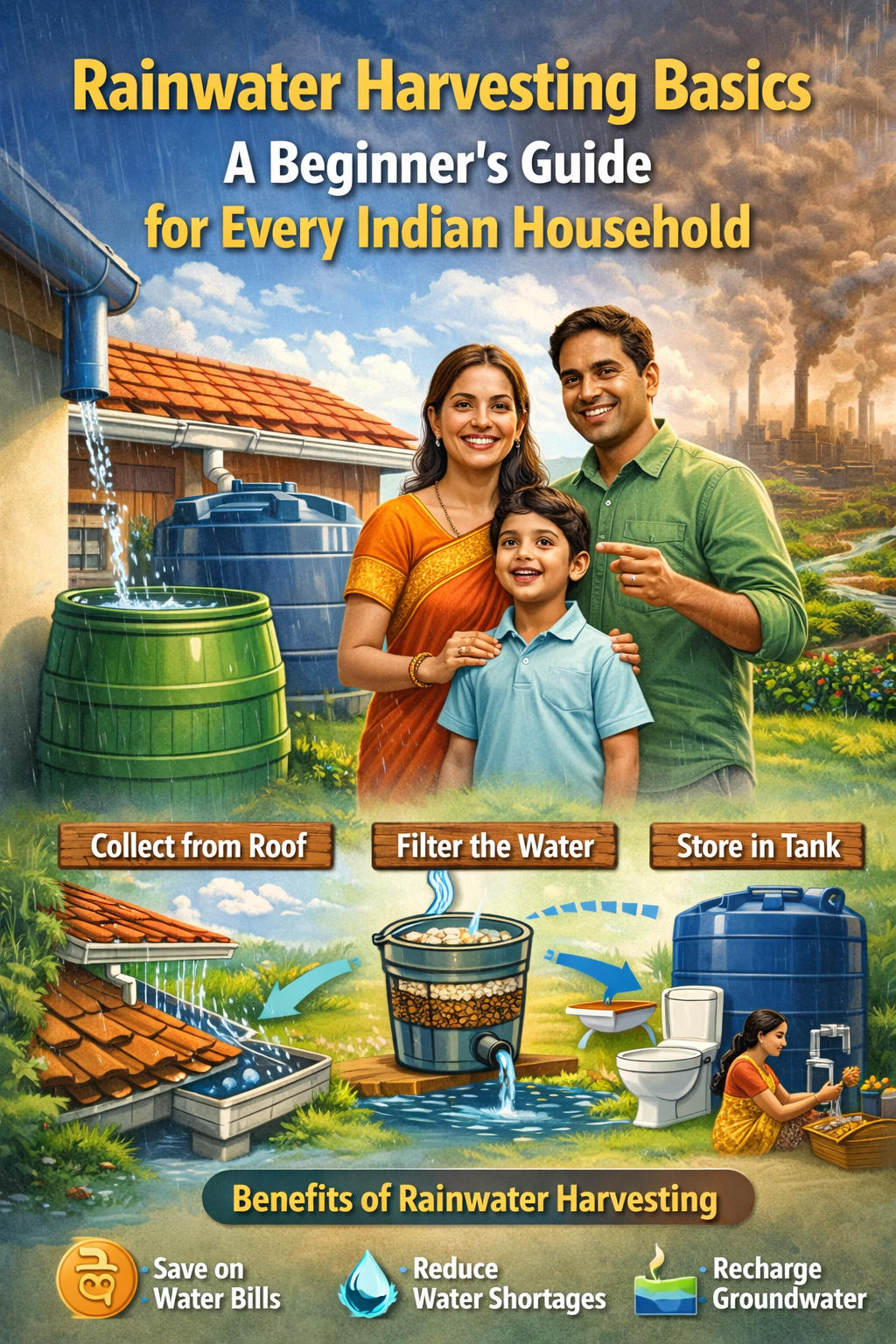
Rainwater harvesting has only three core components:

1. Collection — from rooftops, terraces, or open areas

2. Filtration — removing dust, leaves, and contaminants

3. Storage or Recharge — storing in a tank or directing into the soil

Let’s break each down in a beginner-friendly way.


1. How Rainwater Is Collected at Home

Most Indian homes have:

  • A terrace or roof
  • A sloped sheet roof
  • An open courtyard or paved area

This surface becomes your catchment area.

Tip:
The cleaner and smoother the roof, the higher the water collection efficiency.


2. Basic Filters Used in Rainwater Harvesting

Before rainwater goes into your tank or recharge pit, it passes through filters like:

  • Mesh filters (remove leaves and debris)
  • Sand + gravel filters
  • Charcoal filters
  • Dual-stage RWH filters used by Jalsanchay

Clean filtration = longer system life + safer groundwater.


3. Where the Water Goes: Storage vs. Recharge

Option A: Storage Tanks (For Daily Use)

Collected rainwater can be stored in:

  • Overhead tanks
  • Underground tanks
  • Plastic or ferrocement tanks

Use this water for cleaning, gardening, washing, flushing, etc.


Option B: Groundwater Recharge (Best for Borewells)

RWH can directly help revive groundwater using:

  • Recharge pits
  • Recharge wells
  • Percolation trenches
  • Borewell recharge systems (a Jalsanchay specialty)

This leads to:
✔ Higher borewell yield
✔ Reduced tanker costs
✔ Stable groundwater levels


Why Every Indian Home Should Start Rainwater Harvesting

1. Saves 50–100% on Water Bills

Rainwater is free and abundant.

2. Revives Dry Borewells

Recharge helps refill aquifers.

3. Reduces Tanker Dependency

Especially useful during summer shortages.

4. Prevents Urban Flooding

By absorbing stormwater.

5. Increases Property Value

Homes with RWH systems are seen as premium.

6. Long-Term Environmental Benefit

Supports entire neighbourhoods by restoring groundwater balance.


How Much Water Can an Indian Household Harvest?

Roof SizeAnnual RainfallPotential Harvest
1,000 sq ft800–900 mm80,000–1,00,000 liters/year
2,000 sq ft800–900 mm1.5–2 lakh liters/year
5,000 sq ft800–900 mm4–5 lakh liters/year

Even a small 200 sq ft balcony roof can harvest 15,000–20,000 liters/year.


Simple Rainwater Harvesting Methods for Beginners

1. Rooftop to Storage Tank

Easiest method for small homes.

2. Recharge Pit

Perfect for reviving borewells.

3. Roof to Drum System (Low-budget)

Ideal for renters.

4. Recharge Well

Best for cities with hard-rock geology.

5. Surface Runoff Harvesting

For bungalows, farms, and institutions.


Checklist: What You Need to Start RWH at Home

  • Clean roof
  • Properly angled gutters
  • Good quality PVC pipes
  • First-flush system
  • Filter unit
  • Storage tank or recharge pit

Jalsanchay can design all of this for your home or building.


FAQ (SEO + AEO Optimized)

1. Is rainwater harvesting compulsory in India?

Many states like Tamil Nadu, Karnataka, and Delhi mandate RWH for buildings.

2. Can renters install RWH?

Yes—balcony or drum-based setups work well.

3. Is rainwater safe for drinking?

Yes, if filtered and treated properly, though most households use it for non-potable purposes.

4. How much does a basic RWH system cost?

₹5,000 to ₹1.5 lakh depending on system size and method.

5. Who can install RWH at my house?

Professional consultants like Jalsanchay provide design, installation, maintenance, and recharge solutions.


Conclusion: Start Small, Start Smart—But Start Now

Rainwater harvesting is not complicated. With just a basic understanding and a willingness to start, any Indian household can save thousands of liters every year.

Whether you want to reduce your water bill, recharge your borewell, or simply contribute to the environment—RWH is the easiest first step.


Need Help Setting Up RWH? Contact Jalsanchay

Jalsanchay is one of India’s trusted Rainwater Harvesting Consultants & Service Providers, offering:

  • Complete RWH system design
  • Borewell recharge solutions
  • Filtration systems
  • Site inspection & water audits
  • Repairs, upgrades & maintenance
  • RWH solutions for homes, RWAs, industries, schools & commercial buildings

📞 Call / WhatsApp Jalsanchay: 9016465919
📧 Email: ask@jalsanchay.com
🌐 Website: jalsanchay.com