

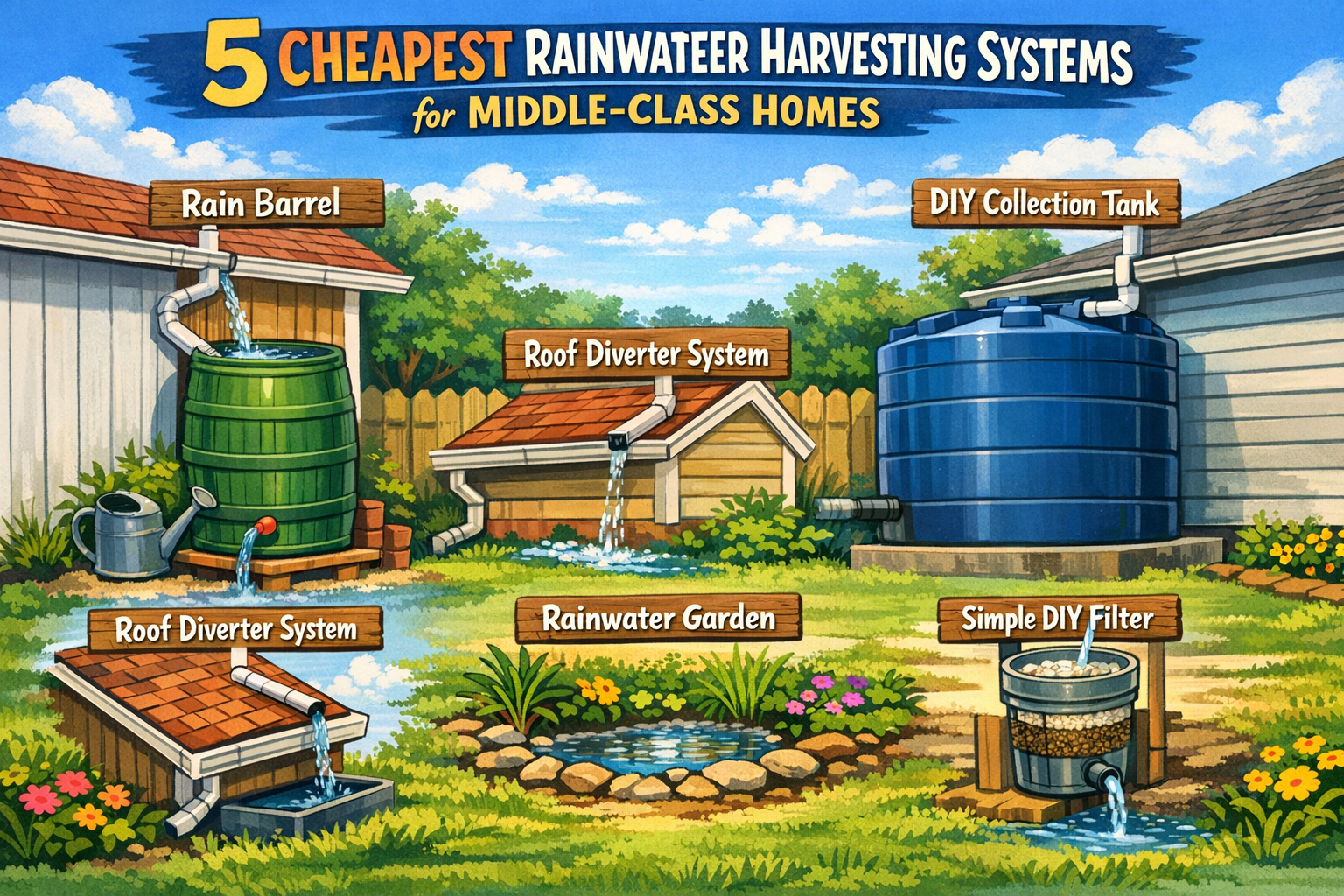
5 Cheapest Rainwater Harvesting Systems for Middle-Class Homes (Budget-Friendly Guide 2025)

For many middle-class Indian households, rising water bills and increasing water shortages make rainwater harvesting a smart, budget-friendly solution. But the biggest question is:
“Which rainwater harvesting system is the cheapest and most effective for my home?”

At Jalsanchay, a trusted rainwater harvesting consultant and service provider, we help families install cost-effective, efficient, and easy-to-maintain harvesting systems tailored for homes, apartments, and small residential plots.

This guide covers the 5 cheapest rainwater harvesting systems you can install without compromising on performance.


1. Rooftop Direct Storage System (Cheapest & Easiest)

Best for: Small homes with limited roof area
Approx. Budget: ₹5,000 – ₹15,000

This is the most basic and economical method where rainwater from your rooftop is filtered and stored directly in an existing or new water tank.

How it Works

  • Rainwater flows through a downpipe
  • Passes through a simple mesh filter or first flush
  • Gets stored in a plastic/HDPE tank

Benefits

  • Cheapest setup cost
  • Easy to install & maintain
  • Ideal for middle-class households

Why It’s Good for SEO Snippet:

This system has simple steps that Google/AI search prefers for direct answers.


2. Recharge Pit System (Low Cost, High Efficiency)

Best for: Houses suffering from low borewell yield
Approx. Budget: ₹12,000 – ₹25,000

A recharge pit allows rainwater to percolate into the ground, increasing groundwater levels.

Components

  • 3–5 ft pit
  • Brick jelly
  • Pebbles & charcoal layers
  • PVC piping

Benefits

  • Improves borewell output
  • Very low maintenance
  • Long-term solution for water scarcity

Why Jalsanchay Recommends It

We specialize in designing pits based on soil, plot size, and water table depth ensuring maximum recharge.


3. Modular Rainwater Filters (Instant & Affordable)

Best for: Homes needing clean, usable non-potable water
Approx. Budget: ₹6,000 – ₹20,000

Modular filters are compact devices fitted to your downpipe to remove dust, leaves, and debris.

Benefits

  • No civil work required
  • Quick installation
  • Suitable for washing, gardening, floor cleaning

SEO Tip:

“Modular rainwater filter price” is a high-volume keyword you can rank easily.


4. Recharge Borewell System (Highly Impactful, Moderate Cost)

Best for: Homes with existing borewells
Approx. Budget: ₹15,000 – ₹35,000

This system channels roof water directly into a borewell through filtration chambers.

Benefits

  • Restores groundwater
  • Helps maintain borewell water levels
  • Works even in urban compact plots

AEO-Friendly Summary

A recharge borewell system routes clean roof water into the borewell to restore groundwater levels at a low cost.


5. Rain Barrel / Drum Storage System (Super Low Budget)

Best for: Families wanting ultra-cheap solutions
Approx. Budget: ₹2,500 – ₹10,000

Plastic barrels or drums can be connected to the roof drainage to collect water.

Benefits

  • Most affordable option
  • Zero structural changes
  • Portable and easy

Best Use Cases

  • Garden watering
  • Cleaning purposes
  • Emergency water storage

Comparison Table (Best for Google Snippets)

System TypeBest ForCost RangeMaintenanceLifespan
Rooftop Direct StorageSmall homes₹5k–15kVery Low10+ years
Recharge PitBorewell recharge₹12k–25kLow20+ years
Modular FilterClean non-potable water₹6k–20kVery Low8–10 years
Recharge BorewellGroundwater boost₹15k–35kLow15–20 years
Rain BarrelsUltra budget use₹2.5k–10kVery Low5–8 years

How to Choose the Right Low-Cost System?

Choosing depends on:

  • Roof area
  • Water demand
  • Soil type
  • Existing borewell
  • Budget

At Jalsanchay, we inspect your home and recommend the perfect system at minimum cost.


Benefits of Low-Cost Rainwater Harvesting for Middle-Class Families

  • Reduces water bills
  • Improves borewell output
  • Prevents waterlogging
  • Eco-friendly & sustainable
  • Requires minimal maintenance
  • 100% return on investment within 1–2 seasons

Rainwater Harvesting FAQs (AEO & Featured Snippet Optimized)

1. Which is the cheapest rainwater harvesting system for homes?

The rain barrel/drum system is the cheapest, starting at just ₹2,500–₹10,000.

2. How much does a basic rainwater harvesting setup cost in India?

A simple rooftop system costs between ₹5,000 and ₹20,000, depending on filter type and tank capacity.

3. Can middle-class homes afford rainwater harvesting?

Yes, most homes install budget systems under ₹10,000–25,000, making it very affordable.

4. Which system increases borewell water levels?

A recharge pit or recharge borewell system is best for improving groundwater.

5. How long does installation take?

Most systems are installed by Jalsanchay in 4–8 hours depending on complexity.


Final Thoughts

Rainwater harvesting doesn’t have to be expensive. With these five cheapest systems, every middle-class home can save water, reduce bills, and become self-reliant.

If you’re planning to install a budget-friendly rainwater harvesting system, Jalsanchay can help with:

✅ Site assessment
✅ System design
✅ Low-cost installation
✅ Maintenance & support


Contact Jalsanchay

📞 Call/WhatsApp: 9016465919
🌐 Website: jalsanchay.com
📧 Email: ask@jalsanchay.com

👉 For any help in selecting or installing a low-cost rainwater harvesting system, contact Jalsanchay today.


How Rainwater Harvesting Reduces Water Tanker Bills — With Real Calculations

Rainwater harvesting Reduces water tanker bills by 40% to 90% depending on roof size and rainfall. For a 1,000 sq. ft. roof in a city with 800 mm rainfall, you can harvest ~80,000 litres annually — equal to 40 water tankers, saving ₹20,000–₹28,000 per year.


Water tanker bills are rising every year — especially in cities like Mumbai, Pune, Bengaluru, Delhi, Gurgaon, Hyderabad, and Indore, where demand is high and supply is limited.

But there’s one solution that permanently reduces your water dependency:

Rainwater Harvesting (RWH).

In this blog, we will show you real-life calculations, savings, and return on investment (ROI) so you know exactly how much money you can save by installing a rainwater harvesting system.

This guide is written by Jalsanchay, a leading rainwater harvesting consultancy and implementation partner helping homes, societies, factories, and commercial buildings save lakhs every year.


How Rainwater Harvesting Reduces Your Tanker Expenses — The Logic

Water tankers cost anywhere from ₹500 to ₹900 per 5,000–6,000 litre tanker.

Most societies depend on 30–200 tankers per month, leading to massive yearly spending.

Rainwater harvesting reduces tanker use by:

  • Increasing on-site water availability
  • Improving groundwater levels & borewell yield
  • Storing free, clean rainwater
  • Reducing dependence on external suppliers

💧 Real Calculation: How Much Water Can YOU Harvest?

Formula for rainwater harvesting potential:

Harvested Water (Litres) = Roof Area (sq. ft.) × Rainfall (mm) × 0.93

(0.93 = runoff coefficient accounting for minor losses)


Example 1: 1,000 sq. ft. Roof — 800 mm Rainfall

ParameterValue
Roof Area1,000 sq. ft.
Annual Rainfall800 mm
Conversion factor0.93

Calculation:

1,000 × 800 × 0.93
= 744,000 litres per year
= ~744 KL per year


❗What Does This Mean Financially?

1 tanker = 5,000–6,000 litres

Let’s assume 5,000 litres for conservative calculation.

Number of tankers replaced:

744,000 ÷ 5,000 = ~149 tankers per year

Money saved:

At ₹700 per tanker →
149 × 700 = ₹1,04,300 saved per year

Yearly savings: ₹1 lakh (approx.)


Example 2: Housing Society – 10,000 sq. ft. Terrace

ParameterValue
Terrace Area10,000 sq ft
Rainfall900 mm
Harvestable Water8.37 lakh litres

Savings:

8,37,000 ÷ 5,000 = 167 tankers saved

167 × ₹800 = ₹1,33,600 saved per year


Example 3: Factory / Industry – 50,000 sq. ft. Roof

With 900 mm rainfall:
Harvestable = 41,85,000 litres

Tankers saved = 837
Annual savings = ₹5.8 lakh to ₹7.5 lakh


🟢 Detailed ROI: When Does RWH Pay Back?

Building TypeApprox System CostAnnual SavingsPayback Period
Individual Home₹40,000–₹1,00,000₹20k–₹1 lakh6–24 months
Society₹2–₹8 lakh₹1–₹5 lakh1–2 years
Factory / Commercial₹5–₹25 lakh₹5–₹20 lakh3–12 months

ROI = Excellent

Rainwater harvesting is one of the few infrastructure projects that pays back within 1–2 monsoons.


🔵 Additional Savings Beyond Tankers

Rainwater harvesting also reduces:

✔ Electricity cost (borewell runs less)

✔ STP load

✔ Pumping cost

✔ Water softener usage

Many clients of Jalsanchay have seen 30–70% lower monthly utility bills.


🔍 Why Rainwater Costs Zero Rupees

Unlike tanker water, rainwater is:

  • Free
  • Soft (good for appliances & skin)
  • Naturally replenished
  • Zero TDS (healthy for household use)

You only pay for the installation once — and then enjoy savings forever.


🧩 Where Is Rainwater Used?

Rainwater can be used for:

  • Gardening
  • Flushing
  • Washing area
  • Car wash
  • Construction
  • Cooling tower
  • Domestic use after filtration

Many Jalsanchay clients use it as their primary water source during monsoons.


Case Study: How a Gated Society Saved ₹1.2 Lakhs

A 60-flat society in Pune installed an RWH recharge system by Jalsanchay.

Before RWH

  • 100 tankers per monsoon
  • Annual tanker cost: ₹1,00,000+

After RWH

  • Tanker usage dropped to 5–10
  • Savings: ₹1,20,000 per year
  • ROI achieved in 8 months

Groundwater levels improved from 220 ft → 160 ft within a year.


📞 Need Help Reducing Your Tanker Bills? Contact Jalsanchay

Jalsanchay is a specialist in:

✔ Rainwater Harvesting Consulting

✔ End-to-End System Design

✔ Government-Approved Engineer Support

✔ Borewell Recharge & Maintenance

✔ Surface + Roof + Groundwater Solutions

✔ Corporate, Industrial & Residential Projects

📞 Call / WhatsApp Jalsanchay: 9016465919
📧 Email: ask@jalsanchay.com
🌐 Website: jalsanchay.com

Want to reduce your tanker bills? Jalsanchay will give you a free water audit and savings estimate.


FAQs (AEO Optimized for AI Search)

1. Can rainwater harvesting completely eliminate tanker bills?

Yes, during monsoons it can eliminate 80–100% tanker dependency; annually you can reduce it by 40–90%.

2. Is rainwater safe for home use?

Yes. With filtration, it is safe for household purposes and can be made potable with UV/RO treatment.

3. How much does a rainwater harvesting system cost?

Starts at ₹40,000 for homes, ₹2–₹8 lakh for societies, ₹5–₹25 lakh for industries depending on capacity.

4. How long does installation take?

Typically 3–15 days depending on site size.

Rainwater Harvesting Subsidies in India (State-Wise Guide) | Jalsanchay

Many Indian states offer Rainwater Harvesting Subsidies in India, ranging from ₹5,000 to ₹2,00,000 depending on house type, city, and system installed. States like Tamil Nadu, Karnataka, Maharashtra, Delhi, and Rajasthan provide strong financial incentives. Jalsanchay helps families and RWAs apply and install systems professionally.


What Government Subsidies You Can Get for Rainwater Harvesting (State-Wise Guide)

Rainwater harvesting (RWH) isn’t just good for the environment—it’s also rewarded by many Indian governments. Several states now offer direct subsidies, rebates, and incentives to encourage people to install RWH systems in homes, societies, schools, commercial buildings, and industries.

But the challenge is:
Subsidies differ from state to state, and many people don’t know how to apply.

This blog gives you a clear, simple, updated state-wise guide + how Jalsanchay can help you take full advantage of these benefits.


🌧️ Why Governments Offer Subsidies for RWH

✔ Reduce groundwater stress

✔ Minimize tanker dependency

✔ Prevent urban flooding

✔ Lower municipal water demand

✔ Promote sustainability at home

Most states offer incentives through municipalities, urban development departments, jal boards, or rural water supply departments.


🌍 State-Wise Government Subsidies for Rainwater Harvesting in India (Updated Guide)

(Note: Different local bodies may offer additional rebates. Jalsanchay helps verify eligibility while designing your RWH system.)


1️⃣ Delhi – Subsidy on Installation + Property Tax Rebate

Types of support:

  • Up to 50% subsidy for RWH installation in colonies
  • 10%–20% property tax rebate for compliant buildings
  • Rebates for borewell recharge units

Who is eligible?
Homes, RWAs, schools, shops.

Bonus:
Mandatory for plots above 100 sq. m.


2️⃣ Karnataka (Bengaluru) – BWSSB Rebate Support

Benefits:

  • Flat ₹5,000–₹10,000 support for compliant homes
  • Penalty waiver if you install RWH after deadline
  • Water bill rebates in some BBMP zones

Focus:
Existing buildings upgrading to RWH.


3️⃣ Tamil Nadu – India’s Most RWH-Friendly State

Tamil Nadu pioneered compulsory rainwater harvesting.

Subsidy:

  • ₹5,000–₹20,000 financial support (varies by district)
  • Extra benefits for rural households
  • Municipal rebate for buildings with verified systems

Special:
Schools and govt buildings get higher benefits.


4️⃣ Maharashtra (Mumbai, Pune) – MCGM Incentives

Benefits include:

  • Up to 50% subsidy for society-level RWH
  • Rainwater recharge systems get rebate on property tax
  • Special grants for low-income housing clusters

Eligible:
Societies, chawls, individual homes, commercial complexes.


5️⃣ Rajasthan – Rural + Urban Subsidy

Because of water scarcity, Rajasthan supports RWH strongly.

Support offered:

  • ₹20,000–₹40,000 subsidy per household
  • Higher assistance for rural recharge wells
  • NGOs receive additional grants for community RWH

6️⃣ Uttar Pradesh – Household Level Incentive

Benefits:

  • ₹10,000–₹50,000 subsidy depending on type of RWH
  • Smart City zones offer extra rebate
  • Some cities offer 5%–10% property tax relief

7️⃣ Haryana – Subsidy for Rooftop RWH

Key incentives:

  • Up to ₹25,000 subsidy on installation
  • Rebates for plots above 500 sq. m
  • Higher assistance in water-stressed districts

8️⃣ Gujarat – Urban & Rural Support

Subsidy includes:

  • ₹10,000–₹30,000 support
  • Rural areas get additional government funding
  • Borewell recharge supported by Jal Shakti Mission

9️⃣ West Bengal – Municipality-Level RWH Incentive

Benefits:

  • ₹5,000–₹15,000 subsidy
  • Community projects get higher funding
  • Incentives vary between municipalities

🔟 Telangana – Hyderabad Water Board Rebate

Support:

  • Property tax benefits for homes with functional RWH
  • ₹10,000–₹25,000 subsidy in select zones
  • Mandatory for new buildings

1️⃣1️⃣ Kerala – Large Subsidy for Rural Households

Government assistance:

  • ₹25,000–₹75,000 subsidy
  • Kudumbashree groups get special support
  • Extra coverage for RWH used for drinking

🟡 General Subsidy Available Through National Missions

Apart from state subsidies, many national missions support RWH:

Jal Jeevan Mission

Supports community-level RWH in rural areas.

Atal Mission for Rejuvenation and Urban Transformation (AMRUT)

Funds municipal-level RWH projects.

Smart City Mission

Smart cities offer rebates for compliant buildings.

MNREGA (Rural)

Helps build recharge pits in villages.


📌 Documents Required to Apply for RWH Subsidies

Most states ask for:

✔ Property tax receipt
✔ Aadhaar
✔ Address proof
✔ Photographs of the RWH system
✔ Bank account details
✔ Installation invoice
✔ Completion certificate (Jalsanchay provides this)


🧮 How Much Subsidy Can You Expect?

On average, Indian households receive:

  • ₹5,000 – ₹50,000 (Homes)
  • ₹25,000 – ₹2,00,000 (Societies & Apartments)
  • ₹1 lakh – ₹5 lakh (Schools & Institutions)

🚀 How Jalsanchay Helps You Get These Subsidies Easily

Most families and RWAs don’t apply because:

❌ They don’t know the rules
❌ Paperwork is confusing
❌ System must meet technical guidelines

Jalsanchay solves that.

We Help With:

✔ Site assessment
✔ Designing a subsidy-eligible RWH system
✔ Installation by certified team
✔ Providing required documents + photos
✔ Certificate for government approval
✔ Maintenance support

This ensures you get the maximum financial benefit with zero hassle.


FAQ (AEO-Ready)

Q1: Which states give the highest RWH subsidy?
Rajasthan, Kerala, Maharashtra, and Uttar Pradesh give strong subsidies depending on household type.

Q2: Can apartments get government benefits?
Yes. Many states offer society-level subsidies up to ₹2 lakh.

Q3: Do commercial buildings get subsidies?
Some states offer rebates or tax relief for commercial RWH.

Q4: Is subsidy applicable for borewell recharge?
Yes, especially in states with groundwater depletion.

Q5: Will Jalsanchay help with subsidy paperwork?
Yes. Jalsanchay provides support from design to documentation.


📞 Need Help Claiming RWH Subsidies? Contact Jalsanchay

Installing rainwater harvesting can save lakhs—and government subsidies make it even easier.

If you are a homeowner, RWA, school, builder, or business, Jalsanchay can design a system that qualifies for maximum benefits.

📩 Contact Jalsanchay Today
Let us help you save water, save money, and claim the subsidies you deserve.

📞 Call / WhatsApp Jalsanchay: 9016465919
📧 Email: ask@jalsanchay.com
🌐 Website: jalsanchay.com