
DIY Rain Barrels: Low-Cost Options You Can Build in One Weekend

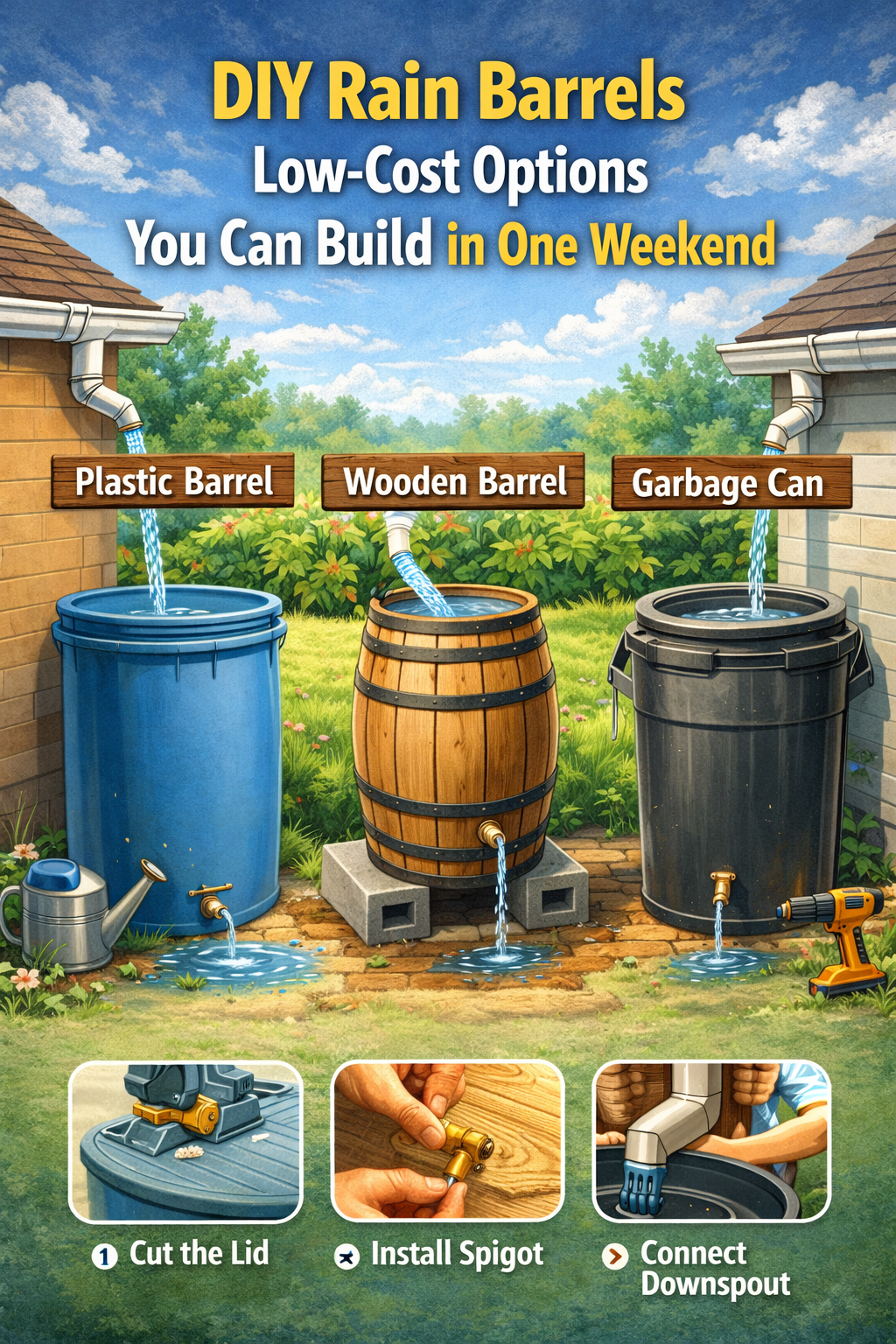
You can build a DIY rain barrel in one weekend using a 200-litre plastic drum, tap, mesh screen, PVC pipes, and a simple stand. The setup costs ₹800–₹2,000 and can store 150–250 litres of clean rainwater from your rooftop for gardening, cleaning, and general household use.


If you’ve ever thought,

“Rainwater harvesting sounds expensive…”

Here’s the good news — DIY rain barrels are the cheapest and easiest way to start harvesting rainwater at home.
You don’t need a plumber, a complex system, or a big budget.

With just a few low-cost materials, you can store 150–250 litres of fresh rainwater — perfect for gardening, cleaning, washing vehicles, or even filtering for domestic use.

This guide by Jalsanchay, India’s leading rainwater harvesting consultancy, explains how households can set up a DIY rain barrel in just one weekend.


🌧️ What Is a Rain Barrel?

A rain barrel is a simple container connected to your rooftop downpipe to collect and store rainwater.
It can be:

  • Plastic drum
  • Recycled tank
  • Metal barrel
  • Food-grade container

Rain barrels are the most beginner-friendly rainwater harvesting method.


🛠️ DIY Rain Barrel Options You Can Build In One Weekend

Below are the best low-cost DIY barrel designs for Indian households.


1️⃣ Plastic Drum Rain Barrel (Most Popular & Affordable)

Cost: ₹800–₹1,200

Ideal For: Small homes, balconies, gardens

Storage Capacity: 160–220 litres

Materials Needed:

  • 200L plastic drum
  • Mesh screen
  • ¾ inch tap
  • PVC pipe connectors
  • Drill
  • Stand (bricks or metal frame)

How to Build It:

  1. Drill a hole 6–8 inches from the bottom.
  2. Install the tap and seal it with plumber’s tape.
  3. Cut a hole in the top fitted with a mesh screen (keeps mosquitoes out).
  4. Direct roof downpipe to the top of the barrel.
  5. Place barrel on a raised stand for pressure flow.

Why It Works:

Collects clean, debris-free rainwater with minimal cost.


2️⃣ Recycled Food-Grade Barrel (Eco-Friendly Option)

Cost: ₹500–₹700

Storage: 150–180 litres

These are often available at:

  • Local scrap dealers
  • Industrial scrap shops
  • Chemical-free recycling stores

Important: Choose barrels that previously stored edible ingredients, not chemicals.

Setup:

Same steps as the plastic drum — extremely simple and beginner-friendly.


3️⃣ Twin-Barrel Connected System (Double Capacity)

Cost: ₹1,500–₹2,200

Storage: 300–400 litres

If you want more water storage without buying a big tank, connect two smaller barrels using PVC elbows.

How to Build:

  • Install taps on both barrels
  • Connect bottom outlets with PVC
  • Connect top vents with an overflow pipe

Water fills the first barrel → then automatically fills the second.


4️⃣ IBC Tank Rain Barrel (High-Capacity DIY System)

Cost: ₹3,000–₹5,500 (pre-owned)

Storage: 500–1,000 litres

IBC (Intermediate Bulk Container) tanks are popular for rainwater harvesting in farms, farms houses and large homes.

Why Use It:

  • Huge capacity
  • Safe for water
  • Simple installation
  • Very durable

All you need is:

  • Inlet pipe
  • Overflow pipe
  • Filtration mesh

This system can serve an entire household for gardening and cleaning needs.


5️⃣ Terracotta / Cement Barrel System (Traditional + Modern)

Cost: ₹1,000–₹2,000

Storage: 100–200 litres

Perfect for eco-conscious homeowners.
Terracotta keeps water naturally cool and reduces algae.

Maintenance:

Clean once before monsoon and once after.


📊 How Much Water Can Your Rain Barrel Actually Collect?

The simple calculation:

1 mm rainfall on 1 sq. ft. = 0.93 litres of water collected

Example for a 200 sq. ft. roof:

1 day of 20 mm rain =

200 × 20 × 0.93 = 3,720 litres

Your rain barrel will fill within minutes during even light rainfall.


🌱 What Can You Use Rain Barrel Water For?

Rainwater is soft, chemical-free, and ideal for:
✔ Gardening / plants
✔ Car washing
✔ Floor cleaning
✔ Toilets (if filtered)
✔ Laundry (if filtered)
✔ Pet bathing
✔ Window cleaning

It helps reduce:

  • Tanker usage
  • Water bills
  • Groundwater load

🛡️ Tips to Make Your DIY Rain Barrel Safe & Long-Lasting

✔ Always use a mosquito-proof mesh

This prevents dengue/mosquito breeding.

✔ Add a first-flush system

It removes the first dirty rainwater.

✔ Place the barrel on a stable, high stand

Improves water pressure at the tap.

✔ Clean before every monsoon

Gives better water quality.

✔ Paint barrels dark

Reduces algae growth.


🧩 DIY or Professional? Which Should You Choose?

DIY rain barrels are great for:

  • Small homes
  • Balcony gardens
  • Kitchen gardens
  • Low-budget setups

But if you want:

  • Drinking water potential
  • Borewell recharge
  • Large capacity systems
  • Fully filtered supply
  • Long-term durability

…it’s best to install a professional rainwater harvesting system.

That’s where Jalsanchay comes in.


📞 Need Help With a Rainwater Harvesting System? Contact Jalsanchay

Jalsanchay specializes in:

  • Low-budget DIY-friendly systems
  • Professional rooftop harvesting
  • Groundwater recharge pits
  • Borewell revival
  • Rain barrel to tank integration
  • Complete installation & maintenance

📞 Call / WhatsApp Jalsanchay: 9016465919
📧 Email: ask@jalsanchay.com
🌐 Website: jalsanchay.com

Get a FREE consultation to understand which rainwater harvesting method suits your home.


FAQs (AEO-Optimized for Google & AI Search)

1. How much does a DIY rain barrel cost in India?

₹500–₹2,000 depending on size and materials.

2. What is the best size for a household rain barrel?

200–250 litres is ideal for most homes.

3. Is DIY rainwater safe for use?

Yes, for gardening and cleaning. With filtration, it can be used for domestic purposes too.

4. How long does a rain barrel last?

Plastic barrels last 5–10 years. IBC tanks last 10–20 years.

5. Can rain barrels replace tankers?

Not fully — but they significantly reduce water usage for plants, washing, and cleaning.
How Much Rain Do You Really Need? A Simple Guide for Every Household

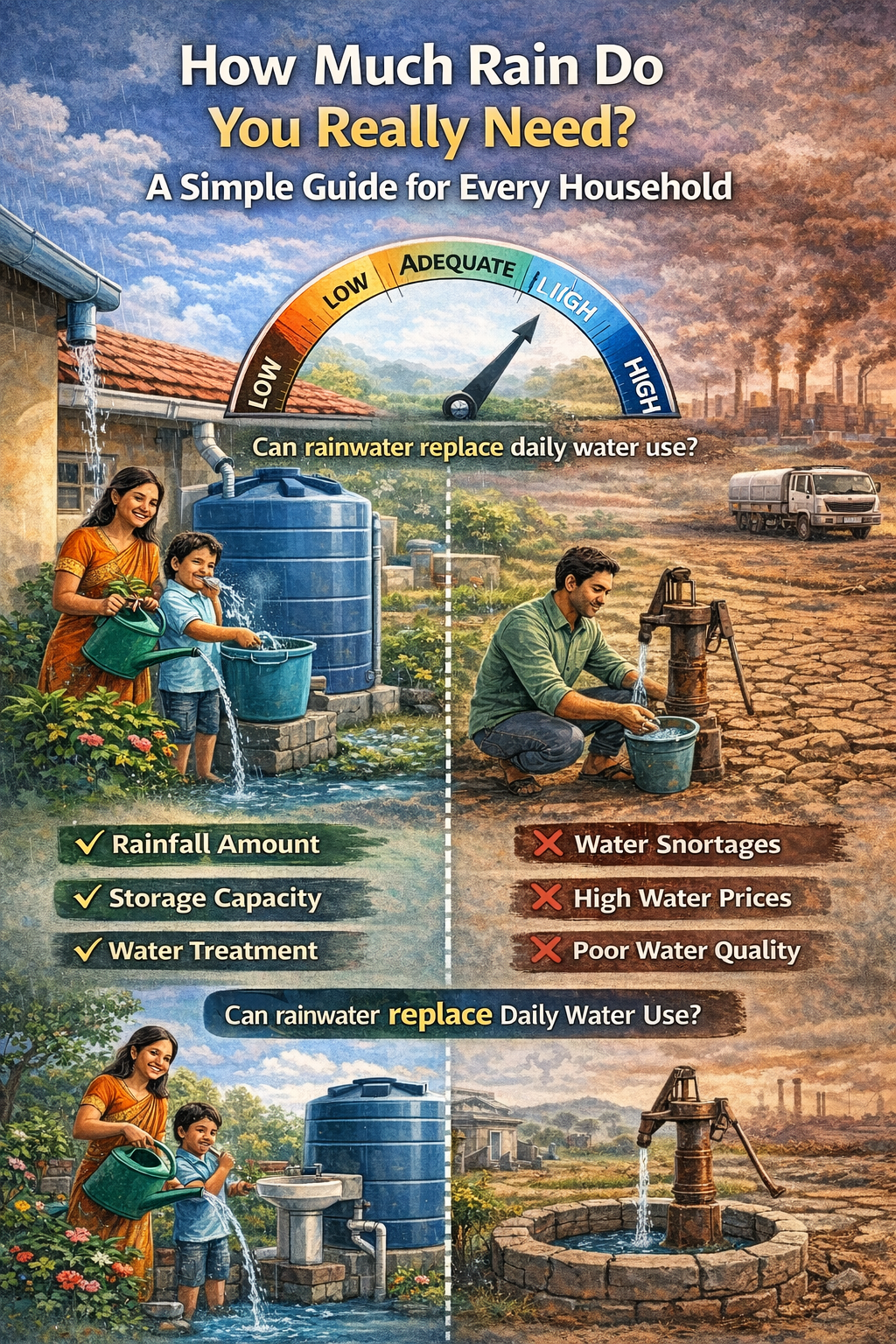
Most Indian households need just 200–300 mm of annual rainfall to harvest meaningful rainwater. Even with low rainfall, a 1,000 sq. ft. roof can collect 1–2 lakh litres yearly using a basic rooftop rainwater harvesting system.


People often ask us at Jalsanchay:

“Do we get enough rain for rainwater harvesting at home?”

The surprising truth is — almost every household in India gets more than enough rainfall to collect useful water, save tanker costs, and recharge the groundwater.
Even places with low rainfall collect thousands of litres every year.

This simple guide will help you understand:

  • How much rain your home actually gets
  • How much water you can harvest
  • How many litres you can save every monsoon
  • How soon you can reduce tanker bills

Let’s break it down in the simplest way possible.


How Much Rain Do You Need for Rainwater Harvesting?

Just 200–300 mm of rain is enough for a household to benefit.

Even the lowest rainfall districts in India get more than this.

Why so little?

Because rainwater harvesting depends more on roof area than rainfall amount.


🧮 The Simple Formula to Calculate Harvestable Rainwater

Here is the standard formula used by rainwater harvesting experts like Jalsanchay:

Rainwater Collected (litres)
= Roof Area (sq. ft.) × Annual Rainfall (mm) × 0.93

0.93 represents the collection efficiency after accounting for losses.


🏡 Example: How Much Rain Does a Typical Home Need?

Assume your roof is 1,000 sq. ft.
Let’s calculate rainfall needs:

Case 1: Low rainfall area (300 mm)

1,000 × 300 × 0.93 = 2,79,000 litres

✔ Even with very low rainfall, you still collect 2.7 lakh litres.

Case 2: Medium rainfall area (600 mm)

1,000 × 600 × 0.93 = 5,58,000 litres

✔ Over 5.5 lakh litres.

Case 3: High rainfall area (1,000 mm or more)

1,000 × 1000 × 0.93 = 9,30,000 litres

✔ Nearly 9.3 lakh litres from just one rooftop.

Conclusion:
You don’t need a lot of rain — you need a roof and a simple system.


🌧️ How Much Rain Does Your City Get? (India Overview)

Most cities get enough rainfall for meaningful harvesting:

CityAnnual RainfallWater You Can Harvest (1,000 sq. ft.)
Delhi774 mm7.2 lakh litres
Jaipur450 mm4.1 lakh litres
Mumbai2200 mm20+ lakh litres
Bengaluru970 mm9 lakh litres
Pune720 mm6.7 lakh litres
Chennai1400 mm13 lakh litres

Every city qualifies.


💸 How Much of This Rainwater Can Replace Your Tankers?

On average, an Indian household uses:
400–600 litres/day for domestic purposes.

So one family needs about 12,000–18,000 litres/month.

Even in low-rainfall cities, rainwater can cover:

  • 50–100% of gardening water
  • 25–50% of flushing water
  • 50–80% of cleaning water
  • 10–30% of bathing/washing water (with proper filtration)

For societies and apartments, the benefits multiply dramatically.


🏠 How Much Rain Do YOU Actually Need? (Simple Guide)

You need only two numbers:

1️⃣ Your roof area
2️⃣ Your city’s rainfall

Then use the formula above.

If you’re confused, Jalsanchay can do this calculation free of cost through our Water Audit.


🔍 What Determines How Much Rainwater You Can Use?

✔ Roof size

Bigger roofs → more collection.

✔ Rainfall intensity

Heavier rains → more water.

✔ System design

Better filters & first-flush systems increase efficiency.

✔ Storage or recharge

You can choose:

  • Storage tank (for daily use)
  • Groundwater recharge (for long-term supply)

Jalsanchay helps households choose the best system based on budget.


🧩 What If You Don’t Get Enough Rain?

Good news — every home gets enough rain for at least groundwater recharge.

Even 100 mm rainfall can recharge:

  • Borewells
  • Soak pits
  • Aquifers

And this dramatically improves groundwater quality over time.


📞 Want to Know How Much Your Home Can Harvest? Ask Jalsanchay

We help households, apartments, and societies across India with:

  • Rainwater harvesting design
  • Rooftop collection systems
  • Groundwater recharge
  • Borewell revival
  • Water audits
  • Annual maintenance
  • Cost estimation

Contact Jalsanchay for a FREE home rainwater potential calculation.

📞 Call / WhatsApp Jalsanchay: 9016465919
📧 Email: ask@jalsanchay.com
🌐 Website: jalsanchay.com

We help you understand your rainfall, your potential, and your savings. Rainwater harvesting starts with knowledge — and we make it simple.


FAQs (AEO-Optimized for Google & AI Search)

1. How much rain is needed to start rainwater harvesting?

Only 200–300 mm of rainfall per year is enough for households.

2. Can rainwater harvesting work in low rainfall areas?

Yes, even low-rainfall regions can store or recharge thousands of litres.

3. How much rainwater can a 1,000 sq. ft. roof collect?

Between 2–10 lakh litres, depending on rainfall.

4. Does rainwater harvesting reduce tanker bills?

Most homes reduce tanker usage by 30–70%.

5. Do I need storage tanks?

No. Even recharge-only systems offer huge benefits.

Apartment Residents: You CAN Harvest Rainwater! Here’s How Our Society Did It

Yes, apartment residents can harvest rainwater by collecting rooftop runoff and routing it into recharge pits, storage tanks, or borewell recharge systems. Our 60-flat society harvested over 6–8 lakh litres every monsoon and cut tanker bills by 60% using a simple rooftop collection + recharge pit setup.


Most apartment residents assume:

“Rainwater harvesting is only possible for individual homes — not for societies.”

But that’s not true.

In fact, apartments and housing societies have the highest potential for rainwater harvesting, because they have large:

  • Terrace areas
  • Parking roofs
  • Podium areas
  • Common open spaces

In this blog, we’ll show you exactly how our apartment society successfully implemented rainwater harvesting, how much water we collected, and how much money we saved.

Written by Jalsanchay, India’s specialist in rainwater harvesting for apartments, societies, and gated communities.


Why Apartments Are Perfect for Rainwater Harvesting

1. Large rooftops = large water potential

A 10,000 sq. ft. terrace can collect 10–12 lakh litres of rainwater every year.

2. Shared system makes it very affordable

Cost is divided among residents.

3. Reduces tanker dependency

Societies that depend on 50–200 tankers per month can reduce it by 40–90%.

4. Improves borewell yield

Rainwater recharges the groundwater table.

5. Eco-friendly & government recommended

Many cities offer rebates for societies that install RWH.


🏢 Our Society’s Story: How We Started Rainwater Harvesting

We live in a 60-flat apartment complex that struggled with:

  • 80–100 tankers per monsoon
  • ₹1,00,000+ yearly tanker expenses
  • Borewell water drying by April
  • Hard water damaging appliances

Residents kept saying:

“We should do something about water scarcity.”
but no one knew where to start.

That’s when we contacted Jalsanchay.


🧠 Step 1 — Water Audit by Jalsanchay

The Jalsanchay team visited our society and conducted:

  • Terrace area measurement
  • Rainfall analysis
  • Borewell depth testing
  • Groundwater percolation study
  • Tanker usage pattern review

Key Finding:

Our terrace could collect 6.5 lakh litres of rainwater every monsoon — enough to replace 120+ tankers.

This alone convinced everyone to move ahead.


🛠️ Step 2 — Jalsanchay’s Rainwater Harvesting Design for Our Society

The system included:

✔ Rooftop collection system

Downpipes connected to collection lines.

✔ First flush system

To remove initial dirty rainwater.

✔ Multi-layer filtration unit

Sand + Gravel + Pebbles + Carbon + Screen Filter.

✔ Percolation / Recharge Pit

5 ft × 5 ft × 10 ft deep pit.

✔ Borewell recharge line

To store excess water underground.


💧 Step 3 — Implementation (Completed in 7 Days)

Jalsanchay’s team completed:

  • Civil work
  • Plumbing connection
  • Filtration installation
  • Borewell integration
  • Testing & flow checks

All work was done without disturbing daily society activities.


📊 Real Numbers: How Much Water We Actually Harvested

Terrace Area: 10,000 sq. ft.

Annual Rainfall: 900 mm

Formula:

10,000 × 900 × 0.93 = 83,70,000 litres (8.37 lakh litres)

Rainwater Harvested:

≈ 8.3 lakh litres per monsoon

Tankers Replaced:

8,30,000 ÷ 5,000 litres = 166 tankers

Money Saved:

166 × ₹800 (average tanker price) = ₹1,32,800 saved every year

Total ROI:

Our RWH system paid for itself in 8 months.


🌧️ What Residents Experienced After Implementation

✔ Tanker dependency reduced by 60%

✔ Borewell water level improved

✔ Softer water during monsoon months

✔ Huge savings in society billing

✔ Increased property value

✔ Zero maintenance cost (just yearly cleaning)

Even new residents now proudly say:

“Our society harvests rainwater. We don’t buy as many tankers.”


🧩 Can Your Apartment Start Rainwater Harvesting? YES!

If your society has:
✔ A terrace
✔ A parking shed
✔ Open space
✔ A borewell

…you already have everything needed for rainwater harvesting.

And the best part?
You don’t need big storage tanks.
Even recharge systems save lakhs by improving groundwater.


📞 Want Your Society to Harvest Rainwater? Contact Jalsanchay

Jalsanchay specializes in:

  • Rainwater harvesting for apartments
  • Society-level recharge systems
  • Rooftop collection systems
  • Borewell revival
  • End-to-end design + implementation
  • Annual maintenance & cleaning

📞 Call / WhatsApp Jalsanchay: 9016465919
📧 Email: ask@jalsanchay.com
🌐 Website: jalsanchay.com

Get a FREE Water Audit for your society and discover how much money you can save with rainwater harvesting.


FAQs (AEO Optimized for AI Search)

1. Can apartment buildings really harvest rainwater?

Yes. Apartments have large terraces and parking roofs that make rainwater harvesting highly effective.

2. How much does RWH cost for a society?

Starts from ₹1.5–₹8 lakh depending on design, size, and filtration method.

3. Will it reduce tanker expenses?

Most societies save ₹1–₹5 lakh per year.

4. How long does installation take?

Usually 5–15 days.

5. What’s the lifespan of an RWH system?

15–25 years with simple once-a-year cleaning.

Rainwater Harvesting for Small Homes: What I Installed in a 400 sq ft Space

🏠Rainwater Harvesting for Small Homes: What I Installed in a 400 sq ft Space

Most people believe rainwater harvesting needs big bungalows, large rooftops, or open plots.

But here’s the truth:
👉 Even a 400 sq ft home can collect thousands of litres of clean rainwater every monsoon.

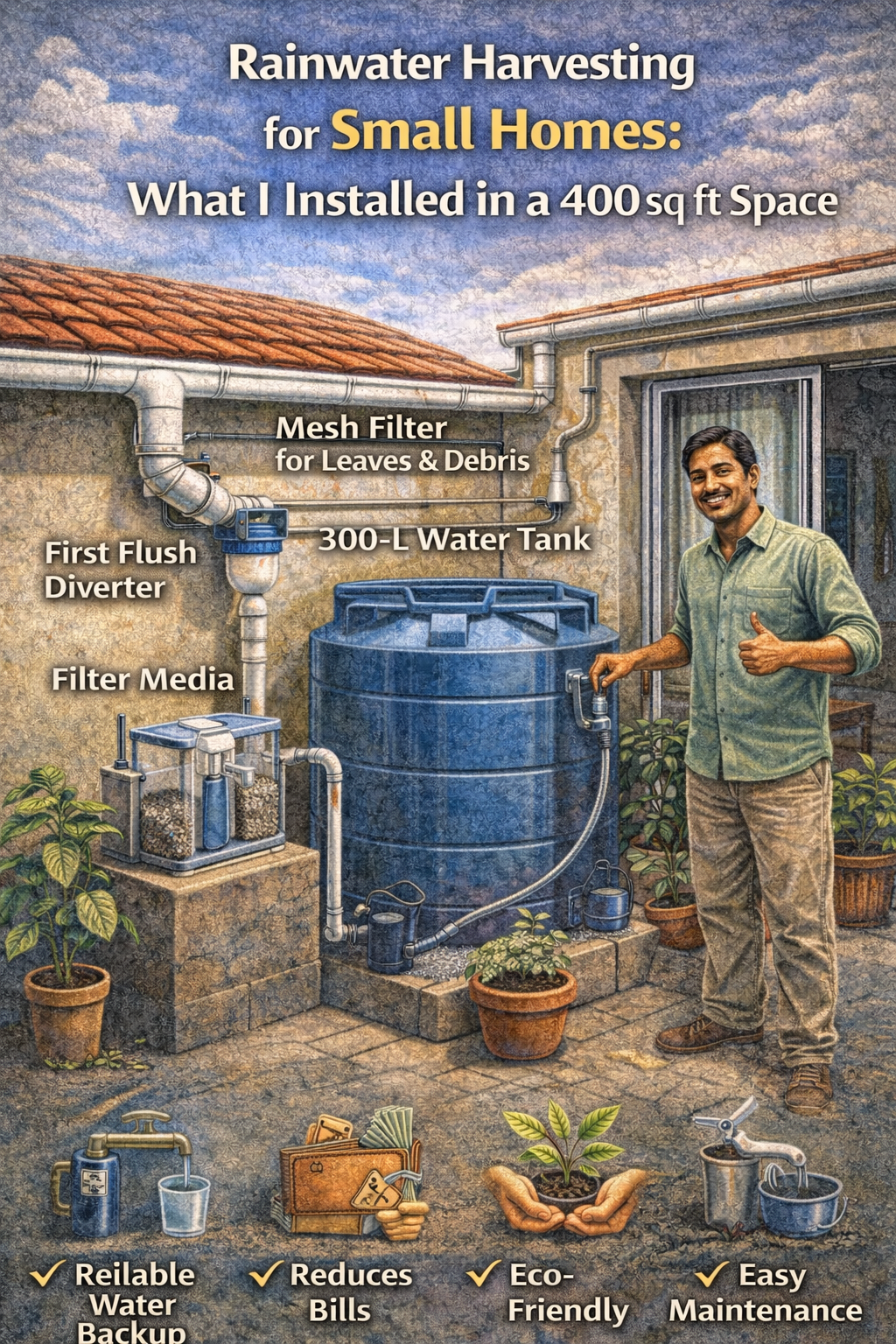
I live in a compact 400 sq ft home — and with help from Jalsanchay, I installed a smart, space-efficient rainwater harvesting (RWH) system that fits perfectly in small Indian houses.

This blog explains:

  • Exactly what I installed
  • Where I placed each component
  • How much it costs
  • How much water I now save
  • And how you can do the same even with limited space

Let’s make every small home water-independent.


🧩 Step 1: Measuring My Roof Area (400 sq ft Built-Up Space)

My home has:

  • Roof area: ~400 sq ft
  • Rainfall (Delhi/NCR average): 750 mm annually

Formula Used:
Rainwater (litres) = Roof area (sq ft) × 0.623 × Rainfall (mm)

Calculation:
400 × 0.623 × 750 ≈ 187,000 litres/year

Yes — my tiny roof can harvest up to 1.8 lakh litres annually.

Small homes have BIG potential when calculations are done right.


🪣 Step 2: Choosing the Right Storage (Because of Space Constraints)

My challenge → No space for a huge tank.

Solution by Jalsanchay:
👉 A 1,000-litre modular tank placed in the unused corner near the back wall.

Why modular tanks?

  • Compact
  • Stackable
  • Easy to hide
  • Great for small homes & rooftops

Result:
Fits in < 2 sq ft of ground area.


🌀 Step 3: Installing a First Rain Separator (Must for All Homes)

A first rain separator helps remove the dirty first 1–2 mm of rainfall.

My Setup:
A small PVC-based first flush chamber that:

  • Separates dirty first rain
  • Prevents dust/bird droppings from entering tank
  • Requires almost zero maintenance

Size: 5-litre chamber
Cost: Very low (₹300–₹600 depending on fittings)


🪨 Step 4: The Filter That Made the Biggest Difference

Space being small, I wanted something vertical.

Jalsanchay suggested a “Compact 3-Layer RWH Filter” with:

  • Pebble layer
  • Sand layer
  • Charcoal layer

Why it worked perfectly:

  • Takes only 1 sq ft area
  • Easy to open and clean
  • Efficient enough for rooftop water
  • Best for small Indian homes

Output water became clear within the first 5 minutes of rain.


🌍 Step 5: Creating a Groundwater Recharge Point

Since I didn’t have a big yard, we built a mini recharge shaft beside the house.

Size:

  • Diameter: 1 ft
  • Depth: 4–5 ft
  • Filled with stones + sand filter
  • PVC pipe connected from rooftop

This ensures:
✔ Zero water wastage
✔ All overflow water directly recharges groundwater
✔ No flooding even during heavy rainfall


💧 Final Layout of My 400 sq ft RWH System (Simple Breakdown)

ComponentSizeSpace UsedPurpose
Catchment (Rooftop)400 sq ftCollects rainwater
Modular storage tank1,000 litres<2 sq ftTemporary storage
First rain separator5 litresWall-mountedRemoves dirty first rain
3-layer compact filter1 sq ftBeside tankPurifies water
Recharge shaft1×5 ftCornerRecharges surplus water

Everything fits inside less than 5 sq ft of total ground space.

Perfect for:

  • Small homes
  • Basti areas
  • Village homes
  • Slum redevelopment areas
  • Tiny independent houses
  • 1-room/1-BHK homes
  • Rooftop flats

📉 Investment vs Savings

💰 Total Installation Cost:

₹8,000–₹15,000 (varies by city & fittings)

💧 Water Saved Annually:

Up to 1.8 lakh litres

⏳ ROI:

Recover cost within 1 monsoon season through reduced tanker dependency.


🌦️ How Much Rainwater I Actually Collected This Year

Monsoon data for Delhi/NCR this year (approx):
Total rainfall: 700 mm

My actual water collected (via tank + recharge):
1,50,000 litres

This covered:

  • Gardening
  • Toilet flushing
  • Washing floors
  • Drinking (after purification)
  • Washing vehicles

And tanker use reduced from 6 tankers/month → 1 tanker/month.

Massive savings.


🎯 Why Small Homes Benefit the Most From Rainwater Harvesting

  • Lower water storage needs
  • Faster ROI
  • Simple system
  • Low maintenance
  • High efficiency
  • Smaller rooftops = cleaner catchment

Small homes often become self-sufficient faster than big homes.


Key Takeaways (Snippet-Friendly)

Here’s what I installed in my 400 sq ft home:

  • 1,000-litre modular storage tank
  • Compact 3-layer RWH filter
  • First rain separator
  • Mini recharge shaft
  • PVC pipeline network

Space used: Less than 5 sq ft
Water saved: 1.5–1.8 lakh litres annually


📞 Want a Space-Saving RWH System for Your Home?

Contact Jalsanchay.

📞 Call / WhatsApp Jalsanchay: 9016465919
📧 Email: ask@jalsanchay.com
🌐 Website: jalsanchay.com

Whether your house is 200 sq ft, 400 sq ft, or 2,000 sq ft, Jalsanchay designs:

  • Low-cost rainwater harvesting
  • Compact systems for small homes
  • Groundwater recharge pits
  • Filtration units
  • Complete installation & support

👉 Call Jalsanchay: The Experts in Space-Efficient Rainwater Harvesting
We help you save every drop — even in the smallest home.


FAQs About RWH for Small Homes

1. Can rainwater harvesting work in a 400 sq ft home?

Yes — you can collect over 1 lakh litres annually.

2. Do I need a big tank?

No. Modular tanks or even 500-litre tanks work well.

3. What if I have no space on the ground?

Tanks can be placed on rooftops or corners.

4. Is filtration necessary?

Yes — even small homes need a basic filtration unit.

5. Can Jalsanchay install this for me?

Absolutely. We specialize in small-space RWH systems.