

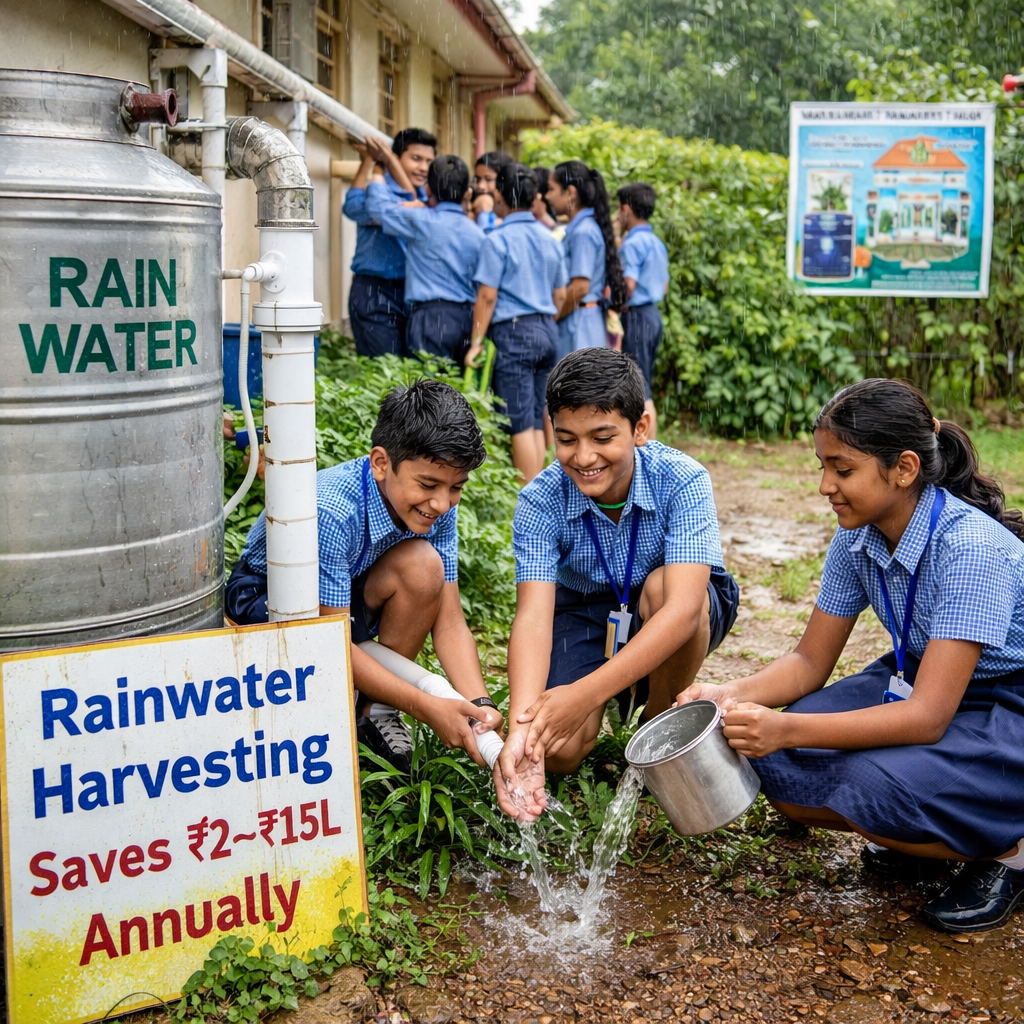

How Rainwater Harvesting For Schools Save ₹2–₹15L Annually.
Explain how Rainwater Harvesting For Schools can reduce water bills and tanker costs by ₹2–₹15L Annually, with practical steps, examples, and savings calculations.
🏫💧 How Schools Can Save Lakhs Every Year Using Rainwater Harvesting
Schools across India face a constant challenge:
high water bills, unreliable supply, and increasing tanker dependency.
A typical school in India uses 10,000–1,00,000 litres of water every day for:
- Toilets
- Handwashing
- Drinking water (after purification)
- Gardening
- Cleaning
- Cooking (mid-day meals)
When municipal supply fails, tanker costs shoot up:
💸 ₹30,000 to ₹3,00,000 per month
But here’s the good news:
👉 Schools can save lakhs every single year by installing Rainwater Harvesting (RWH).
This blog explains exactly how.
🌧️ Why Schools Are the BEST Places for Rainwater Harvesting
Schools have two major advantages:
1. Large Rooftops
Schools often have 1,000–20,000 sq ft rooftops → perfect catchment areas.
2. High Daily Water Demand
This means every drop harvested directly reduces tanker bills.
Even a 5,000 sq ft school roof can harvest:
💧 20–30 lakh litres per year (depending on rainfall)
That alone can cover up to 60–90% of a school’s total water needs.
📉 How Rainwater Harvesting Helps Schools Save Lakhs
Let’s break down the yearly savings:
1️⃣ Reduced Tanker Dependency (The Biggest Saving)
Example:
A medium-sized school using tankers spends:
- ₹1,000–₹2,000 per tanker
- 2–10 tankers per day in summer
- Yearly expense: ₹8–₹20 lakhs
With RWH:
✔ Tankers reduce by 50–90%
✔ Annual savings: ₹4–₹15 lakhs
2️⃣ Lower Borewell Electricity Costs
Pumping groundwater from deep borewells costs:
- High electricity
- Frequent motor repairs
- Unpredictable yield
RWH recharges borewells, increasing their output.
Result:
✔ Higher water availability
✔ Lower electricity costs
✔ Extended motor lifespan
Estimated savings: ₹50,000–₹2,00,000 per year
3️⃣ Free Supply of Soft, Low-TDS Water
Rainwater is naturally:
- Soft
- Low in minerals
- Ideal for washing, cleaning, gardening
This improves plumbing health and reduces maintenance.
Savings: ₹30,000–₹1,00,000 per year
4️⃣ Recharge Pits Reduce Flooding & Waterlogging
Schools often face:
- Playground flooding
- Basement seepage
- Building damage during monsoon
RWH recharge pits solve this.
Savings in maintenance: ₹50,000–₹3,00,000 per year
5️⃣ Long-Term Water Independence
Municipal supply fails?
Tanker strike?
Borewell dry?
No problem.
A school with RWH becomes water-secure for decades, not just seasons.
🌧️📊 Sample Savings: What a 5,000 sq ft School Can Save
Rainfall (Indian average): 800 mm
Catchable rain:
5,000 × 0.623 × 800 ≈ 24,92,000 litres per year
Estimated Realistic Savings
| Expense Type | Without RWH | With RWH | Savings |
|---|---|---|---|
| Tankers | ₹12,00,000 | ₹3,00,000 | ₹9,00,000 |
| Electricity | ₹1,50,000 | ₹80,000 | ₹70,000 |
| Maintenance | ₹1,00,000 | ₹50,000 | ₹50,000 |
| Flooding Repairs | ₹1,50,000 | ₹20,000 | ₹1,30,000 |
Total Savings:
👉 ₹11.5 lakh per year
One-time installation cost?
₹2–₹10 lakhs depending on school size.
ROI recovered within 3–6 months.
🛠️ What a Rainwater Harvesting System in a School Includes
A complete RWH setup for schools involves:
✔ Rooftop catchment
Large flat roofs channel rainwater efficiently.
✔ First rain separator
To remove initial dust and contaminants.
✔ Multi-layer filtration unit
Sand + charcoal + gravel layers.
✔ Storage tanks (5,000–50,000 litres)
Depending on consumption.
✔ Recharge pits or shafts
To revive groundwater.
✔ Network of downpipes & PVC channels
Connecting roof to filtration points.
✔ Overflow safety & maintenance access
Schools usually require big storage + big recharge, and both are fully feasible.
📝 Additional Benefits for Schools (Beyond Savings)
1. Helps School Meet CSR & Sustainability Ratings
Important for private schools and college campuses.
2. Helps Get Green Building Certification
RWH is a mandatory component.
3. Educational Opportunity for Students
Schools can teach students:
- Science of water
- Environmental responsibility
- Real sustainability in action
Students love visiting recharge pits and filter chambers — it becomes a living laboratory.
4. Community Reputation Boost
“Green School” branding attracts parents.
🌍 What Types of Schools Benefit the Most?
- CBSE / ICSE schools
- Private schools
- Government schools
- Colleges
- NGOs & Trust-run institutions
- Residential schools
- Hostels / campuses
Every school with a rooftop can implement it.
📞 Want Your School to Save Lakhs Every Year?
Contact Jalsanchay — India’s Trusted RWH Consultant.**
Jalsanchay provides end-to-end rainwater harvesting solutions for schools:
✔ Site evaluation
✔ Tailored system design
✔ Complete installation
✔ Borewell recharge planning
✔ Maintenance & annual servicing
✔ Low-cost, high-efficiency filtration units
We help schools harvest millions of litres every monsoon and become water-secure.
📲 Reach out to Jalsanchay today and turn your school into a water-efficient campus.
❓ FAQs: Rainwater Harvesting for Schools
1. How much water can a typical school harvest annually?
Anywhere between 5–50 lakh litres, depending on roof size.
2. Is rainwater safe for school use?
Yes — after proper filtration and purification.
3. How soon does the investment pay back?
Most schools recover their cost within one monsoon season.
4. Does RWH work for multi-floor school buildings?
Absolutely — rooftop systems are ideal.
5. Does Jalsanchay provide school-specific designs?
Yes, we specialize in large-roof, high-demand RWH systems.