












Web
Stories
Recent
Posts
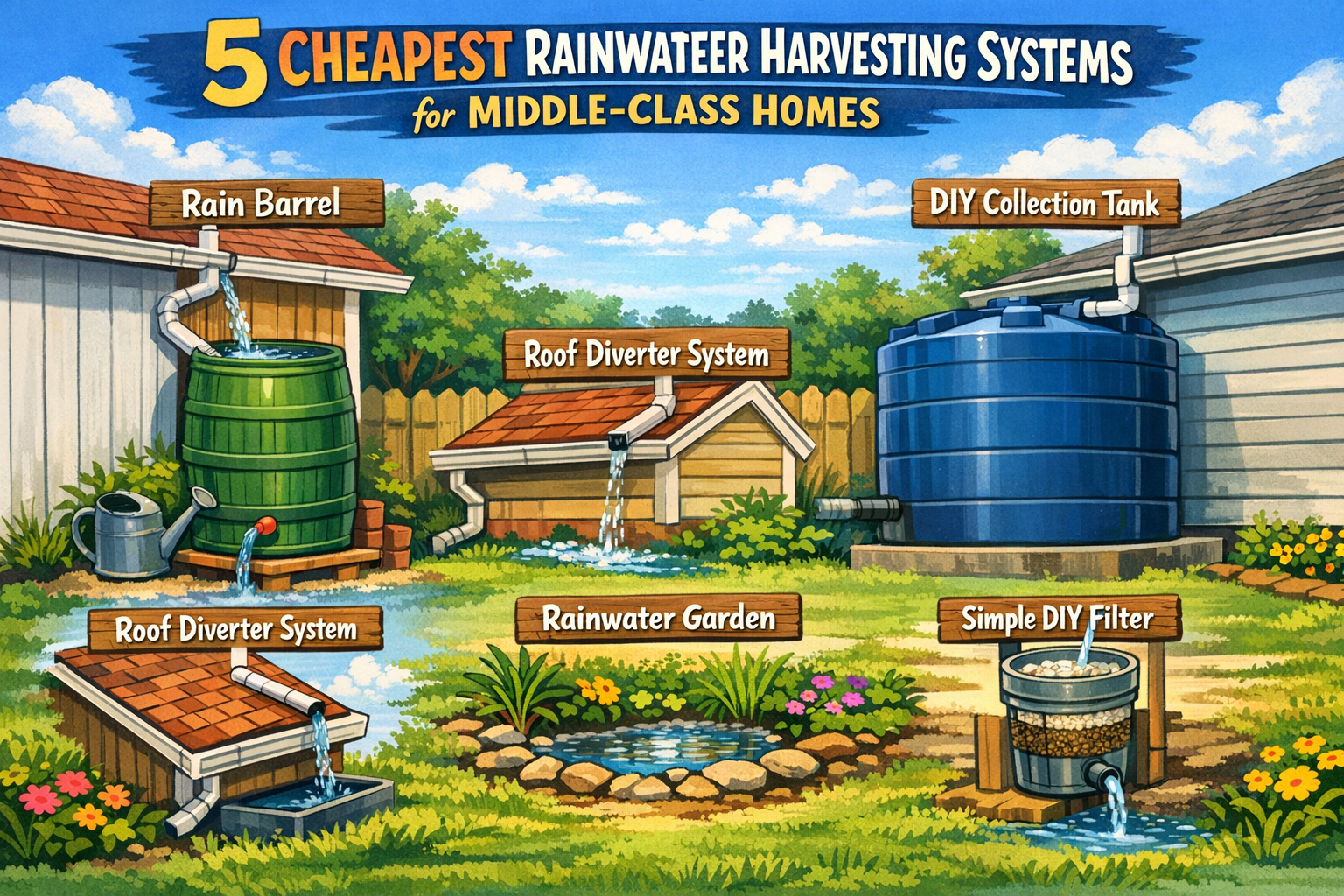

5 Cheapest Rainwater Harvesting Systems for Middle-Class Homes (Budget-Friendly Guide 2025)
For many middle-class Indian households, rising water bills and increasing water shortages make rainwater harvesting a smart, budget-friendly solution. But the biggest question is:
“Which rainwater harvesting system is the cheapest and most effective for my home?”
At Jalsanchay, a trusted rainwater harvesting consultant and service provider, we help families install cost-effective, efficient, and easy-to-maintain harvesting systems tailored for homes, apartments, and small residential plots.
This guide covers the 5 cheapest rainwater harvesting systems you can install without compromising on performance.
1. Rooftop Direct Storage System (Cheapest & Easiest)
Best for: Small homes with limited roof area
Approx. Budget: ₹5,000 – ₹15,000
This is the most basic and economical method where rainwater from your rooftop is filtered and stored directly in an existing or new water tank.
How it Works
- Rainwater flows through a downpipe
- Passes through a simple mesh filter or first flush
- Gets stored in a plastic/HDPE tank
Benefits
- Cheapest setup cost
- Easy to install & maintain
- Ideal for middle-class households
Why It’s Good for SEO Snippet:
This system has simple steps that Google/AI search prefers for direct answers.
2. Recharge Pit System (Low Cost, High Efficiency)
Best for: Houses suffering from low borewell yield
Approx. Budget: ₹12,000 – ₹25,000
A recharge pit allows rainwater to percolate into the ground, increasing groundwater levels.
Components
- 3–5 ft pit
- Brick jelly
- Pebbles & charcoal layers
- PVC piping
Benefits
- Improves borewell output
- Very low maintenance
- Long-term solution for water scarcity
Why Jalsanchay Recommends It
We specialize in designing pits based on soil, plot size, and water table depth ensuring maximum recharge.
3. Modular Rainwater Filters (Instant & Affordable)
Best for: Homes needing clean, usable non-potable water
Approx. Budget: ₹6,000 – ₹20,000
Modular filters are compact devices fitted to your downpipe to remove dust, leaves, and debris.
Benefits
- No civil work required
- Quick installation
- Suitable for washing, gardening, floor cleaning
SEO Tip:
“Modular rainwater filter price” is a high-volume keyword you can rank easily.
4. Recharge Borewell System (Highly Impactful, Moderate Cost)
Best for: Homes with existing borewells
Approx. Budget: ₹15,000 – ₹35,000
This system channels roof water directly into a borewell through filtration chambers.
Benefits
- Restores groundwater
- Helps maintain borewell water levels
- Works even in urban compact plots
AEO-Friendly Summary
A recharge borewell system routes clean roof water into the borewell to restore groundwater levels at a low cost.
5. Rain Barrel / Drum Storage System (Super Low Budget)
Best for: Families wanting ultra-cheap solutions
Approx. Budget: ₹2,500 – ₹10,000
Plastic barrels or drums can be connected to the roof drainage to collect water.
Benefits
- Most affordable option
- Zero structural changes
- Portable and easy
Best Use Cases
- Garden watering
- Cleaning purposes
- Emergency water storage
Comparison Table (Best for Google Snippets)
| System Type | Best For | Cost Range | Maintenance | Lifespan |
|---|---|---|---|---|
| Rooftop Direct Storage | Small homes | ₹5k–15k | Very Low | 10+ years |
| Recharge Pit | Borewell recharge | ₹12k–25k | Low | 20+ years |
| Modular Filter | Clean non-potable water | ₹6k–20k | Very Low | 8–10 years |
| Recharge Borewell | Groundwater boost | ₹15k–35k | Low | 15–20 years |
| Rain Barrels | Ultra budget use | ₹2.5k–10k | Very Low | 5–8 years |
How to Choose the Right Low-Cost System?
Choosing depends on:
- Roof area
- Water demand
- Soil type
- Existing borewell
- Budget
At Jalsanchay, we inspect your home and recommend the perfect system at minimum cost.
Benefits of Low-Cost Rainwater Harvesting for Middle-Class Families
- Reduces water bills
- Improves borewell output
- Prevents waterlogging
- Eco-friendly & sustainable
- Requires minimal maintenance
- 100% return on investment within 1–2 seasons
Rainwater Harvesting FAQs (AEO & Featured Snippet Optimized)
1. Which is the cheapest rainwater harvesting system for homes?
The rain barrel/drum system is the cheapest, starting at just ₹2,500–₹10,000.
2. How much does a basic rainwater harvesting setup cost in India?
A simple rooftop system costs between ₹5,000 and ₹20,000, depending on filter type and tank capacity.
3. Can middle-class homes afford rainwater harvesting?
Yes, most homes install budget systems under ₹10,000–25,000, making it very affordable.
4. Which system increases borewell water levels?
A recharge pit or recharge borewell system is best for improving groundwater.
5. How long does installation take?
Most systems are installed by Jalsanchay in 4–8 hours depending on complexity.
Final Thoughts
Rainwater harvesting doesn’t have to be expensive. With these five cheapest systems, every middle-class home can save water, reduce bills, and become self-reliant.
If you’re planning to install a budget-friendly rainwater harvesting system, Jalsanchay can help with:
✅ Site assessment
✅ System design
✅ Low-cost installation
✅ Maintenance & support
Contact Jalsanchay
📞 Call/WhatsApp: 9016465919
🌐 Website: jalsanchay.com
📧 Email: ask@jalsanchay.com
👉 For any help in selecting or installing a low-cost rainwater harvesting system, contact Jalsanchay today.

How Rainwater Harvesting Helps in Reducing Global Warming
Rainwater Harvesting Helps in Reducing Global Warming by lowering energy-intensive water pumping, cutting carbon emissions, improving soil moisture, supporting groundwater recharge, increasing green cover, and reducing urban flooding and heat. By capturing rain where it falls, RWH minimizes dependence on fossil-fuel-powered water supply systems and creates cooler, greener environments.
Water Crisis and Climate Crisis Are Connected
When people talk about global warming, they rarely think about water.
But in reality, water and climate change are deeply linked.
- More heat → more evaporation
- More evaporation → less groundwater
- Less groundwater → more pumping
- More pumping → more electricity
- More electricity → more carbon emissions
This vicious cycle speeds up global warming.
Rainwater Harvesting (RWH) is one of the simplest and most powerful tools to break this cycle — and surprisingly, very few people know how big its impact really is.
At Jalsanchay, we explain to homeowners, societies, corporates, and farmers that RWH is not just a water-saving solution…
👉 It is a climate solution.
Let’s understand how.
1️⃣ RWH Reduces Electricity Use — and Thus Carbon Emissions
Did you know?
Pumping groundwater is one of the biggest sources of energy consumption in India.
Farm pumps
Society borewells
Industrial pumps
Municipality pumping stations
All run on electricity or diesel.
When we harvest rainwater:
- Groundwater dependence reduces
- Pumping hours drop
- Electricity consumption decreases
- CO₂ emissions come down
✔ Example Calculation
Pumping 10,000 litres of groundwater uses approx 3–4 units of electricity.
If a society harvests 10 lakh litres annually, they reduce up to:
👉 3,000–4,000 electricity units
👉 Equivalent to planting 150–200 trees
Rainwater = less pumping = less carbon = less global warming.
2️⃣ RWH Reduces Urban Heat by Recharging Soil Moisture
Dry land heats up faster.
Moist soil stays cooler.
RWH systems:
- Recharge groundwater
- Maintain soil moisture
- Reduce heat absorption
- Lower surrounding temperature by 1–3°C
- Prevent heat islands in cities
Cities like Delhi, Mumbai, Bengaluru and Pune experience extreme heat partly because:
✔ Groundwater is depleted
✔ Soil is dry
✔ Concrete retains heat
Rainwater harvesting reverses this effect naturally.
3️⃣ RWH Increases Greenery — Which Absorbs CO₂
Plants grow better with rainwater because it is:
- Soft
- Low in minerals
- Free from chlorine
When homes, farms, and societies store rainwater:
- Plantation projects increase
- Green belts revive
- Trees grow stronger
- Air quality improves
- CO₂ absorption rises
Small Rainwater Harvesting → Big Environmental Benefits
1 roof = thousands of litres = greener surroundings.
4️⃣ RWH Reduces Flooding and Soil Erosion (Both Linked to Climate Change)
Extreme rainfall events are rising due to global warming.
But uncontrolled runoff causes:
- Flooding
- Soil erosion
- Topsoil loss
- Sedimentation in rivers
- Destruction of crops
Farm ponds, recharge pits, contour trenches, and rooftop systems created by Jalsanchay control runoff and store it safely.
This reduces pressure on natural systems and stabilizes local climate conditions.
5️⃣ RWH Reduces Dependence on Tankers — A Big CO₂ Source
Water tankers burn massive amounts of diesel.
One tanker trip = 3–6 kg of CO₂ released into the air.
If a society or industry installs RWH:
👉 Tanker trips reduce
👉 Diesel consumption drops
👉 Air pollution decreases
👉 Carbon emissions fall
This has a direct impact on global warming.
6️⃣ RWH Helps Recharge Groundwater — Nature’s Own Climate Buffer
Groundwater behaves like a natural climate defense system.
When aquifers are full:
- Wells stay stable
- Soil retains moisture
- Streams flow longer
- Plants survive heat waves
- Local climate becomes cooler
Rainwater harvesting strengthens this natural protection.
7️⃣ RWH Converts Rooftops and Open Land Into Climate Protectors
Every rooftop in India is a missed climate opportunity.
A 1,000 sq ft roof can capture 25,000–60,000 litres of water annually.
If 1 crore Indian homes harvest rainwater:
💧 25,000 crore litres saved
💨 Millions of units of electricity saved
🌱 Huge reduction in CO₂ emissions
🔥 Lower urban heat
This is why global climate experts call RWH:
“The simplest climate action that anyone can start today.”
Why Jalsanchay’s RWH Solutions Make Climate Impact Stronger
At Jalsanchay, we design RWH systems for:
✔ Homes
✔ Apartments
✔ Schools
✔ Industries
✔ Farmlands
✔ Commercial buildings
✔ Village communities
Our systems maximize:
- Ground recharge
- Water storage
- Energy savings
- Soil cooling
- Greenery growth
Because better design = better climate benefits.
Conclusion: Rainwater Harvesting Is a Climate Action You Can Start Today
You don’t need massive investments…
You don’t need expensive technology…
You just need to store the rain that already falls on your roof or land.
Rainwater harvesting:
🌍 Reduces carbon
🌿 Increases greenery
💧 Saves water
🔥 Lowers heat
⚡ Cuts electricity
🏙 Improves city climate
Few actions offer this many environmental benefits at such a low cost.
**📞 Want to Make Your Home or Building Climate-Friendly?
Contact Jalsanchay Today**
Jalsanchay provides:
✔ Complete RWH consultation
✔ Custom system design
✔ Farm, home & society RWH solutions
✔ Groundwater recharge structures
✔ Maintenance & audits
✔ Budget-friendly, high-impact systems
Whether you want to lower your water bills or reduce your carbon footprint —
Jalsanchay is your trusted rainwater partner.

How Cities Like Bengaluru and Chennai Are Combating Urban Water Crisis with Rainwater Harvesting (RWH)
Urban water crisis has hit Bengaluru and Chennai — two of India’s fastest-growing cities — causing them to face one of the worst shortages in recent decades. Rapid urbanization, shrinking lakes, erratic monsoons, and over-extraction of groundwater have pushed both cities to the edge.
But both cities are also proving that rainwater harvesting (RWH) is not just an eco-friendly idea — it is a survival strategy.
This blog explains how Bengaluru and Chennai are fighting the water crisis through large-scale RWH adoption, government policies, community movements, and successful city-wide models that other Indian cities can copy.
🌆 Why We Are Facing Urban Water Crisis
1. Overdependence on external water sources
- Bengaluru: 60% water comes from the Cauvery River
- Chennai: Highly dependent on distant reservoirs & tankers
2. Vanishing lakes
- Bengaluru once had 262 lakes; less than 80 remain functional
- Chennai lost over 50% of its natural water bodies in 30 years
3. Groundwater depletion
Both cities have areas where groundwater levels dropped to 1,000+ feet.
4. Unpredictable rainfall patterns
Heavy rainfall but short duration → poor natural recharge.
🌧️🌆 How Bengaluru Is Combating the Water Crisis with Rainwater Harvesting
1. Mandatory RWH Laws
Bengaluru’s RWH mandate (BBMP & BWSSB) requires:
- Every building above 60×40 ft plot must install RWH.
- New constructions must include rooftop + recharge pits.
This law pushed over 2.5 lakh households to adopt rainwater harvesting.
2. Apartment-Level RWH Revolution
Large apartment complexes now install:
- Rooftop RWH tanks
- Recharge wells
- Stormwater diversion systems
Many apartments report:
➡ Reduction of tanker use by 50–70%
➡ Reduction in maintenance costs
➡ Year-round water availability
3. Revival of Bengaluru Lakes Through RWH
Citizen groups like Jal Mitra, Namma Lake, and Paani Panchayat work with BBMP to:
- Desilt lakes
- Create recharge wells
- Install percolation trenches
- Reconnect natural stormwater channels
Examples:
- Kaikondrahalli Lake
- Puttenahalli Lake
- Jakkur Lake
These lakes now recharge millions of liters into groundwater every monsoon.
4. The “Recharge Wells” Bengaluru Model
Bengaluru is the only Indian city with a community-driven “Million Wells Campaign”, reviving the ancient tradition of Mannuvaddars (well diggers).
Over 30,000 recharge wells were dug, significantly improving groundwater levels in areas like:
- Koramangala
- Whitefield
- Indiranagar
- Malleshwaram
🌧️🌇 How Chennai Is Combating the Water Crisis with Rainwater Harvesting
1. The Most Successful RWH Law in India (Tamil Nadu 2003 Act)
Tamil Nadu was the first state in India to make RWH compulsory for all buildings.
Result?
Chennai’s groundwater levels rose by 50% in just six years.
This is considered India’s most successful water management story.
2. Chennai’s Rooftop RWH Model
Buildings are required to:
- Channel rooftop water into underground tanks
- Install percolation pits & recharge wells
Many homes store 20,000–50,000 liters per monsoon.
3. Restoration of Temple Tanks & Lakes
Chennai revived dozens of ancient water bodies like:
- Mylapore Tank
- Madhavaram Lake
- Villivakkam Lake
These act as massive natural recharge structures.
4. Community-Led RWH Projects
Residents Welfare Associations across:
- Anna Nagar
- Velachery
- Tambaram
- Porur
…have built shared community RWH systems that provide free water for:
- Gardening
- Cleaning
- Recharge
- Drinking (after filtration)
⚖️ Bengaluru vs Chennai: A Quick Comparison
| Feature | Bengaluru Model | Chennai Model |
|---|---|---|
| Mandate Year | 2009 | 2003 |
| RWH Style | Recharge wells + Rooftop | Rooftop + Community Tanks |
| Success Rate | High in apartments | Highest in India |
| Key Challenge | Unplanned growth | Frequent drought cycles |
| Unique Feature | Million Wells Campaign | Recharged ancient temple tanks |
💧 How Rainwater Harvesting Helps Cities Solve Water Crises
✔ Boosts groundwater levels
✔ Reduces dependency on tankers
✔ Cuts water bills
✔ Prevents flooding (excess rain is redirected into earth)
✔ Increases water security for future generations
✔ Supports sustainable urban development
🧰 How Citizens Can Contribute (Simple Steps)
🏡 For Homeowners
- Install a rooftop RWH system (₹8,000–₹40,000).
- Create a 3×3 ft recharge pit.
- Maintain filters & mesh screens.
🏢 For Apartments
- Build a common storage tank (10,000–50,000 liters).
- Divert terrace water into recharge wells.
- Monitor water quality every 6 months.
🏙️ For Communities
- Revive lakes & ponds.
- Adopt stormwater recharge programs.
- Support local RWH volunteers & NGOs.
🧩 FAQs
❓ How is Bengaluru solving its water crisis?
Bengaluru solves its water crisis through mandatory RWH laws, widespread recharge wells, apartment-level systems, and large-scale lake revival projects.
❓ How is Chennai combating water shortage?
Chennai uses the strongest RWH mandate in India, rooftop RWH systems in almost every building, revival of temple tanks, and community rainwater programs.
❓ Which Indian city has the best rainwater harvesting model?
Chennai is widely considered the most successful city due to the 2003 mandatory RWH law and significant groundwater recovery.
❓ Does rainwater harvesting reduce tanker dependence?
Yes. Most apartments report a 50–70% reduction in tanker usage after installing proper RWH systems.
🏁 Conclusion
Bengaluru and Chennai prove that rainwater harvesting is not optional — it is essential for urban survival in India. Their models show that with the right policies, community participation, and consistent maintenance, any city can overcome water scarcity.
Whether you are a homeowner, builder, RWA member, policymaker, or citizen —
you have the power to contribute to water security starting today.