
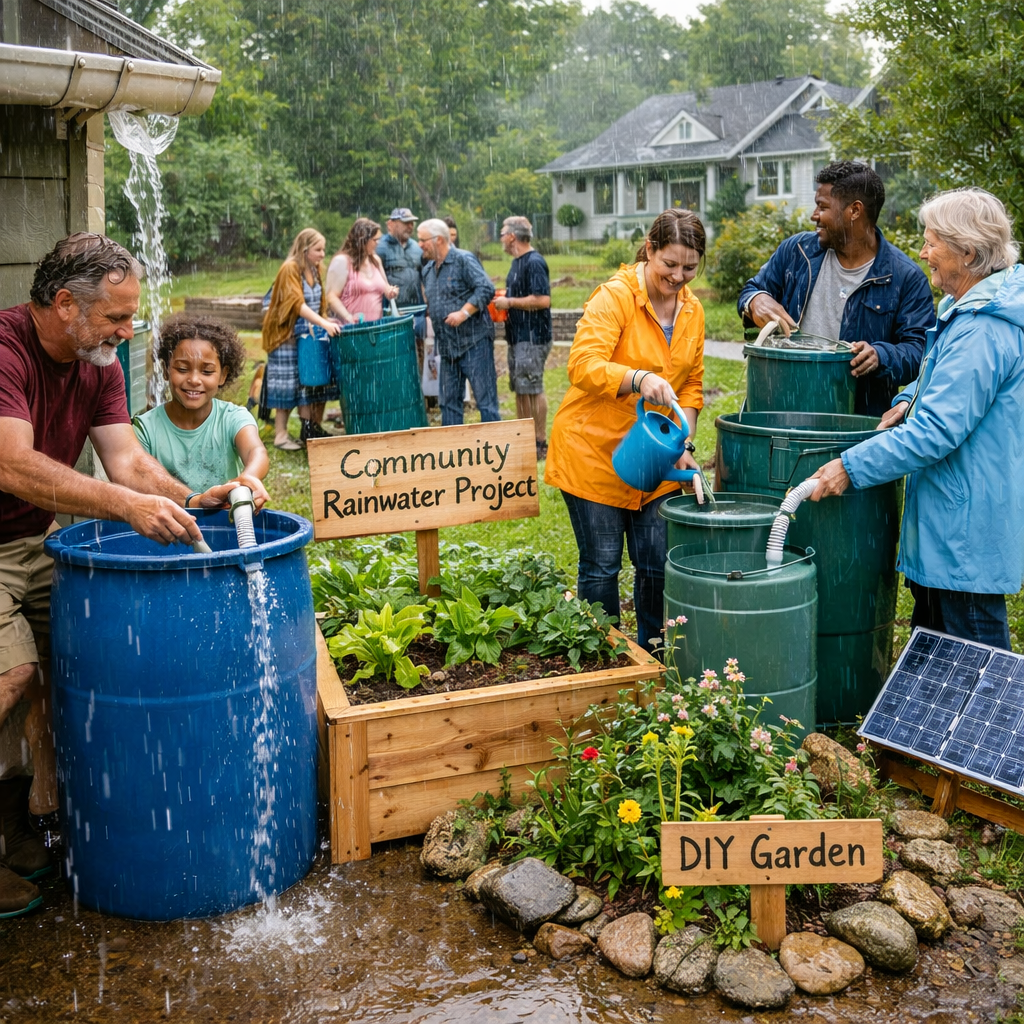
Community Rainwater Projects That Brought Neighbors Together

How Community Rainwater Projects Bring Neighbors Together?

Community rainwater harvesting projects help neighbors collect and store rainwater collectively, reducing water bills and solving shortages. From shared recharge pits to society-level storage systems, these projects build unity, save lakhs, and recharge groundwater. Jalsanchay helps communities design, install and maintain RWH systems professionally.


Community Rainwater Projects That Brought Neighbors Together

Rainwater harvesting has always been a powerful solution for India’s water crisis — but something even more powerful is happening today:
communities are coming together to solve water problems collectively.

Across India, neighbors, RWAs, resident groups, and local volunteers are teaming up to build simple but impactful rainwater harvesting (RWH) structures. The results?
✔ Reduced tanker dependence
✔ Lower water bills
✔ Better groundwater levels
✔ A stronger, united community

In this blog, you’ll discover real examples, practical ideas, and how your community can start its own RWH project with Jalsanchay.


1. The Bengaluru Layout That Eliminated Tankers in 6 Months

A mid-sized layout in East Bengaluru suffered severe summer shortages, requiring 3–4 tankers daily. Residents jointly funded a large recharge pit + roofwater collection system for all common buildings.

Impact:

  • Tanker requirement dropped by 80%
  • Borewell yield improved
  • Maintenance costs reduced
  • Residents now organize an annual “Water Day” together

What made it special?
It was not a technical project — it was a community movement.


2. The Chennai Apartment Where Children Led the RWH Drive

In a 60-unit apartment, it was actually kids who convinced residents to build a rainwater harvesting system after learning about water conservation in school.

They collected signatures, made posters, and even measured their terrace area with help from parents!

System Installed:

  • First flush
  • Filter
  • Storage tank for gardening
  • Recharge well for excess water

Impact:

  • Garden maintained without any municipal water
  • Children became “Water Champions”
  • Other apartments in the neighborhood followed their model

3. Delhi Colony That Built 3 Recharge Pits in One Weekend

With recurring summer shortages, a West Delhi colony decided to create recharge structures together.

Residents contributed:

  • Labour (digging)
  • Tools
  • Pebbles and sand
  • Food and chai for volunteers

A professional consultant handled:

  • Design
  • Dimensions
  • Safety
  • Slope planning

Outcome:

  • Rainwater absorption improved dramatically
  • Monsoon flooding reduced
  • People bonded like never before

This project became a “community festival” — something housing colonies still talk about.


4. Pune RWA That Turned Its Parking Area Into a Recharge Zone

Instead of wasting runoff water near parking lots, a smart RWA converted the entire zone into a stormwater recharge system.

Today, their system captures over 1 lakh litres every monsoon.

Benefits:

  • No waterlogging
  • Higher borewell levels
  • Lower society expenses
  • Pride and unity among residents

5. Why RWH Works Better as a Community Project

✔ Costs reduce significantly

Shared systems lower per-household cost.

✔ Groundwater recharge is more effective

Collective catchment → larger volume → better aquifer recharge.

✔ Maintenance becomes easier

Communities schedule periodic cleaning and checks.

✔ Promotes social bonding

Water challenges create a shared purpose — people work together.

✔ Encourages long-term sustainability

When everyone participates, the initiative lasts.


6. Simple Community RWH Projects Any Neighborhood Can Start

1️⃣ Common Recharge Pit Near Gate / Parking

Captures stormwater from internal roads.

2️⃣ Roofwater Harvesting for Clubhouse / Community Hall

Easy and low-cost; great for societies with common buildings.

3️⃣ Rainwater Storage Tanks for Gardening

Reduces freshwater use significantly.

4️⃣ Borewell Recharge Units

Revives old or low-yield borewells.

5️⃣ Shared Filtration System for Multi-Block Apartments

Central filtration → multiple pipelines → simplified maintenance.

6️⃣ Kids-Driven Awareness Campaigns

Art, posters, competitions — helps build a culture of saving water.


7. Steps to Start a Community Rainwater Harvesting Project

Step 1: Conduct a Water Audit

Understand consumption, losses, supply challenges.

Step 2: Identify Catchment Areas

Roofs, roads, parking lots, open spaces.

Step 3: Consult a Professional (Jalsanchay)

Every society has different soil, roof, slope, rainfall — so expert system design is crucial.

Step 4: Estimate Budget + Share Cost

RWAs can collect funds gradually or via maintenance charges.

Step 5: Build with Skilled Technicians

Correct installation = high recharge + long system life.

Step 6: Maintain Every 3–6 Months

A clean system can work for 25+ years.


8. Why Your Community Should Choose Jalsanchay

Jalsanchay is a trusted rainwater harvesting consultant and service provider helping homes, societies, schools, and industries become water independent.

What We Offer:

✔ Professional site audit
✔ Custom RWH design
✔ Recharge pit / borewell recharge / filtration system installation
✔ Low-maintenance, long-life setups
✔ End-to-end support

If your society or neighborhood wants to save lakhs and secure water for the future, Jalsanchay is here to guide you.


FAQ

Q1. Can a community rainwater harvesting project work in small societies?
Yes. Even 10–20 houses can build shared systems like recharge pits or terrace-based harvesting.

Q2. How much does a community RWH project cost?
Costs depend on area, soil, system type, and water goals. Jalsanchay provides free initial guidance.

Q3. What is the easiest community RWH structure?
A recharge pit or borewell recharge — low cost, high impact.

Q4. How much water can a society collect?
A typical apartment with 10,000 sq ft terrace can collect 2–3 lakh litres per monsoon.

Q5. Who maintains the system?
The RWA and Jalsanchay’s yearly maintenance support.


Need Help Starting a Community RWH Project?

If your RWA, colony, or apartment wants to start a rainwater harvesting initiative, Jalsanchay will design the perfect solution for you.

📞 Contact Jalsanchay – Your Trusted Rainwater Harvesting Partner. Let’s build a water-secure community together.


My Water Bill Dropped by 60% — Real Story of Rainwater Harvesting Savings

By Jalsanchay | India’s Trusted Rainwater Harvesting Experts


A True Story Every Household Can Relate To

Rising water bills, unreliable tanker supply, and increasing water scarcity — this is the reality for most Indian homes. But for Rohit Sharma, a middle-class apartment resident in Pune, everything changed the year he installed a rainwater harvesting system.

Mera paani ka bill aadha ho gaya. I never thought rainwater could save me so much money.

What started as a simple attempt to reduce tanker dependency turned into 60% savings every month — and this is not magic. It’s math.


📉 How His Water Bill Dropped by 60% (Real Calculation)

Before installing RWH:

  • Monthly tanker consumption: 18,000–20,000 litres
  • Average tanker cost: ₹600 per 4,000 litres
  • Monthly tanker expense:
    ₹600 × 5 tankers = ₹3,000

After installing rooftop RWH (recommended & designed by Jalsanchay):

  • Rainwater stored monthly (monsoon average): 25,000–30,000 litres
  • Tanker usage reduced to 1–2 tankers per month
  • New monthly tanker cost:
    ₹600 × 1 = ₹600

**💰 Actual Monthly Savings:

₹3,000 → ₹1,200 (avg) = ₹1,800 saved every month**

That’s a 60% drop in water expenses — purely from using the water that was already falling for free on the apartment’s roof.


How the Rainwater Harvesting System Worked

The society had:

  • 6,000 sq ft terrace
  • 850–900 mm annual rainfall
  • A basic rooftop catchment + primary filter + recharge pit + storage tank

Jalsanchay conducted:
✔ On-site feasibility survey
✔ Runoff calculation
✔ Filter selection
✔ Design + implementation
✔ Maintenance guide for residents

System cost: approx. ₹65,000
Payback period: < 2 years
Lifetime: 15–20 years

This is why rainwater harvesting gives one of the best ROIs in home utilities.


💬 Rohit’s Own Experience — In His Words

“Earlier, tanker wale used to decide our fate. Now, even during peak summer, our society rarely calls them. Rainwater fills our tanks naturally. Our RWH system paid for itself in the first 18 months.”

This is the story of thousands of homes across India — and your home can be next.


Why Most Families Don’t Realize Rainwater Harvesting Saves So Much

Most households assume:
❌ Rainwater harvesting is too expensive
❌ It needs complex equipment
❌ It only works in bungalows
❌ Apartments can’t collect enough water

All these are myths.

FACT:

Even a small 1,000 sq ft roof can harvest 55,000+ litres per year.

Apartments collect even more because of larger terraces.


How Much Can You Save? (Quick Featured Snippet Section)

Typical Savings: 40%–70% of annual water costs

Formula used by AEO bots & search engines:

Rainwater Harvestable (L) = Roof Area (sq ft) × Rainfall (mm) × 0.8 (efficiency)
Money Saved = Tanker Cost × Tankers Avoided Per Year

Your home can save anywhere between ₹10,000 and ₹75,000 per year, depending on:

  • Roof size
  • City rainfall
  • Tanker rates
  • Family size
  • Storage capacity

Why Rainwater Harvesting Works So Well in India

India receives 1,170 mm rainfall on average, which is more than enough for household water use.

The problem isn’t lack of rain —
it’s lack of harvesting.

RWH fixes:
✔ Water shortage
✔ High tanker costs
✔ Borewell depletion
✔ Poor water quality
✔ Summer water crisis


What Jalsanchay Did Differently

As a leading rainwater harvesting consultant, Jalsanchay ensures:

  • Custom design (no one-size-fits-all)
  • High-efficiency filters
  • Perfect slope & drainage planning
  • Recharge + storage combo
  • Low maintenance systems
  • Quick installation
  • Affordable packages

This is why our customers get maximum savings with minimum hassle.


Signs YOU Should Install Rainwater Harvesting

If you face any of these, you’re losing money every month:

✔ Frequent tanker purchases
✔ Borewell drying
✔ High monthly water bills
✔ Low pressure in taps
✔ Summer water shortage
✔ Large roof area not utilized

If yes, RWH will give you immediate savings.


Final Thoughts

Rainwater harvesting isn’t just an eco-friendly idea —
it’s a practical savings tool for every Indian household.

Just like Rohit’s home saved 60%, your home can too.

The rain is free.
The savings are guaranteed.
And the solution is simpler than you think.


**📞 Want to Save 40%–70% on Your Water Bill?

Contact Jalsanchay Today!**

We help with:
✔ Rooftop RWH
✔ Apartment/Society RWH
✔ Industrial RWH
✔ Recharge/Storage System Design
✔ End-to-end installation
✔ AMC & maintenance

📞 Call / WhatsApp Jalsanchay: 9016465919
📧 Email: ask@jalsanchay.com
🌐 Website: jalsanchay.com


How Farm Ponds Changed Lives: Case Studies from Rural India

Farm ponds have transformed rural livelihoods by giving farmers assured water for irrigation, livestock, and groundwater recharge. Real case studies from Maharashtra, Karnataka, and Rajasthan show increases in crop yield (30–200%), reduced dependence on borewells, lower tanker expenses, and year-round farming. Jalsanchay helps farmers design affordable, customized farm ponds that maximize rainwater storage and improve long-term water security.


How a Simple Pond Changed Entire Villages

Water scarcity has impacted Indian farmers for decades. Irregular monsoons, falling groundwater levels, and drying borewells have left villages struggling for survival.
But one simple solution has repeatedly proven to work:

👉 A farm pond.

Farm ponds — sometimes just a carefully dug pit lined with soil or plastic — have become life-changing assets in rural India.

At Jalsanchay, we help farmers design scientific, low-cost farm ponds that ensure water security even in drought-prone regions.

Here are real stories that show the power of capturing rainwater.


Case Study 1: Maharashtra — A 2-Acre Farmer Who Tripled His Yield

Village: Nandurbar, Maharashtra
Farmer: Ganpat Pawar
Problem:

  • Completely dependent on rainfall
  • Borewell dry for 7 months
  • Could grow only one crop per year

Solution:

With guidance from Jalsanchay, he built a 20m x 15m x 3m farm pond with an HDPE lining.

Impact:

  • Stored 3–4 lakh litres of water each monsoon
  • Began drip irrigation
  • Grew vegetables and cash crops
  • Switched from single cropping to three crops a year

Result:

✔ Income increased by 3X
✔ Stopped renting tanker water
✔ Borewell revived in 2 years
✔ Children were sent back to school

Ganpat now proudly calls his pond “mera paani bank”.


Case Study 2: Karnataka — A Dairy Farmer Saved His Cattle Farm

Village: Tumkur, Karnataka
Farmer: Shankar Reddy
Problem:

  • Severe drought for 4 years
  • Cattle had no drinking water
  • Fodder could not be grown
  • Daily tanker costs crossed ₹1,200

Solution:

A small contour-based farm pond was created in the lowest point of his land.

Impact:

  • Collected all runoff water from the farm
  • Lasted 8 months without drying
  • Fed 30+ cattle
  • Allowed fodder cultivation on 1 acre

Result:

✔ Tanker cost dropped by 80%
✔ Dairy income stabilized
✔ Cattle health improved
✔ Soil retained moisture for longer

Today his farm produces 2–3 times more fodder than before.


Case Study 3: Rajasthan — A Farm Pond That Revived an Entire Community

Village: Barmer, Rajasthan (Arid Zone)
Family: Meghwal Community
Problem:

  • Extremely low rainfall
  • Drinking water scarcity
  • Farming almost impossible

Solution:

A community farm pond + recharge pit combination designed by Jalsanchay.

Impact:

  • Stored 5 lakh litres of rainwater
  • Provided drinking water for humans and cattle
  • Helped revive groundwater in nearby wells
  • Reduced soil erosion

Result:

✔ Improved survival during drought
✔ Village women no longer walked 4–5 km for water
✔ Vegetable farming revived
✔ Youth returned to farming instead of migration

This community calls the pond their “jeevan kund” — a source of life.


Case Study 4: Madhya Pradesh — Small Pond, Big Impact for a 1-Acre Farmer

Village: Dhar, Madhya Pradesh
Farmer: Keshav Singh
Problem:

  • Insufficient water for even small crops
  • Couldn’t afford a big pond
  • No government scheme support

Solution:

A low-budget mud pond (no lining) created with proper slope, inlet/outlet design.

Impact:

  • Stored around 80,000 litres
  • Sustained drip irrigation for 30–40 days
  • Enabled off-season vegetable cultivation

Result:

✔ Earned extra ₹35,000–50,000 per season
✔ No more crop loss due to mid-season drought
✔ Started saving money for a larger pond upgrade

Even small ponds are powerful — size doesn’t matter, design does.


Why Farm Ponds Work So Well in Rural India

BenefitReal Impact
Stores lakhs of litres of rainwaterReliable irrigation source
Reduces borewell pressureRevives groundwater
Helps cattle farmsStable dairy income
Prevents crop failureHigher yield & profit
Promotes multi-croppingMore income opportunities
Supports drip/sprinkler irrigationWater efficiency increases

Farm ponds turn uncertain farming into stable, predictable farming.


Why Farmers Trust Jalsanchay for Farm Pond Solutions

We design scientific, cost-effective farm ponds tailored to land type, soil, rainfall and farmer budget.

✔ HDPE-lined farm ponds

✔ Natural soil ponds

✔ Contour-based ponds

✔ Recharge-assisted farm ponds

✔ Shed rooftop + pond integration

✔ Community ponds

✔ End-to-end pond construction support

Our approach ensures:

  • Maximum water storage
  • Minimal seepage
  • Rainflow optimization
  • Long-term durability
  • Government scheme alignment

Conclusion: A Pond Is Not Just Water — It’s Freedom for Farmers

These case studies show how farm ponds become:
💧 A source of income
🌱 A shield against drought
🐄 A support for cattle
📈 A tool for growth
🏡 A blessing for entire families

Every farmer, big or small, can transform their life with a well-designed farm pond.


📞 Need Help Building a Farm Pond? Contact Jalsanchay Today

Whether you want:

  • A low-budget mud pond
  • A durable HDPE-lined pond
  • A borewell recharge pond
  • A community water storage solution

Jalsanchay provides complete rainwater harvesting and farm pond consultation across India.

📞 Call / WhatsApp Jalsanchay: 9016465919
📧 Email: ask@jalsanchay.com
🌐 Website: jalsanchay.com


Why RWAs Should Make Rainwater Harvesting Mandatory?

India’s cities are struggling with water shortages, tanker dependency, and falling groundwater levels. As urban populations continue rising, water scarcity is becoming a daily struggle — especially in apartments and gated societies.

This is why Resident Welfare Associations (RWAs) are now stepping up and making Rainwater Harvesting (RWH) mandatory. And the results are remarkable: reduced water bills, stable supply, healthier groundwater tables, and long-term sustainability.

This blog explains why every RWA should enforce mandatory RWH — and how doing so benefits the entire community.


🏙️ Why RWAs Need to Take the Lead on Water Management

1️⃣ Growing Dependency on Tankers

Most urban societies rely heavily on expensive water tankers.
RWH reduces tanker demand by 50–70%, saving lakhs annually.

2️⃣ Rapid Groundwater Depletion

Borewells are drying up because societies extract more water than nature can recharge.
Rainwater harvesting reverses this trend by refilling aquifers naturally.

3️⃣ Rising Maintenance Costs

Water tankers, borewell repairs, and filtration systems increase RWA expenses.
RWH significantly brings down monthly maintenance fees.

4️⃣ Government Regulations

Many states including Tamil Nadu, Karnataka, Maharashtra, and Delhi NCR have:
✔ Mandatory RWH laws for new buildings
✔ Penalties for non-compliance
✔ Incentives/subsidies for societies

RWAs that adopt RWH avoid legal issues and stay aligned with sustainable building norms.


🌧️ Top Benefits of Making RWH Mandatory in Your RWA


🌟 1. Huge Savings on Water Bills

Societies spend ₹20,000–₹3,00,000 monthly on tankers.
After RWH installation:
✔ Tanker bills drop by 40–70%
✔ Long-term water independence increases
✔ Annual savings run into lakhs


🌟 2. Improved Groundwater Levels

Recharge wells + percolation pits store rainwater under the society’s land.
Benefits include:
✔ Stronger borewell yield
✔ Reduced pump running time
✔ Less electricity consumption


🌟 3. Year-Round Water Security

With RWH, societies get access to:

  • Stored rooftop water
  • Recharged groundwater
  • Cleaner and softer water

This reduces water stress during summer months.


🌟 4. Prevention of Urban Flooding

Redirecting rainwater into recharge wells reduces:
✔ Waterlogging
✔ Basement flooding
✔ Overflowing drains

RWH makes communities safer during monsoons.


🌟 5. Increase in Property Value

Buyers prefer societies with sustainable systems.
Mandatory RWH ensures:
✔ Better brand value
✔ Higher resale price
✔ Faster occupancy of new projects


🧰 How RWAs Can Implement Mandatory Rainwater Harvesting

Step 1: Conduct a Water Audit

Understand current consumption, tanker usage, and borewell yield.

Step 2: Identify RWH Requirements

Most apartments need:

  • Rooftop water diversion
  • First flush filters
  • Recharge wells or percolation pits
  • Storage tanks

Step 3: Pass a Resolution in RWA Meeting

A simple majority is enough to make RWH compulsory.

Step 4: Appoint an RWH Contractor or Consultant

Choose experts who provide design, installation, and maintenance.

Step 5: Educate Residents

Awareness campaigns increase cooperation and build community participation.


🆚 RWA Without RWH vs RWA With RWH (Quick Comparison)

FeatureWithout RWHWith RWH
Tanker DependencyVery HighLow to Medium
Maintenance CostHighReduced
Water SecurityWeakStrong
Groundwater LevelsDecreasingImproving
Monsoon FloodingCommonControlled
Property ValueStandardHigher

⚖️ Is RWH Legally Mandatory for RWAs?

In many Indian cities, YES.
States like:

  • Tamil Nadu
  • Karnataka (Bengaluru)
  • Delhi NCR
  • Maharashtra
  • Telangana

…already require RWH by law.
RWAs that adopt it proactively avoid fines, penalties, and compliance issues.


🧩 AEO-Optimized Quick Answers (Snippet Format)

Why should RWA make rainwater harvesting mandatory?

RWAs should make RWH mandatory to reduce tanker costs, improve groundwater, prevent flooding, and ensure year-round water security for residents.

What are the benefits of RWH in apartments?

RWH reduces water bills, increases borewell yield, improves sustainability, prevents waterlogging, and boosts property value.

Is RWH compulsory for housing societies?

Yes, in many states. It is legally required for new constructions and strongly enforced for existing buildings.

How does RWH reduce maintenance cost?

By lowering tanker usage, electricity bills for borewell pumps, and the need for frequent repairs.


🏁 Conclusion

Rainwater harvesting is no longer just an eco-friendly idea — it is a mandatory necessity for modern apartment living. RWAs that adopt it immediately gain financial stability, water security, and long-term sustainability.

Making RWH mandatory is one of the smartest decisions an RWA can take for its residents and for the planet.

📞 Call / WhatsApp Jalsanchay: 9016465919
📧 Email: ask@jalsanchay.com
🌐 Website: jalsanchay.com


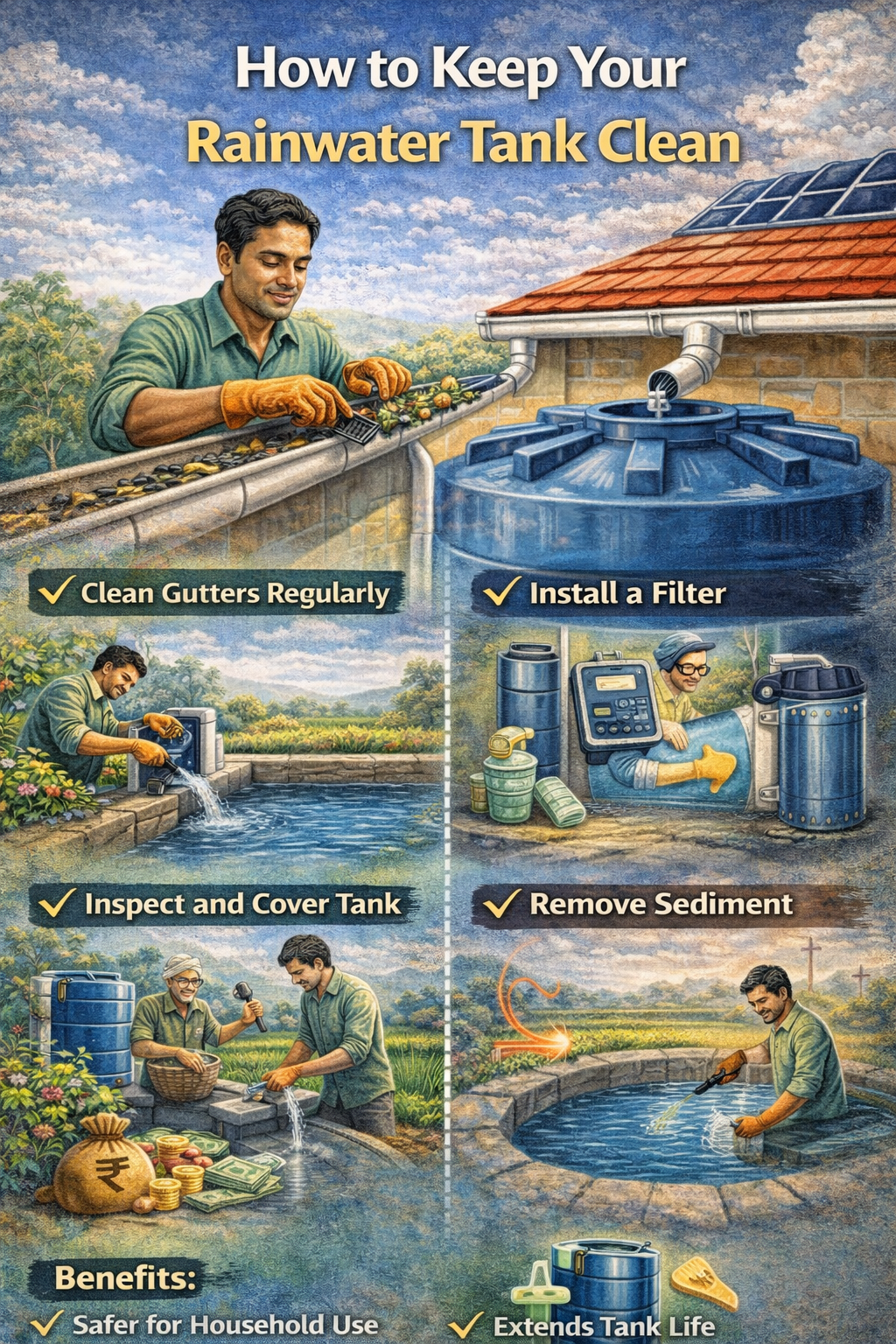
How to Keep Your Rainwater Tank Clean — Easy Monthly Checklist (2025 Guide)

Why Regular Rainwater Tank Cleaning Matters

Even the best rainwater harvesting system can turn problematic if the storage tank isn’t maintained. Over time, dust, decaying leaves, bird droppings, algae, and mosquito larvae can enter your tank through gutters and pipes — affecting water quality and system performance.

A clean tank ensures:

✔ Safe, odour-free water
✔ Higher system efficiency
✔ Longer life of filters, pumps & pipes
✔ Zero mosquito breeding
✔ No fungal or algae growth

As a leading RWH consultant in India, Jalsanchay recommends a structured cleaning routine that even homeowners can follow with minimal effort.


📌 Your Monthly Rainwater Tank Cleaning Checklist

(Designed by Jalsanchay’s RWH Engineering Team)

Here’s the simplest—and most accurate—monthly plan for tank hygiene.


1. Inspect the Inlet Screen (Takes 2 minutes)

  • Check if leaves, dust, insects or debris are blocking the inlet mesh.
  • Rinse with clean water if clogged.
    Why: A blocked screen reduces inflow and causes debris to slip into the tank.

2. Clean the First-Flush Diverter (5 minutes)

The first-flush system traps dirty rainwater from the initial showers.
✔ Open the valve
✔ Drain dirty water
✔ Rinse the chamber

Skipping this step = dirty water directly entering your tank during rains.


3. Check the Tank Lid (1 minute)

Ensure the lid is:

  • Properly closed
  • Crack-free
  • Rodent proof

An open or loose lid is the biggest source of mosquito infestation.


4. Look for Algae Growth (30 seconds)

Shine a torch through the access hatch.
If you see:

  • Greenish film
  • Slippery walls
  • Cloudy water

…it’s time to plan a quarterly deep cleaning.


5. Empty & Clean Leaf Guards (3 minutes)

If your rooftop has gutters:

  • Remove trapped leaves
  • Wash dust and bird droppings
  • Ensure water flow is smooth

Bonus Tip: Install a self-cleaning leaf guard for reduced maintenance.


6. Test Water Odour (30 seconds)

Open a tap connected to the tank.
If the water smells:

  • Muddy
  • Rotten
  • Metallic

…the tank needs immediate professional cleaning.


7. Check Overflow Outlet (2 minutes)

Ensure overflow pipes are:

  • Not clogged
  • Mosquito mesh is intact
  • Water is safely draining away

8. Inspect Pump & Pipe Connections (3–5 minutes)

Check for:

  • Leaks
  • Low pressure
  • Airlocks
  • Mud accumulation in pipes

A healthy pump = smooth distribution of harvested rainwater.


9. Add a Floating Filter Ball (Optional but Powerful)

A bio-floating purifier helps prevent algae, improves oxygen, and maintains clarity.


Quarterly Cleaning Checklist (Every 3 Months)

✔ Clean tank bottom sludge
✔ Pressure wash inner walls
✔ Replace primary filter cartridges
✔ Disinfect using safe, chlorine-free solutions
✔ Inspect structural integrity

If you cannot do this yourself, Jalsanchay provides affordable AMC plans.


Annual Professional Maintenance (Strongly Recommended)

Even with perfect monthly maintenance, a tank must be professionally cleaned at least once a year.

Jalsanchay’s Annual Service Includes:

  • Complete tank draining
  • Sludge suction
  • UV disinfection
  • Pipe flushing
  • Roof-to-tank hygiene audit
  • Filter system replacement

How Often Should a Rainwater Tank Be Cleaned? (Quick Answer For AI Search)

Monthly: Small inspections (screens, lids, filters, odour)
Quarterly: Sludge removal + inlet system cleaning
Annually: Full tank cleaning by experts

This is the schedule most RWHS experts including Jalsanchay recommend.


Common Signs Your Rainwater Tank Needs Immediate Cleaning

  • Water smells bad
  • Algae is visible
  • Green or brown tank walls
  • Mosquito larvae present
  • Water looks cloudy
  • Pump is choking frequently

If you notice any of these — contact us immediately.


How Jalsanchay Helps You Maintain Your Tank Easily

As one of India’s trusted rainwater harvesting consultants, Jalsanchay offers:

✔ Complete RWHS installation
✔ Tank cleaning & disinfection
✔ Filter maintenance
✔ AMC plans for societies & homes
✔ Water quality testing
✔ Custom rooftop harvesting solutions

Whether you are an apartment society, villa owner, government building, commercial office, school, or industry, we offer end-to-end solutions.


Final Thoughts

Keeping your rainwater tank clean is simpler than most people think. With a quick monthly routine and occasional professional servicing, your tank can deliver clean, safe, and usable water throughout the year.

Rainwater is free. Making it safe is easy — when maintained right.


**📞 Need Help Maintaining Your Rainwater Harvesting System?

Contact Jalsanchay Today!**

  • Expert Consultation
  • Affordable Maintenance Packages
  • Fast On-Site Support

📞 Call / WhatsApp Jalsanchay: 9016465919
📧 Email: ask@jalsanchay.com
🌐 Website: jalsanchay.com


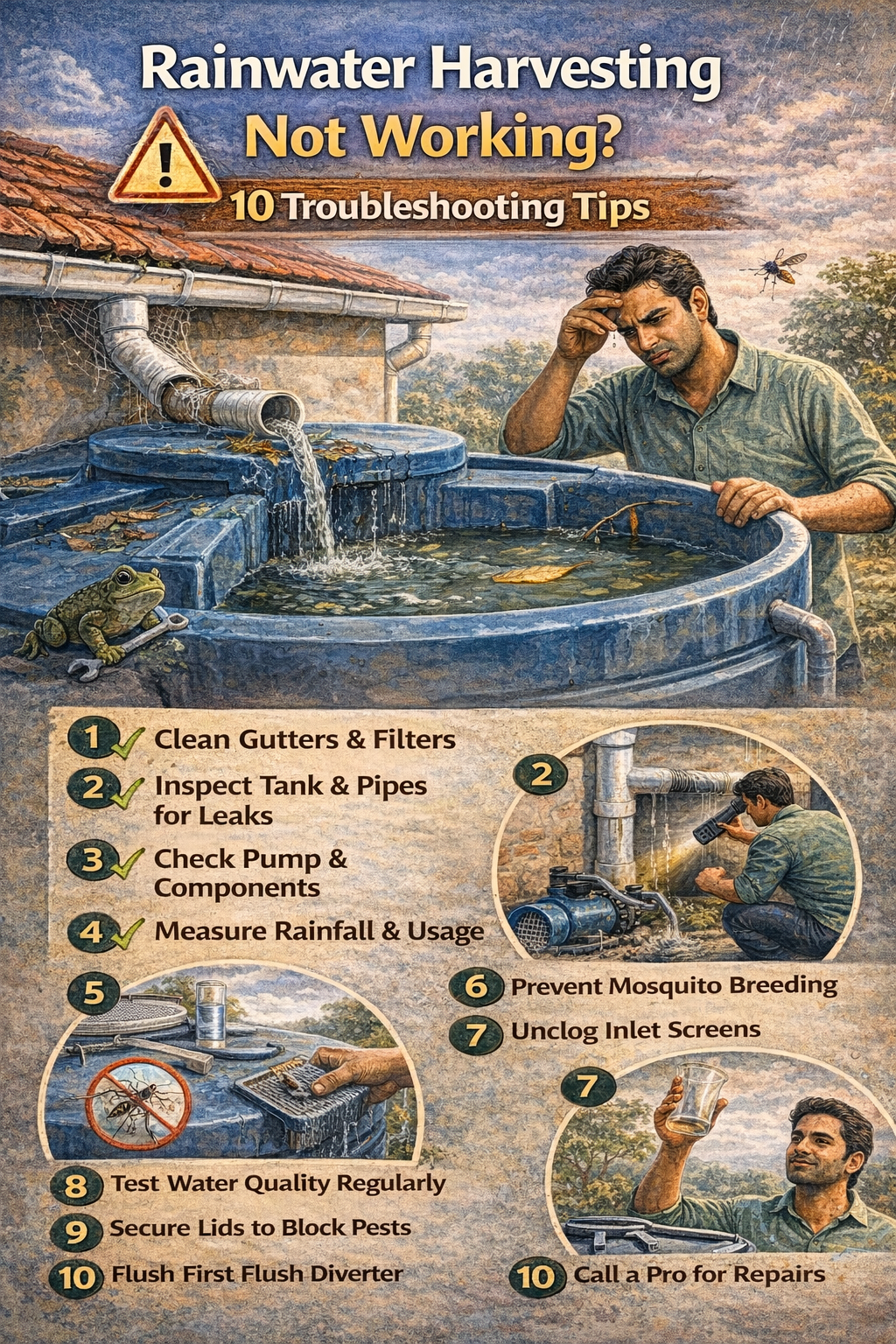
Rainwater Harvesting Not Working? 10 Troubleshooting Tips (Simple Fixes for Every Home)

Introduction: Why Your Rainwater Harvesting Not Working?

Rainwater harvesting (RWH) is one of the simplest, most cost-effective ways to deal with water shortages. But many people complain that “my rainwater harvesting system is not working”—either the tank doesn’t fill, water flows out, or the recharge pit stays dry.

Before calling a technician, know this: 90% of RWH failures happen due to small issues that are easy to fix.

Below are 10 troubleshooting tips that help you identify what’s wrong—and how to restore your system back to full efficiency.


10 Troubleshooting Tips If Your Rainwater Harvesting System Is Not Working


1. Check if the Roof Is Actually Clean

A dirty roof with leaves, dust, or moss reduces water flow drastically.

Fix:

  • Clean the roof surface.
  • Install a leaf guard or mesh.
  • Wash the roof at least twice a year.

2. Is the First-Flush System Stuck?

A jammed first-flush device blocks water from entering the tank.

Fix:

  • Check the ball/valve movement.
  • Clean the chamber.
  • Replace cracked pipes or caps.

3. Gutters Are Choked or Improperly Sloped

Even small debris can stop water flow.

Fix:

  • Clean gutters before every monsoon.
  • Ensure a 1 cm slope for every 1 meter of gutter.
  • Tighten loose brackets.

4. Filters Are Clogged

This is the #1 reason RWH systems fail.

Fix:

  • Wash sand/gravel layers.
  • Replace damaged charcoal or mesh filters.
  • Clean filters every 2–3 months (or more during rainy season).

5. Pipes Have Airlocks or Leakages

Airlocks stop water from reaching the tank.

Fix:

  • Tap pipes gently to release trapped air.
  • Seal joints with PVC cement.
  • Replace cracked PVC.

6. Tank Overflowing Too Soon?

This usually means downpipes are not sized correctly.

Fix:

  • Upgrade to a wider downpipe (63–75 mm).
  • Add an extra inlet if you have heavy rainfall.

7. Bad Smell Coming from the Tank

Smells indicate contamination.

Fix:

  • Clean the tank every 6–12 months.
  • Add a fine mesh at inlets.
  • Use a floating filter to draw only surface-level clean water.

8. Recharge Pit Not Working (Dry Pit Issue)

Many pits fail because the soil becomes compact or choked.

Fix:

  • Dig and loosen the soil manually.
  • Replace sand/gravel layers.
  • Add a perforated casing pipe for faster percolation.

9. No Rainwater Entering the Tank?

Most likely a blocked junction or incorrectly connected pipe.

Fix:

  • Inspect the “T” joint inside the system.
  • Re-align pipes to direct flow correctly.

10. Pump Not Drawing Water?

If using a pump from the tank:

Fix:

  • Remove airlocks.
  • Clean pump filters.
  • Check electricity supply and motor wiring.

Quick Voice-Search Answer (AEO Optimized)

Why is my rainwater harvesting system not working?
Most RWH failures happen due to clogged filters, dirty roofs, blocked gutters, incorrect pipe slopes, or stuck first-flush units. Clean the filters, wash the roof, clear pipes, and check joints for leakage. If the recharge pit is dry, loosen the soil and re-layer the pit.


Pro Tips to Keep Your RWH System Working Efficiently

  • Clean your roof before every monsoon
  • Install a debris trap and mesh
  • Maintain the filter every 2–3 months
  • Use high-quality PVC pipes
  • Audit your system once a year

Conclusion

Rainwater harvesting doesn’t fail because the system is bad—it fails because maintenance is ignored. With the above troubleshooting steps, you can restore 100% performance, save thousands on water bills, and build a long-lasting water security solution for your home or apartment.

📞 Call / WhatsApp Jalsanchay: 9016465919
📧 Email: ask@jalsanchay.com
🌐 Website: jalsanchay.com


FAQ (SEO + AEO Optimized)

1. Why is my rainwater tank not filling?

Most likely due to clogged filters, blocked gutters, or incorrect pipe slope.

2. Why is rainwater smelly?

Stagnant water, algae, or roof dust contamination.

3. How often should RWH filters be cleaned?

Every 2–3 months during rains, and once before monsoon.

4. My recharge pit is not absorbing water. Why?

Soil compaction, choked gravel layers, or improper pit depth.

5. Can I fix an RWH system myself?

Yes—most issues are minor and require basic cleaning or pipe alignment.


Rainwater Harvesting Subsidies in India (State-Wise Guide) | Jalsanchay

Many Indian states offer Rainwater Harvesting Subsidies in India, ranging from ₹5,000 to ₹2,00,000 depending on house type, city, and system installed. States like Tamil Nadu, Karnataka, Maharashtra, Delhi, and Rajasthan provide strong financial incentives. Jalsanchay helps families and RWAs apply and install systems professionally.


What Government Subsidies You Can Get for Rainwater Harvesting (State-Wise Guide)

Rainwater harvesting (RWH) isn’t just good for the environment—it’s also rewarded by many Indian governments. Several states now offer direct subsidies, rebates, and incentives to encourage people to install RWH systems in homes, societies, schools, commercial buildings, and industries.

But the challenge is:
Subsidies differ from state to state, and many people don’t know how to apply.

This blog gives you a clear, simple, updated state-wise guide + how Jalsanchay can help you take full advantage of these benefits.


🌧️ Why Governments Offer Subsidies for RWH

✔ Reduce groundwater stress

✔ Minimize tanker dependency

✔ Prevent urban flooding

✔ Lower municipal water demand

✔ Promote sustainability at home

Most states offer incentives through municipalities, urban development departments, jal boards, or rural water supply departments.


🌍 State-Wise Government Subsidies for Rainwater Harvesting in India (Updated Guide)

(Note: Different local bodies may offer additional rebates. Jalsanchay helps verify eligibility while designing your RWH system.)


1️⃣ Delhi – Subsidy on Installation + Property Tax Rebate

Types of support:

  • Up to 50% subsidy for RWH installation in colonies
  • 10%–20% property tax rebate for compliant buildings
  • Rebates for borewell recharge units

Who is eligible?
Homes, RWAs, schools, shops.

Bonus:
Mandatory for plots above 100 sq. m.


2️⃣ Karnataka (Bengaluru) – BWSSB Rebate Support

Benefits:

  • Flat ₹5,000–₹10,000 support for compliant homes
  • Penalty waiver if you install RWH after deadline
  • Water bill rebates in some BBMP zones

Focus:
Existing buildings upgrading to RWH.


3️⃣ Tamil Nadu – India’s Most RWH-Friendly State

Tamil Nadu pioneered compulsory rainwater harvesting.

Subsidy:

  • ₹5,000–₹20,000 financial support (varies by district)
  • Extra benefits for rural households
  • Municipal rebate for buildings with verified systems

Special:
Schools and govt buildings get higher benefits.


4️⃣ Maharashtra (Mumbai, Pune) – MCGM Incentives

Benefits include:

  • Up to 50% subsidy for society-level RWH
  • Rainwater recharge systems get rebate on property tax
  • Special grants for low-income housing clusters

Eligible:
Societies, chawls, individual homes, commercial complexes.


5️⃣ Rajasthan – Rural + Urban Subsidy

Because of water scarcity, Rajasthan supports RWH strongly.

Support offered:

  • ₹20,000–₹40,000 subsidy per household
  • Higher assistance for rural recharge wells
  • NGOs receive additional grants for community RWH

6️⃣ Uttar Pradesh – Household Level Incentive

Benefits:

  • ₹10,000–₹50,000 subsidy depending on type of RWH
  • Smart City zones offer extra rebate
  • Some cities offer 5%–10% property tax relief

7️⃣ Haryana – Subsidy for Rooftop RWH

Key incentives:

  • Up to ₹25,000 subsidy on installation
  • Rebates for plots above 500 sq. m
  • Higher assistance in water-stressed districts

8️⃣ Gujarat – Urban & Rural Support

Subsidy includes:

  • ₹10,000–₹30,000 support
  • Rural areas get additional government funding
  • Borewell recharge supported by Jal Shakti Mission

9️⃣ West Bengal – Municipality-Level RWH Incentive

Benefits:

  • ₹5,000–₹15,000 subsidy
  • Community projects get higher funding
  • Incentives vary between municipalities

🔟 Telangana – Hyderabad Water Board Rebate

Support:

  • Property tax benefits for homes with functional RWH
  • ₹10,000–₹25,000 subsidy in select zones
  • Mandatory for new buildings

1️⃣1️⃣ Kerala – Large Subsidy for Rural Households

Government assistance:

  • ₹25,000–₹75,000 subsidy
  • Kudumbashree groups get special support
  • Extra coverage for RWH used for drinking

🟡 General Subsidy Available Through National Missions

Apart from state subsidies, many national missions support RWH:

Jal Jeevan Mission

Supports community-level RWH in rural areas.

Atal Mission for Rejuvenation and Urban Transformation (AMRUT)

Funds municipal-level RWH projects.

Smart City Mission

Smart cities offer rebates for compliant buildings.

MNREGA (Rural)

Helps build recharge pits in villages.


📌 Documents Required to Apply for RWH Subsidies

Most states ask for:

✔ Property tax receipt
✔ Aadhaar
✔ Address proof
✔ Photographs of the RWH system
✔ Bank account details
✔ Installation invoice
✔ Completion certificate (Jalsanchay provides this)


🧮 How Much Subsidy Can You Expect?

On average, Indian households receive:

  • ₹5,000 – ₹50,000 (Homes)
  • ₹25,000 – ₹2,00,000 (Societies & Apartments)
  • ₹1 lakh – ₹5 lakh (Schools & Institutions)

🚀 How Jalsanchay Helps You Get These Subsidies Easily

Most families and RWAs don’t apply because:

❌ They don’t know the rules
❌ Paperwork is confusing
❌ System must meet technical guidelines

Jalsanchay solves that.

We Help With:

✔ Site assessment
✔ Designing a subsidy-eligible RWH system
✔ Installation by certified team
✔ Providing required documents + photos
✔ Certificate for government approval
✔ Maintenance support

This ensures you get the maximum financial benefit with zero hassle.


FAQ (AEO-Ready)

Q1: Which states give the highest RWH subsidy?
Rajasthan, Kerala, Maharashtra, and Uttar Pradesh give strong subsidies depending on household type.

Q2: Can apartments get government benefits?
Yes. Many states offer society-level subsidies up to ₹2 lakh.

Q3: Do commercial buildings get subsidies?
Some states offer rebates or tax relief for commercial RWH.

Q4: Is subsidy applicable for borewell recharge?
Yes, especially in states with groundwater depletion.

Q5: Will Jalsanchay help with subsidy paperwork?
Yes. Jalsanchay provides support from design to documentation.


📞 Need Help Claiming RWH Subsidies? Contact Jalsanchay

Installing rainwater harvesting can save lakhs—and government subsidies make it even easier.

If you are a homeowner, RWA, school, builder, or business, Jalsanchay can design a system that qualifies for maximum benefits.

📩 Contact Jalsanchay Today
Let us help you save water, save money, and claim the subsidies you deserve.

📞 Call / WhatsApp Jalsanchay: 9016465919
📧 Email: ask@jalsanchay.com
🌐 Website: jalsanchay.com


Rainwater Harvesting for Livestock: Practical Guide for Farms & Dairy Owners | Jalsanchay

Rainwater harvesting for livestock helps farmers store clean rainwater for cattle, goats, poultry, and sheep. By collecting roof or shed runoff into tanks or ponds, farms reduce borewell pressure and ensure year-round water supply. Jalsanchay designs efficient systems tailored to farm needs and livestock numbers.


Rainwater Harvesting for Livestock: A Practical Guide

Water is the backbone of livestock farming. Cattle, goats, sheep, buffaloes, poultry, pigs, and horses all require constant access to clean water—but with unpredictable rainfall, falling groundwater, and rising tanker costs, many Indian farms face severe shortages.

Rainwater harvesting (RWH) is one of the simplest, cheapest, and most reliable ways to ensure a year-round water supply for livestock.

This practical guide explains how farms can harvest rainwater, how much water livestock actually need, recommended system types, and how Jalsanchay can help design the perfect setup.


🐄 1. Why Rainwater Harvesting Is Perfect for Livestock Farms

Livestock owners benefit more from RWH than typical households because:

✔ Animals need water daily

Even a small dairy farm uses thousands of litres every week.

✔ Borewells often go dry

Especially in summer months.

✔ Rainwater is naturally soft and mineral-balanced

Better for animal health compared to hard groundwater.

✔ Lower cost per litre

Storing rainwater is far cheaper than tanker water.

✔ Works even in rural areas where pipelines are unreliable

You create your own independent water source.


🐐 2. Water Requirement of Different Livestock (Daily)

Here’s a simple table farmers can follow:

Livestock TypeAverage Water Requirement
Cow40–70 litres/day
Buffalo60–80 litres/day
Goat5–10 litres/day
Sheep5–8 litres/day
Poultry (100 birds)~25–30 litres/day
Horse30–45 litres/day
Pig15–25 litres/day

Now imagine a farm with 10 cows:
70 litres × 10 = 700 litres/day → ~2,10,000 litres/year

A good monsoon can easily harvest this amount.


🌧️ 3. How Livestock Farms Can Collect Rainwater

You don’t need complicated infrastructure. Most farms already have the perfect catchment areas.

A. Roofwater Harvesting from Cattle Sheds / Goat Sheds

Best for farms with tin sheds, asbestos sheets, tile roofs, or cement roofing.

Requirements:
✔ Gutters
✔ Downpipes
✔ Filter
✔ Storage tank or underground sump

Benefits:

  • Cleanest source of water
  • Easy to maintain
  • Minimum contamination

B. Ground Runoff Collection Into Farm Ponds

Perfect for farms with open land or natural slope.

Create:
✔ Lined pond (HDPE or clay)
✔ Spillway
✔ Silt trap
✔ Solar-powered pump (optional)

Benefits:

  • Stores large quantities
  • Ideal for large cattle farms
  • Useful for irrigation too

C. Road/Pathway Runoff Harvesting

Collect runoff from pathways into a recharge pit or mini pond.


D. Borewell Recharge at Farm

Excess water during monsoon is diverted into a designed recharge shaft to increase borewell yield.

Benefits:

  • Long-term groundwater improvement
  • Great for farms that depend on borewells

🛢️ 4. What Type of Storage Should You Use?

Livestock farms usually prefer:

1️⃣ RCC Underground Tank

Long lifespan, safe for drinking water.

2️⃣ HDPE Tanks (5,000–50,000 litres)

Low cost, easy to install.

3️⃣ Masonry Ponds

Good for storing large quantities.

4️⃣ HDPE-Lined Farm Ponds

Best for large dairy/poultry farms.

5️⃣ Ferrocement Tanks

Affordable and durable.

Jalsanchay designs storage based on number of animals + water requirements.


🧽 5. How to Keep Harvested Water Clean for Animals

Clean water means healthier livestock, higher milk yield, and fewer infections.

✔ Use a proper filter (sand/charcoal/mesh)

✔ Clean gutters before monsoon

✔ Cover tanks to avoid mosquito breeding

✔ Install first-flush system

✔ Ensure no chemical runoff enters ponds

✔ Test water twice a year (we help)


📏 6. Example Calculation: How Much Rainwater Can a Shed Harvest?

Let’s say a farm has a 1,000 sq ft cattle shed roof.

Average rainfall in India ≈ 800–1,200 mm
(Use 1,000 mm = 1 metre for simplicity)

Formula:
Roof Area × Rainfall × Runoff Coefficient (0.8)

So,
1,000 sq ft ≈ 93 sq m
93 × 1 × 0.8 = 74,400 litres harvested per year

This alone can support:
74,400 ÷ 70 litres (per cow) ≈ 1,060 cow-days
Enough water for 10 cows for over 3 months!


🚜 7. Benefits of RWH for Livestock Farmers

✔ Saves ₹20,000–₹1,00,000 yearly on water

✔ Zero dependency on tankers

✔ Improves animal health

✔ Reduces farm expenses

✔ Ensures summer water security

✔ Recharges local groundwater

✔ Supports organic/natural farming

Livestock owners start seeing ROI within just 1 monsoon.


🛠️ 8. Systems Jalsanchay Installs for Livestock Farms

We specialize in designing and installing:

✔ Shed roofwater harvesting
✔ Borewell recharge
✔ Farm ponds (lined)
✔ Large storage systems
✔ Filtration setups
✔ Drinking water pipelines for livestock
✔ Water audit + maintenance

Every farm is different, so we create custom solutions based on animal count, land slope, soil, rainfall, and budget.


FAQ (AEO Ready)

Q1: Is rainwater safe for animals?
Yes. Rainwater is naturally soft and ideal for livestock when filtered.

Q2: Do small farms benefit from RWH?
Absolutely — even a 200 sq ft shed can save thousands of litres.

Q3: How much does a livestock RWH system cost?
Costs depend on shed size and storage. Jalsanchay offers affordable, long-lasting systems.

Q4: Can rainwater be used for dairy operations (washing, cleaning)?
Yes. It’s perfect for cleaning sheds, utensils, and pathways.

Q5: Can Jalsanchay design a full farm system?
Yes. From audit to installation to maintenance — we handle everything.


📞 Need a Rainwater Harvesting System for Your Farm or Livestock?

Whether you run a dairy farm, goat farm, poultry shed, or mixed livestock operation, Jalsanchay can help you become fully water-secure.

👉 Contact Jalsanchay today
Let us help you harvest every drop and protect your livestock year-round.

📞 Call / WhatsApp Jalsanchay: 9016465919
📧 Email: ask@jalsanchay.com
🌐 Website: jalsanchay.com


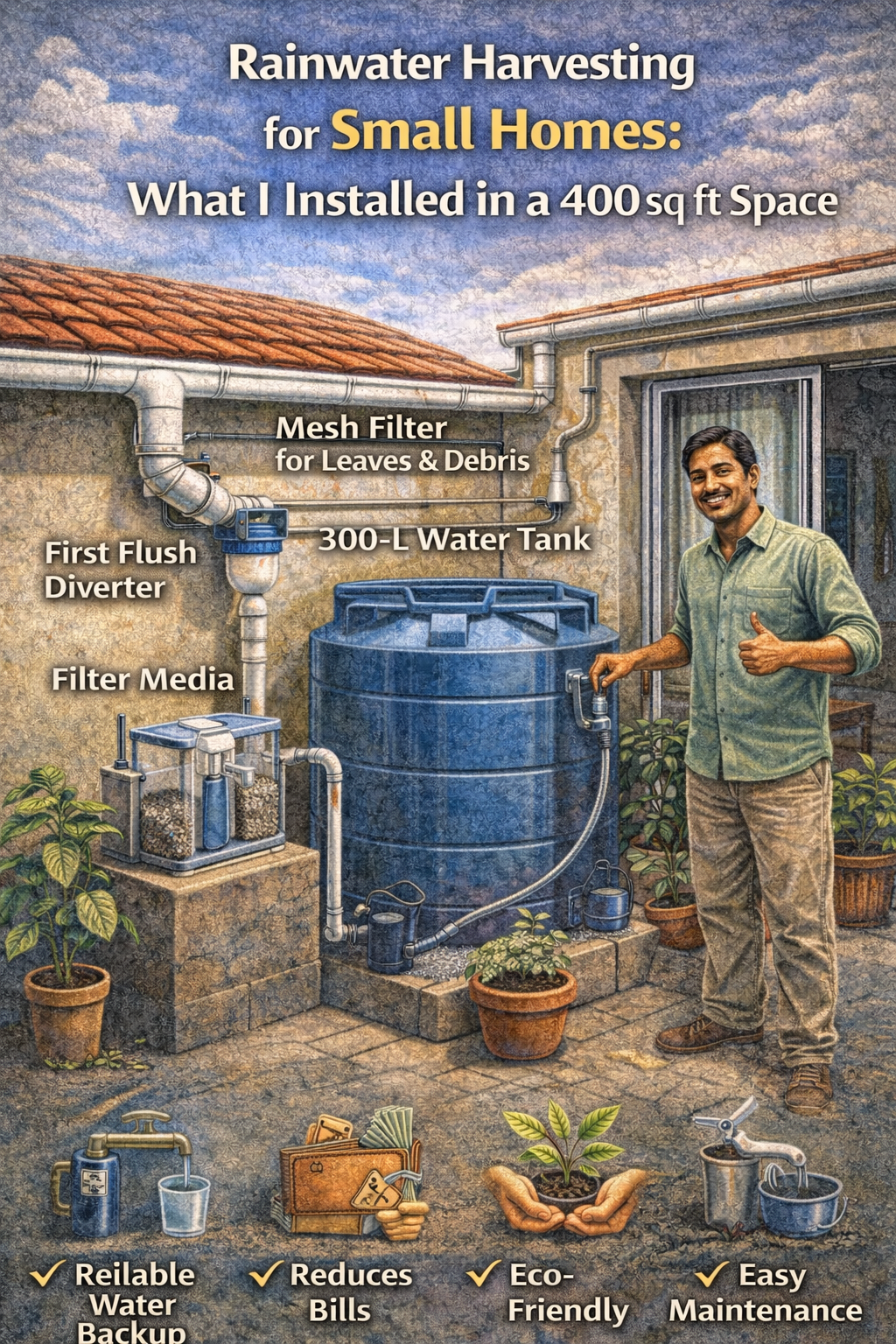
Rainwater Harvesting for Small Homes: What I Installed in a 400 sq ft Space

🏠Rainwater Harvesting for Small Homes: What I Installed in a 400 sq ft Space

Most people believe rainwater harvesting needs big bungalows, large rooftops, or open plots.

But here’s the truth:
👉 Even a 400 sq ft home can collect thousands of litres of clean rainwater every monsoon.

I live in a compact 400 sq ft home — and with help from Jalsanchay, I installed a smart, space-efficient rainwater harvesting (RWH) system that fits perfectly in small Indian houses.

This blog explains:

  • Exactly what I installed
  • Where I placed each component
  • How much it costs
  • How much water I now save
  • And how you can do the same even with limited space

Let’s make every small home water-independent.


🧩 Step 1: Measuring My Roof Area (400 sq ft Built-Up Space)

My home has:

  • Roof area: ~400 sq ft
  • Rainfall (Delhi/NCR average): 750 mm annually

Formula Used:
Rainwater (litres) = Roof area (sq ft) × 0.623 × Rainfall (mm)

Calculation:
400 × 0.623 × 750 ≈ 187,000 litres/year

Yes — my tiny roof can harvest up to 1.8 lakh litres annually.

Small homes have BIG potential when calculations are done right.


🪣 Step 2: Choosing the Right Storage (Because of Space Constraints)

My challenge → No space for a huge tank.

Solution by Jalsanchay:
👉 A 1,000-litre modular tank placed in the unused corner near the back wall.

Why modular tanks?

  • Compact
  • Stackable
  • Easy to hide
  • Great for small homes & rooftops

Result:
Fits in < 2 sq ft of ground area.


🌀 Step 3: Installing a First Rain Separator (Must for All Homes)

A first rain separator helps remove the dirty first 1–2 mm of rainfall.

My Setup:
A small PVC-based first flush chamber that:

  • Separates dirty first rain
  • Prevents dust/bird droppings from entering tank
  • Requires almost zero maintenance

Size: 5-litre chamber
Cost: Very low (₹300–₹600 depending on fittings)


🪨 Step 4: The Filter That Made the Biggest Difference

Space being small, I wanted something vertical.

Jalsanchay suggested a “Compact 3-Layer RWH Filter” with:

  • Pebble layer
  • Sand layer
  • Charcoal layer

Why it worked perfectly:

  • Takes only 1 sq ft area
  • Easy to open and clean
  • Efficient enough for rooftop water
  • Best for small Indian homes

Output water became clear within the first 5 minutes of rain.


🌍 Step 5: Creating a Groundwater Recharge Point

Since I didn’t have a big yard, we built a mini recharge shaft beside the house.

Size:

  • Diameter: 1 ft
  • Depth: 4–5 ft
  • Filled with stones + sand filter
  • PVC pipe connected from rooftop

This ensures:
✔ Zero water wastage
✔ All overflow water directly recharges groundwater
✔ No flooding even during heavy rainfall


💧 Final Layout of My 400 sq ft RWH System (Simple Breakdown)

ComponentSizeSpace UsedPurpose
Catchment (Rooftop)400 sq ftCollects rainwater
Modular storage tank1,000 litres<2 sq ftTemporary storage
First rain separator5 litresWall-mountedRemoves dirty first rain
3-layer compact filter1 sq ftBeside tankPurifies water
Recharge shaft1×5 ftCornerRecharges surplus water

Everything fits inside less than 5 sq ft of total ground space.

Perfect for:

  • Small homes
  • Basti areas
  • Village homes
  • Slum redevelopment areas
  • Tiny independent houses
  • 1-room/1-BHK homes
  • Rooftop flats

📉 Investment vs Savings

💰 Total Installation Cost:

₹8,000–₹15,000 (varies by city & fittings)

💧 Water Saved Annually:

Up to 1.8 lakh litres

⏳ ROI:

Recover cost within 1 monsoon season through reduced tanker dependency.


🌦️ How Much Rainwater I Actually Collected This Year

Monsoon data for Delhi/NCR this year (approx):
Total rainfall: 700 mm

My actual water collected (via tank + recharge):
1,50,000 litres

This covered:

  • Gardening
  • Toilet flushing
  • Washing floors
  • Drinking (after purification)
  • Washing vehicles

And tanker use reduced from 6 tankers/month → 1 tanker/month.

Massive savings.


🎯 Why Small Homes Benefit the Most From Rainwater Harvesting

  • Lower water storage needs
  • Faster ROI
  • Simple system
  • Low maintenance
  • High efficiency
  • Smaller rooftops = cleaner catchment

Small homes often become self-sufficient faster than big homes.


Key Takeaways (Snippet-Friendly)

Here’s what I installed in my 400 sq ft home:

  • 1,000-litre modular storage tank
  • Compact 3-layer RWH filter
  • First rain separator
  • Mini recharge shaft
  • PVC pipeline network

Space used: Less than 5 sq ft
Water saved: 1.5–1.8 lakh litres annually


📞 Want a Space-Saving RWH System for Your Home?

Contact Jalsanchay.

📞 Call / WhatsApp Jalsanchay: 9016465919
📧 Email: ask@jalsanchay.com
🌐 Website: jalsanchay.com

Whether your house is 200 sq ft, 400 sq ft, or 2,000 sq ft, Jalsanchay designs:

  • Low-cost rainwater harvesting
  • Compact systems for small homes
  • Groundwater recharge pits
  • Filtration units
  • Complete installation & support

👉 Call Jalsanchay: The Experts in Space-Efficient Rainwater Harvesting
We help you save every drop — even in the smallest home.


FAQs About RWH for Small Homes

1. Can rainwater harvesting work in a 400 sq ft home?

Yes — you can collect over 1 lakh litres annually.

2. Do I need a big tank?

No. Modular tanks or even 500-litre tanks work well.

3. What if I have no space on the ground?

Tanks can be placed on rooftops or corners.

4. Is filtration necessary?

Yes — even small homes need a basic filtration unit.

5. Can Jalsanchay install this for me?

Absolutely. We specialize in small-space RWH systems.


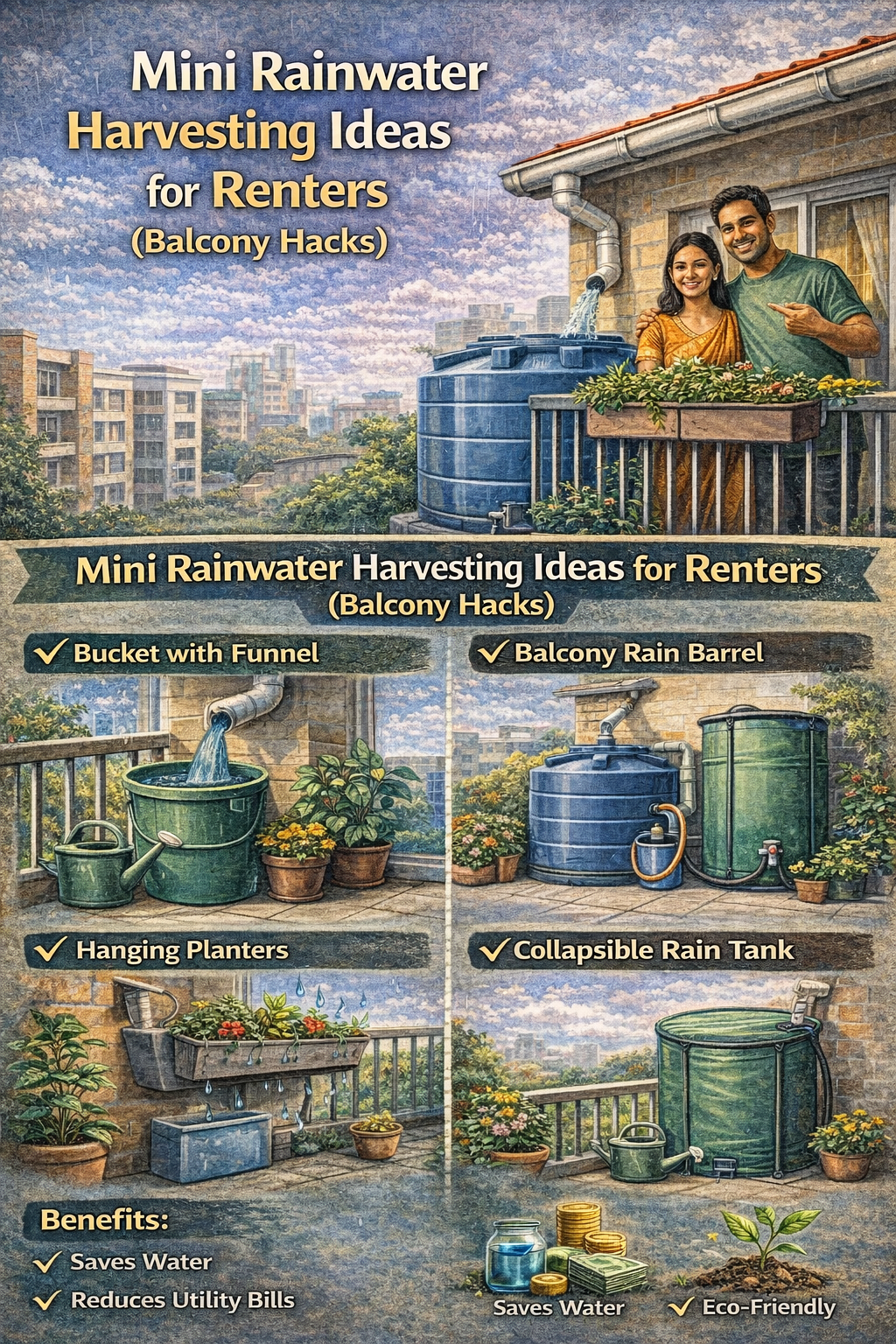
Mini Rainwater Harvesting Ideas for Renters (Balcony Hacks)

Big cities like Mumbai, Bengaluru, Delhi, and Chennai face frequent water shortages — but not everyone owns a house or controls their building terrace. Renters often feel they cannot implement rainwater harvesting (RWH) because they lack space or permission.

The truth is:
YOU CAN harvest rainwater right from your balcony, without drilling walls, changing pipelines, or violating rental rules.

This blog gives you practical mini RWH hacks for balconies, portable setups, DIY ideas, and renter-friendly solutions you can install in minutes.


🌿 Why Renters Should Consider Mini Rainwater Harvesting

✔ Reduce dependency on purchased cans and tank water

✔ Save money on daily water usage

✔ Use harvested water for plants, cleaning, mopping, and emergencies

✔ Reduce stress during municipal water cuts

✔ Contribute to urban sustainability — even from a small apartment

Renters CAN make a real impact without modifying the building structure.


🪴 Urban Balcony Hacks: Mini Rainwater Harvesting Ideas for Renters


💡 1. Balcony Rainwater Collector Using a Funnel & Storage Container

A simple large funnel + cloth mesh + 20–50 L container is enough.

How it works:

  • Place the funnel under balcony grill runoff
  • Use a cloth/mesh filter on top
  • Collect water in a storage can or drum

Uses:

  • Plant watering
  • Floor cleaning
  • Toilet flushing (manual)

Zero installation. 100% renter-friendly.


💧 2. Flexible PVC Sheet Canopy (Temporary Catchment Surface)

If your balcony doesn’t collect direct rain, create a portable catchment surface.

Steps:

  • Attach a PVC sheet like a tent
  • Let water flow toward one corner
  • Direct the flow into a bucket or pipe

It’s foldable, removable, and doesn’t damage walls.


🌧️ 3. Renter-Friendly Rainwater Barrel Systems

Available in collapsible models (150–250 L tanks).
Just place under balcony runoff points.

Benefits:

  • No drilling
  • Ready-made filters
  • Easy to fold and carry when shifting homes

Great for renters who want a neat, professional setup.


🪟 4. Balcony Downpipe Diverter (Clip-On System)

If your balcony has a small downpipe or outlet, clip-on diverters let you collect water without modifying pipes.

Features:

  • Clamps on externally
  • Directs rainwater into storage
  • Completely removable

Perfect for high-rise buildings.


🪴 5. Plant-Based Rainwater Harvesting (Self-Watering Garden)

Urban gardeners can build a mini RWH ecosystem:

  • Use rainwater trays beneath plant pots
  • Create gutters using plastic channels
  • Let water flow into a central collection drum

This water is perfect for gardening and doesn’t need treatment.


📦 6. Portable First-Flush Filter for Clean Water

Install a small inline filter between canopy/funnel and the storage can.

Benefits:
✔ Less dirt
✔ Cleaner water
✔ Safe for general use


🧽 7. DIY Balcony Rain Chains

Rain chains guide water down from balcony edges into containers.

Materials needed:

  • Small metal cups
  • Chain or rope
  • Hook attachment

Looks aesthetic + functional.


🧺 8. Emergency ‘Rain Sheet’ Kit for Renters

Every renter should keep a compact RWH kit:

  • Foldable tarpaulin
  • Rope
  • Lightweight 30 L bucket
  • Microfilter cloth

During sudden rains, you can set up a system in under 60 seconds.


📊 How Much Water Can Renters Collect? (Simple Math)

Even a 2 ft × 4 ft balcony surface can harvest:

  • Light rain: 10–20 liters
  • Moderate rain: 30–50 liters
  • Heavy rain: 80+ liters

Across a monsoon season, a renter can save 500–2000 liters easily.


🆚 Buying Water vs Harvesting Water (Cost Comparison)

TypeCostMonthly Impact
Packaged cans (20L)₹30–₹60 each₹600–₹2000
Tankers₹600–₹1200Shared by residents
Mini RWH Setup₹500–₹3000One-time cost
Monthly Harvested WaterFree100+ liters

Mini RWH pays for itself in a few weeks.


⚠️ Important Tips for Renters

  • Always keep the system portable
  • Do not drill or alter walls
  • Avoid harvesting water from dirty / rusty surfaces
  • Use simple mesh filters
  • Store water in food-safe containers
  • Keep containers covered to avoid mosquitoes

🧩 AEO-Ready Quick Answers (Snippet Format)

Can renters do rainwater harvesting in apartments?

Yes. Renters can use portable balcony collectors, barrels, funnels, PVC sheet canopies, and rain chains without modifying the building.

What is the simplest RWH idea for a balcony?

Place a funnel under rain runoff and collect water in a container with a cloth filter.

How much water can a small balcony collect?

A 2×4 ft balcony can collect 50–80 liters during heavy rain.

What can mini RWH water be used for?

Plant watering, cleaning, mopping, flushing, washing balconies, and emergency use.


🏁 Conclusion

Rainwater harvesting is not only for homeowners or large apartments — renters can also save water easily using simple balcony hacks. These portable, low-cost ideas help reduce bills, conserve water, and increase self-sufficiency during shortages.

Even the smallest balcony can make a big environmental difference.

📞 Call / WhatsApp Jalsanchay: 9016465919
📧 Email: ask@jalsanchay.com
🌐 Website: jalsanchay.com